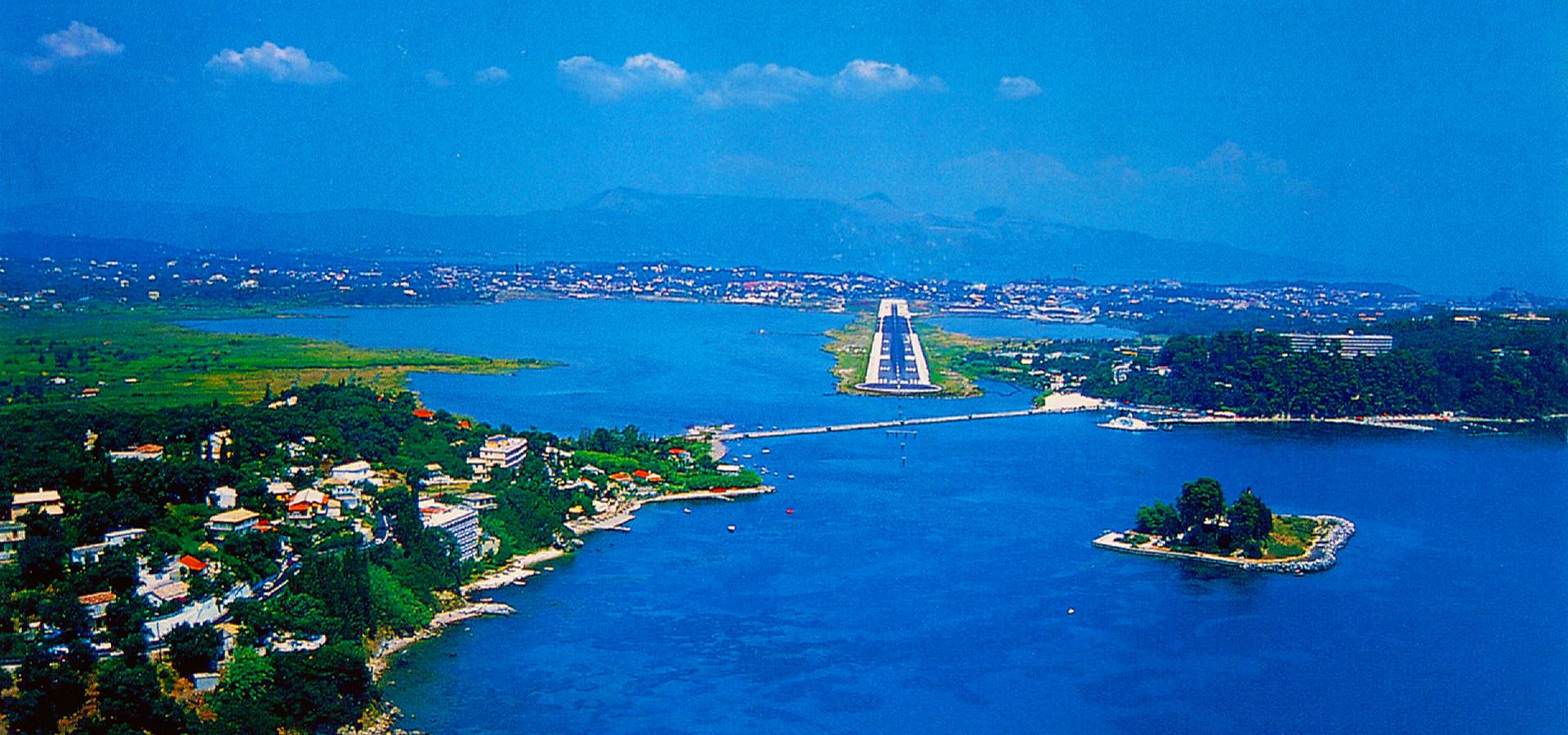
Corfu is the greenest island in the Ionian Sea and one of the most beautiful places in Greece.
One of the most densely populated islands in the Mediterranean with the densest road network, Corfu was the first to open its gates to tourism long before other destinations were developed.
During your vacation in Corfu, there is plenty to do, enjoy, see, and visit.
Lively non-stop nightlife resorts are perfect for anyone who needs days to explore and admire.
Countless lively beaches with emerald and crystal clear waters surrounded by cypress and lush vegetation.
Hidden seaside paradises with little or no tourist development for lovers of seclusion, idyllic places for romantics.
Corfu’s old town, full of vibrant colors and small alleys between tall medieval buildings, will make you feel like you’re in another age.
Its unique cultural heritage has left monuments and sights of unique beauty that are not found elsewhere, it gives the visitor a different feel with its different architecture and color from the other islands.
There are also many resorts on this lovely island.
There are picturesque mountain villages that look like time has stopped, cosmopolitan tourist resorts with huge hotel units providing all the amenities, a lot of tourist traffic, and a vibrant nightlife, all these have made Corfu a global tourist attraction.
And people are always friendly and willing to make you feel at home.
The very intense nightlife exists in many places and is mainly for foreign tourists but also for all those who still feel very young.
There is, of course, a nightlife for pure Greek tastes mainly in the north of the city, bars for those who love good music, and all kinds of restaurants for gastronomic delights.
On the Kaiser Bridge, for example, there is a restaurant with a seafront.
The tourist infrastructure is one of the best and largest in Greece with 2 to 5-star hotels for every wallet and budget.
There are also plenty of rooms to rent and other accommodations scattered throughout the island.
Wherever you enjoy your holidays in Corfu, there will be something exciting and interesting to see and do, we are sure you will enjoy finding your favorites!
Although it is not necessary to use a car it is very useful, with so many places to visit you will probably need one.
Diving, Skiing, and Sailing in Corfu
Water sports and Paragliding
Paragliding and Skiing can be found in almost every medium to large holiday resort.
Diving
Corfu offers spectacular underwater spots ideal for diving and is one of the very few islands with so much to explore under the water.
There are many diving centers on the island offering equipment and organizing safe guided diving in some of the world’s nicest underwater sites.
Briefly mentioned are:
Achilleon Diving
activated in Paleokastritsa and Ermones. See more here
All the above schools and Diving centers can offer or hire you all the necessary equipment.
Corfu Mountainbike Shop
Fabulous Cycling Holidays & Tours for groups and individuals by GIANT, Located in Dassia. For more click here
Asprokavos Water sports
In Kavos, Their yacht can carry comfortably 25 people to Paxos or Sivota.
Corfu Sea Discovery
Paleokastritsa offers boat trips on a bottomless boat, you can see and enjoy the undersea world.
Arena Horse Riding in Roda
A Horse riding school in Roda Greece, near Karniaris area east of Roda resort. for more click here
Nautilus Underwater Experience
In Paleokastritsa, discover all the underwater wonders of the Ionian Sea on a super modern sea craft, built with a special and bulletproof glass bottom measuring 2 X 3 meters wide.
Captain Homer
A private boat trip perfect for family, and friends, or an exclusive adventure tailored to your wishes, we are in Messonghi. more on their website
Captain Spyros’ Pirate Ship
Captain Spyros’ Pirate Ship is a boat trip organizer, located in Gouvia.
No Stress Yachting – Sailing Trips in Corfu
Asterios Boats and Water sports
Or else Kaminaki boats and water sports, located In Nissaki at northeast Corfu. more here
Agni Boats Hire
A large selection of speedboats for hire with varying engine sizes to suit your needs, based on Agni in Northeast Corfu. Website
Submarine explorations
Skydiving and Paragliding
Golf Course
The course at Corfu Golf Club is located a couple of miles from Ermones, on the Ropa Valley, founded and designed back in 1971 by the English architect John Harradine, More on the website
Surfing, windsurfing, and kite
Guided Hiking and Camping
Kayak and Canoeing
Eco-Tours
Eco destinations in northern Corfu for hip travelers.
There is no single “prettiest” island — it depends on personal taste.
Popular choices include:
Santorini: sunsets and volcanic views
Mykonos: nightlife and beaches
Crete: size, history, variety
Zakynthos: turquoise waters
Corfu: green landscapes and Venetian charm
Which Hellenic Island has the best beaches?
Several Greek islands are known for excellent beaches:
Zakynthos: Navagio (Shipwreck Beach)
Crete: Elafonisi (pink sand)
Corfu: Paleokastritsa, Glyfada, Agios Georgios
Naxos: long sandy beaches
Milos: unique rock formations
The “best” depends on whether you prefer sandy, secluded, or dramatic beaches.
Is there a Volcano in Corfu?
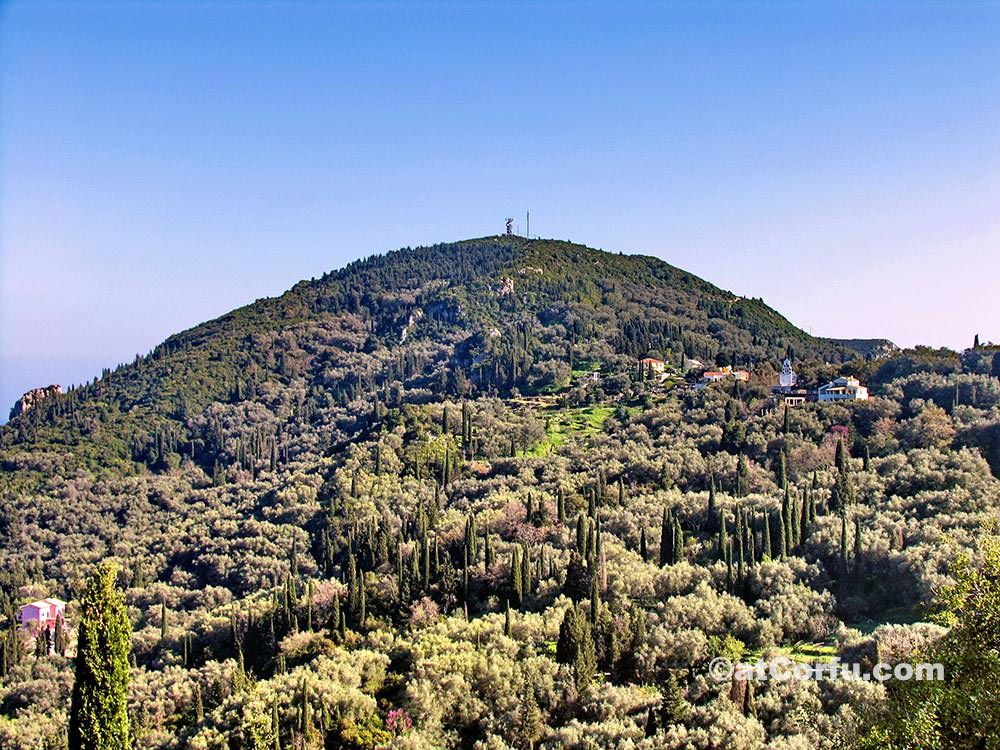
Top of Agioi Deka
No, there are no active or dormant volcanoes in Corfu.
The island is not part of Greece’s volcanic arc. Its landscape is mainly limestone hills and mountains.
There may have been volcanic activity millions of years ago, but today Corfu is geologically stable.
Culture, History & Meaning
What is Corfu famous for?
Esplanade Square and the Old Fortress
Corfu is known for:
Beaches: Clear waters and a mix of sandy and rocky shores
Old Town: UNESCO site with Venetian architecture
History: Influences from Greeks, Venetians, French, and British
Culture: Festivals, especially Easter celebrations
Nature: Green landscapes, mountains, and olive groves
Food: Local cuisine and products like olive oil and kumquat
What food do they eat in Corfu?
Corfu cuisine blends Greek and Venetian influences. Typical dishes include:
Sofrito: Beef in white wine and garlic sauce
Bourdeto: Spicy fish stew
Pastitsada: Pasta with meat and tomato sauce
Savoro: Fried fish with vinegar and raisins
Stifado: Meat stew with onions
Moussaka: Classic Greek casserole
Also common: fresh salads, seafood, olive oil, local wine, and kumquat products.
It is well known that Corfu is not only its beaches and coasts, where we usually hang and stay.
But it hides a lot in its interior, from picturesque spots, traditional large villages, Exceptional nature with high mountains and valleys where the vegetation revels, plains, sandy deserts such as Halikounas, even medieval villages that have been abandoned centuries ago such as the mountainous Old Perithia on the slopes of Pantokrator mountain.
Corfu, in spite of all the problems it faces, will always survive as a strong tourist destination because it has many more than other islands.
It has a turbulent and rich history, as a result of which its unique culture, as well as unprecedented unique natural beauties, despite its small size it is a continent in miniature, with so many variations in landscapes that make it look larger.
Watch this 35 minutes video of beautiful beaches, known and familiar destinations, but also many unknown small villages in the island’s interior that look like hidden treasures.
Corfu, without any special effort, will always be the flagship of Greek tourism!
The video was created by Petros Kapsokavadis on behalf of Oasis hotel in Perama, Corfu.
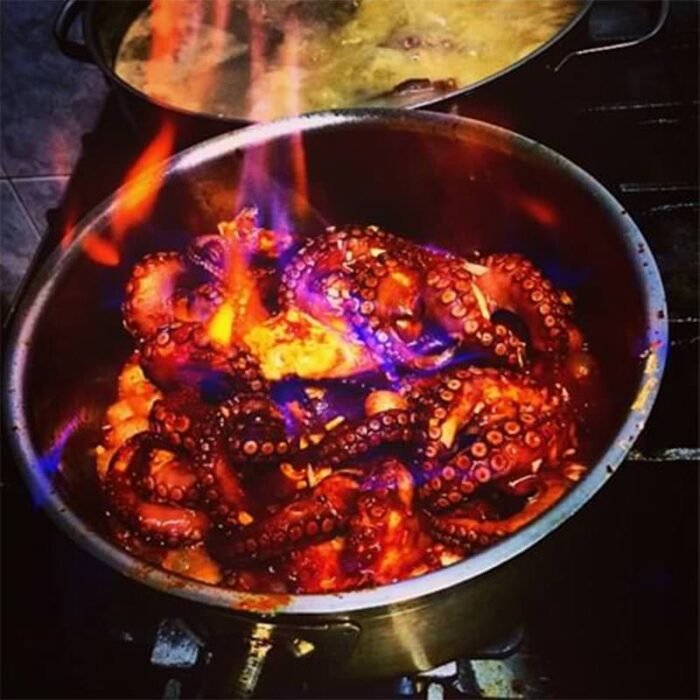
Bourdeto with octopus is one of Corfu’s most iconic dishes – fiery, aromatic, and deeply tied to the island’s fishing tradition.
For generations, local housewives and fishermen have perfected this spicy octopus stew, simmering it slowly with olive oil, pepper, and lemon until the flavors are bold yet balanced.
It is a dish that captures the heart of Corfiot cuisine.
Octopus Bourdeto – spicy and authentic
Ingredients (serves 4–6)
1 medium or large fresh octopus
1 glass white vinegar
1 glass extra virgin olive oil (250–300 g)
½ teaspoon hot red pepper
½ teaspoon sweet red pepper
1 large onion, cut into quarters
4 large potatoes, sliced
50–70 g fresh lemon juice (the secret to perfect flavor!)
Note: Do not add salt – octopus naturally contains enough.
Instructions
In a pot, heat 3–4 glasses of water with the vinegar. Briefly add the octopus, then remove and cut it into pieces.
In another pot, sauté the octopus on low heat until it releases its natural juices.
Add the olive oil, hot and sweet red pepper, onion, and enough water to cover the octopus. Simmer until most of the liquid evaporates.
Add the sliced potatoes and a little more water. Continue cooking until the sauce is nearly reduced.
Finish with the fresh lemon juice, stir well, and cook for one more minute.
Some Corfiots prefer it slightly juicy, while others – especially when serving as a meze – let it reduce almost completely, leaving the octopus coated in rich, spicy olive oil.
Tips for Perfect Octopus Bourdeto
Tenderize the octopus: Traditionally, fishermen beat it against rocks by the sea, then rub it for 30 minutes to keep it soft. If that’s not possible, freezing works as a modern alternative.
Choose wisely: Fresh octopus is best, but frozen local octopus works too. Avoid large imported ocean-frozen ones, which can be tough.
Texture & color: The final dish should have a deep red hue from the peppers, not black. The sauce is slightly oily, and the tentacles remain intact.
Serving Suggestions
Serve with fresh, crusty bread to soak up the rich sauce.
Pair with a bold Corfiot red wine or a crisp white for balance.
Enjoy as a main dish with potatoes, or as part of a meze spread alongside olives, cheese, and local salads.
Frequently Asked Questions
Is Bourdeto always made with octopus?
No – the classic Bourdeto is made with scorpionfish, but in many Corfiot homes, octopus is a beloved variation.
How spicy is traditional Bourdeto?
It is meant to be bold and peppery, but you can adjust the heat by reducing the hot red pepper to your taste.
Can I prepare it in advance?
Yes – Bourdeto actually tastes better the next day as the flavors deepen. Just reheat gently before serving.
Discover more authentic Corfiot recipes and explore the rich food culture of Corfu.
Corfu has been one of Greece’s top tourist islands since at least the 1960s. As locals who’ve spent almost our entire lives here, every corner, cove, and change in the island’s long tourist history is etched in our minds.
We love our home, Corfu. Honestly, we consider it one of the most beautiful islands in Greece: crystal-clear waters, stunning beaches, amazing food, and fantastic hotels.
The island is medium-sized, but its very long coastline makes it feel much bigger. There are countless “hidden gems,” and while July and August get busy, Corfu never feels overhyped like some Aegean islands. You can always find a quiet beach or charming village to escape to.
Where to stay for Families and Couples
In this guide, we’ll share our personal take on the best places to stay in Corfu, the top beaches, must-visit areas, and a few hotels we personally recommend.
Of course, there are hotels all over the island, but we’re most familiar with certain areas, such as Benitses and its surroundings. This guide reflects our experience and preferences, so we ask for your understanding if your favorite spot isn’t covered in detail.
Many travelers prefer the north of the island, but it depends on what you’re looking for. If nightlife, crowds, and large resorts are your thing, the north is for you. If you prefer huge sandy beaches, nature, and less crowded spots, the south is ideal.
Acharavi in the north, along with Sidari and, to a lesser extent, Roda, are mostly typical tourist traps. Development has exploded over the last few decades, and while the beaches are a mix of sand and pebbles, the areas lack charm.
Sidari, with its famous Canal d’Amour, wide sandy beach, and its nightlife, is definitely a better choice if you’re aiming for Northern Corfu.
Corfu Town is the island’s heart, an old Venetian-style town that has kept its character intact. A week here is enough to enjoy its monuments, elegant nightlife, and nearby large clubs. Wander cobblestone alleys, explore shops, and savor meals at charming restaurants. Luxury hotels with historic vibes, reminiscent of the medieval past, add an extra touch of elegance.
We’ll cover other areas further down. The northeast is a special area with private villas for VIPs, while the west coast combines a cosmopolitan vibe with the simple, relaxed charm of the southwest.
Messonghi beach
Northwest Corfu Family Resorts
The Northwest Coast combines stunning natural beauty with safe, sandy beaches and a relaxed vibe — perfect for families seeking both adventure and tranquility.
Agios Georgios Pagon: Wide horseshoe bay with calm waters, plenty of shops, and family-friendly tavernas. Ideal for kids to play and explore.
Arillas: A laid-back beach village with shallow, sandy shores, perfect for toddlers and families seeking a peaceful getaway.
Acharavi & Roda: Bustling twin towns featuring long sandy beaches, modern amenities, and loads of activities for all ages.
Sidari: Known for its famous Canal d’Amour and long sandy beaches, Sidari balances a lively atmosphere with safe swimming and watersports for kids.
Northeast Corfu: Quiet Family Havens
The northeast coast of Corfu blends wild and unspoiled areas with popular tourist resorts.
Visitors can discover the untouched Erimitis region, the ecological Antinioti Lagoon, and Agios Spyridon Karniaris beach, as well as the coves of Old Sinies, including Agios Stefanos, Kerasia, Kouloura, Kalami, Agni, Krouzeri, and Kaminaki.
Further south, the coastline becomes more developed with major resorts:
Nissaki – a peaceful village with clear waters and pebble beaches
Barbati – long beach with both quiet spots and beach bars
Ipsos – lively resort known for nightlife and water sports
Dassia – a family-friendly area with hotels, restaurants, and shallow waters
Gouvia – home to the island’s main marina and luxury hotels
Kassiopi: Picturesque harbor town with clean beaches, lively yet family-friendly nightlife, and plenty of dining options.
Central Corfu Family Spots
Close to Corfu Town, central areas offer easy access, sandy beaches with sunbeds, and a range of family-focused amenities.
Benitses: Traditional resort with calm pebble beaches, a playground in the village center, a sea museum for kids, and a relaxed nightlife.
Messonghi: Known for its large, safe sandy beach and shallow waters, ideal for families with young children.
Moraitika: Neighboring village sharing the same beach, with plenty of bars and taverns along the shore.
South Corfu: Laid-Back Family Retreats
The southern coast boasts wide sandy beaches, shallow waters, and quiet villages perfect for relaxed family holidays away from the crowds.
It also includes Kavos, the nightlife capital of the island, with a bit of a notorious vibe, suitable only for young people.
Issos Beach: Long, sandy beach with shallow water, great for kids, and easy parking.
Halikounas Beach: Calm waters near the famous Lake Korission — a natural playground for adventurous families.
Marathias Sandy Beach: Quiet beach with shallow entry, perfect for young children and peaceful days.
Kavos: The famous nightlife resort at the southern edge of Corfu.
Palaiokastritsa: Scenic and Family-Friendly
A stunning resort with a mix of pebble and hidden coves, plus mountain views and family-friendly activities nearby.
While the water here can be cooler due to an underwater stream, families love the safe environment and attractions like Paleokastritsa village and nearby Aqualand Water Park.
Notes: Peaceful, perfect for walking and relaxing.
Arillas
Best for: Couples, Families with toddlers
Vibe: Calm, laid-back
Beach: Sandy, shallow
Notes: Relaxed pace, small spiritual/alternative scene.
Acharavi & Roda
Best for: Families, Mixed
Vibe: Busy, convenient
Beach: Long, mixed (sand/pebble)
Notes: Plenty of shops, restaurants, and a long beach stretch.
Kassiopi (Northeast)
Best for: Couples, Families with teens
Vibe: Lively, charming
Beach: Pebbly coves
Notes: Pretty harbor, dining spots, and activities.
Sidari
Best for: Families with teens
Vibe: Lively, touristy
Beach: Sandy, cliffs (Canal d’Amour)
Notes: Nightlife, tourist facilities, busier than others.
Benitses
Best for: Couples, Older families
Vibe: Traditional, calm
Beach: Pebbly
Notes: Excellent position near Corfu Town, so ideal for exploration around the island, with historic charm and some nightlife.
Messonghi
Best for: Families with kids
Vibe: Family-friendly
Beach: Sandy/pebble
Notes: Calm sea, great for younger children.
Palaiokastritsa
Best for: Couples
Vibe: Scenic, romantic
Beach: Pebbly, turquoise, cold waters.
Notes: Beautiful but steep terrain, less ideal for toddlers.
What is the nicest part of Corfu?
With its crystal-clear waters, dramatic coastline, hidden beaches, and panoramic mountain views, Paleokastritsa stands out as the most breathtaking area in Corfu.
Island hop
Corfu also offers easy island-hopping adventures. The Diapontian Islands to the northwest and Paxos and Antipaxos in the south are accessible by daily ferries and make excellent day trips for families seeking variety.
Best Hotel Resorts in Corfu
Here are some top hotel resorts with beaches in Corfu, popular with families and couples:
For Couples:
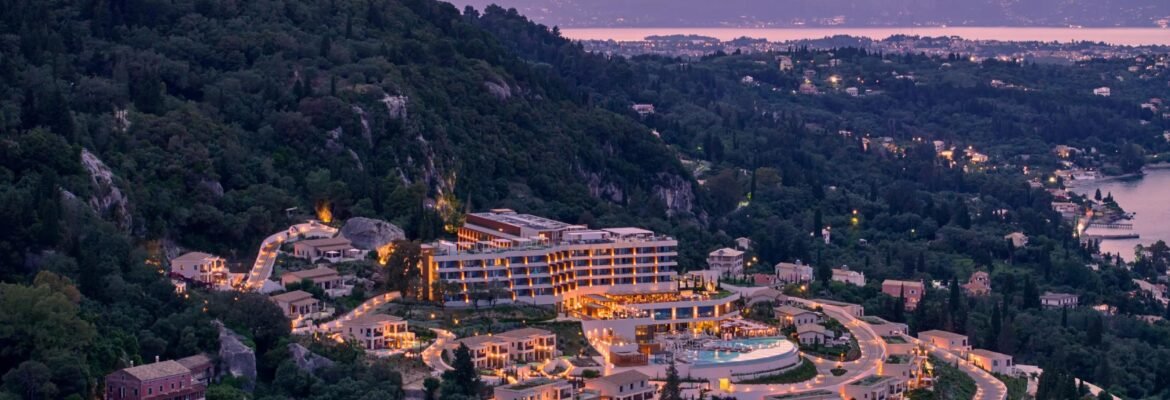
Angsana Corfu Resort & Spa: A 5-star resort on a hill on the north side of Benitses, 150 meters above sea level, providing uninterrupted views of the south of the island
Grecotel Eva Palace: Luxurious resort with private beach, spa, romantic dining, and stunning sea views.
MarBella Corfu: Upscale hotel combining relaxation with activities, private beach, pools, and wellness amenities.
Mayor Mon Repos Palace “Art Hotel”: Boutique hotel near Corfu Town blending historic charm and modern comfort — great for cultural exploration.
For Families:
Ikos Dassia: Family-friendly all-inclusive with pools, kids’ clubs, and diverse dining options.
Aquis Sandy Beach Resort: Spacious rooms, multiple pools, and entertainment for all ages.
Mitsis Roda Beach Resort & Spa: Located on Blue Flag beach, with pools, water slides, and family amenities.
Grecotel Corfu Imperial: Luxury resort with private beach, kids’ clubs, pools, and activities for all ages.
Check resort websites for the latest offers and amenities to find the perfect fit for your family.
FAQ: Quick Answers: Where to Stay in Corfu
First-timers – where do you land?
It’s ideal to start with a night or two in Corfu Town. It’s a short ride from the airport, and walking its old streets gives you a real taste of the island’s charm. After that, you can usually head to a beach area, our favorites are the beaches of Southwest Corfu if you like the sandy stretches, such as Chalikounas or Issos. But also, Glyfada is a fine cosmopolitan sandy beach near Corfu town.
Renting a car? Absolutely. It’s the easiest way to chase hidden coves and tiny villages that few tourists ever see.
Couples’ pick?
For a romantic escape, Angsana in Benitses, or else go to MarBella, Mar-Bella Collection, right by the beach of Agios Ioannis Peristeron, 3 miles south of Benitses. Modern and perfect if you want a mix of relaxation and a little luxury. Honeymooners, this one’s a winner.
Best resort for older couples?
Benitses is a great pick — traditional, calm, close to Corfu Town for easy exploring, with a slower pace than the busier beach towns. If you want something more private and polished, Angsana Corfu Resort & Spa is adults-only, set on a hill above Benitses with uninterrupted sea views — ideal if you want quiet, comfort, and no kids’ clubs anywhere nearby.
Best resort for young couples?
Sidari or Glyfada suit young couples well — Sidari has the Canal d’Amour, sandy beaches, and a livelier atmosphere; Glyfada is Corfu’s most cosmopolitan beach, close to nightlife and a younger crowd. If you want a mix of relaxation and a bit of luxury, MarBella near Agios Ioannis Peristeron is a strong pick too.
Adults-only vibes?
You will love Angsana Corfu Resort & Spa. It’s calm, luxurious, and fully adults-only, ideal when you want to forget the world. If you want more options, dive into a full adults-only guide, but this one always stands out.
Families — Where do we go?
Acharavi, Agios Georgios Pagon, or Benitses, Messonghi, and Sidari are highly family-friendly areas, with long beaches, calm waters, and plenty of restaurants and activities within walking distance.
Benitses is especially great for families because it has a large children’s playground, giving kids a safe and fun place to play while parents relax.
Many resorts often have kids’ clubs, pools, and entertainment that keep everyone happy.
Renting a car helps, but if you stay put in one spot, these towns give you everything you need for a stress-free family holiday.
Staying put without a car?
Sticking to Corfu Town, everything is steps away. If you’re in a beach town for the whole stay, pick a resort with everything on-site. Acharavi or Agios Georgios are great for this kind of slow, beach-life trip.
Is Corfu really worth it?
Absolutely. Many find it affordable, stunning, and still a little under the radar compared to Santorini or Mykonos. Perfect for couples, families, or anyone wanting beaches, food, and a taste of local life.
Our final take
People still come back because Corfu always surprises them: a quiet cove here, a bustling village there, crystal waters everywhere. And when they want a touch of luxury and total peace, the island is full of these luxury hotels.
Summary
Most seaside Corfu resorts suit families, but the best combine safety, calm shallow waters, kid-friendly activities, and nearby facilities for stress-free holidays.
According to our knowledge, the top family-friendly resorts are Agios Georgios Pagon, Arillas, Acharavi, Roda, Kassiopi, Sidari, Benitses, Messonghi, and Palaiokastritsa.
Most foreigners are told that “malaka” is a rude Greek insult meaning wanker, jerk, or idiot. But ask any Greek, and you’ll hear very different stories – ones that include laughter, friendship, and even affection.
In truth, this single word is used everywhere in Greece. It’s not just another one of the swear words – it’s culture.
In Greece, “Malaka” also works as a mask, so they don’t have to call you what you actually are – wanker, jerk, idiot, moron, asshole, useless, clown, walking disaster, pain in the ass – they use this word instead – and somehow, the same word also means friend, buddy, mate, legend.
But let’s be honest – you’ll mostly hear it from younger people. As people get older, it fades out. In many ways, it’s less a lifelong habit and more a piece of youth culture.
Why “Malaka” vs. “Malakas”?
If you’ve seen both malaka and malakas, don’t worry—it’s the same word. It’s just Greek grammar.
In the nominative case (the “dictionary form”), we say ο μαλάκας → “the guy.” That’s why you see the -s at the end, especially in word lists.
In the vocative case (when calling someone directly), the -s drops: μαλάκα! → “Hey malaka!” This is the way Greek grammar changes the endings.
👉 In English, there’s no difference, because English doesn’t really use cases anymore. But in Greek, that little -s tells you whether you’re talking about someone or calling out to them.
So, who’s a “Malaka”?
Chances are… We are.
Put simply: no one hasn’t been called a wanker, asshole, or jerk at some point.
Does that make us all fools? Probably — we all do something a little stupid now and then.
So don’t worry if someone calls you that; even the gods of Greek mythology, in their stories, weren’t immune to foolish mistakes. See? It’s not that complicated!
Accept it. Stereotypes exist for a reason.
What does malaka mean in Greece?
“Malaka” is probably the first Greek slang tourists hear. You’ll catch locals tossing it around casually, and it can sound either friendly or aggressive — context is everything.
“Malaka” means “masturbator.” But the modern usage is far more nuanced. Depending on tone, it can express insult, affection, or frustration:
A versatile word with strange rules: When referring to someone you hate, “Malaka” means “jerk“, “asshole”, “motherfucker”, “wanker“, “idiot”, or “stupid”—yet when spoken to a friend, the entire meaning flips into a warm greeting like “dude” or “mate” depending on one crucial social rule. See? It’s a bit complicated!
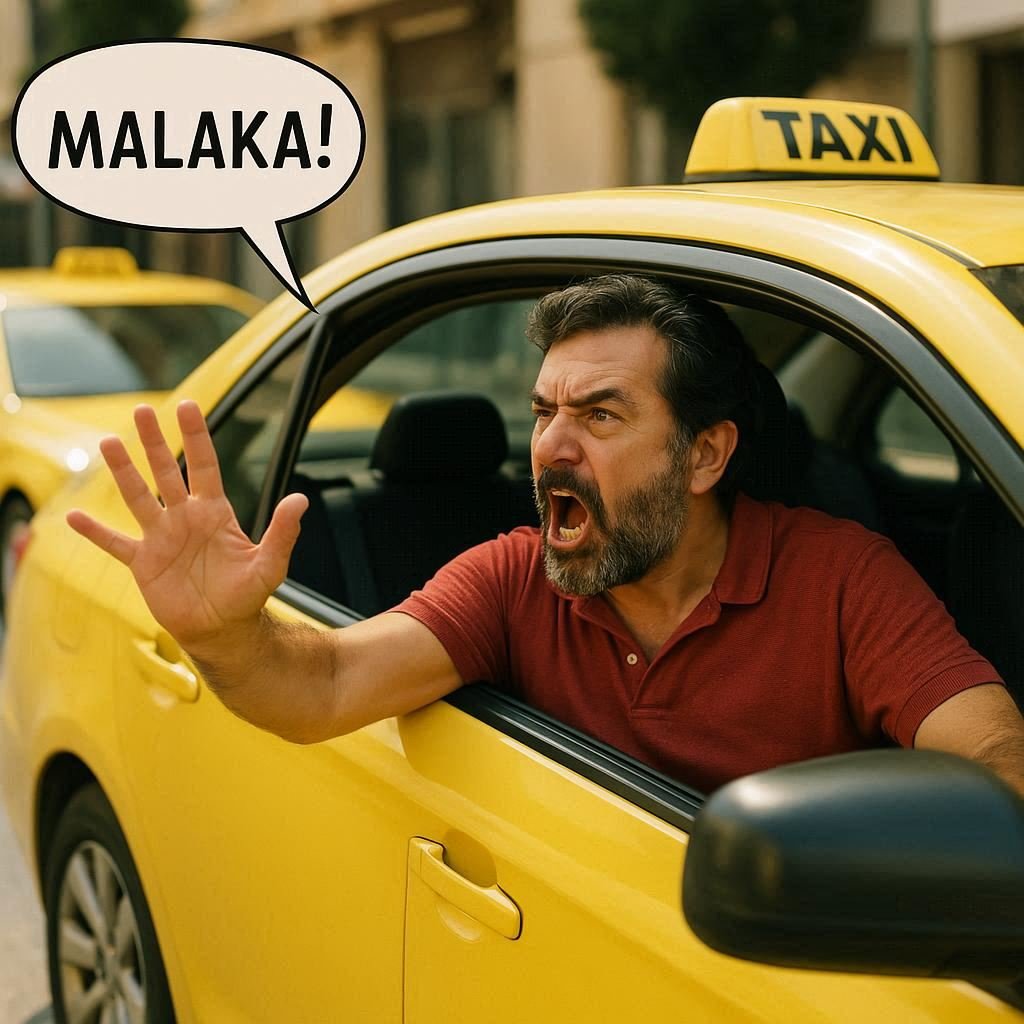
Malaka taxi driver
A word not only for idiots.
Let’s put it straightforward: the fact is that “Malaka” does not refer only to idiots.
It’s a word with a lot of ambivalence, but let’s be honest: unless we say it to our best friend directly, in almost all other cases, it’s an insulting word. And remember! No one will forgive us if we call him a malaka behind his back — not even friends.
🚫 When not to use Malaka
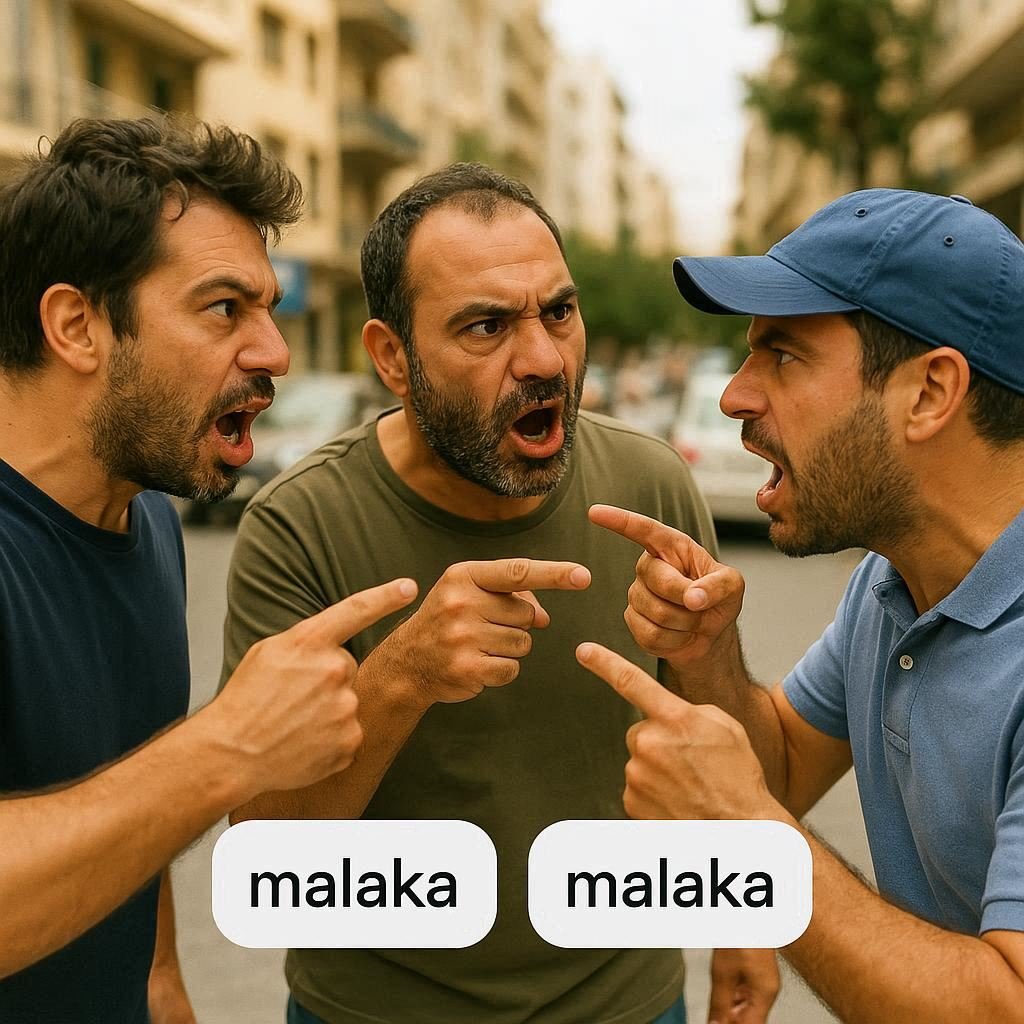
Three Malakes are arguing
Although malaka can be friendly between close friends, there are many situations where you should avoid using it:
Do not use it with women. Even if you hear Greek men using it among themselves, calling a woman malaka is usually offensive.
Do not use it when meeting someone for the first time. It is not the appropriate way to break the ice.
Do not use it with strangers. Almost all people will take it as an insult rather than a joke.
Do not use it with older people. It is considered disrespectful when addressing parents, grandparents, or other elders.
Avoid it during arguments. Even among friends or siblings, malaka can quickly turn a disagreement into a serious confrontation.
Never use it in road rage. After a traffic incident, calling another driver malaka is one of the fastest ways to escalate the situation.
Don’t assume you understand the context. Greeks can use malaka in dozens of different ways depending on tone, relationship, and situation. Until you understand these nuances, it’s safer not to use the word at all.
Rule of thumb: If you’re not a native Greek speaker and you’re unsure whether malaka is appropriate, don’t use it. It’s much easier to recognize the word than to master when it is socially acceptable.
✅ When you can call someone Malaka
Although malaka literally means “offensive,” Greeks often use it as a friendly expression in informal situations.
You can use malaka only when all of the following are true:
With close friends. Among good friends, malaka often means something like “mate,” “buddy,” or “pal.”
With siblings or close relatives. Brothers and sisters may use it jokingly, provided they are not arguing.
In a relaxed, informal conversation. Expressions such as “ela re malaka” (“come on, mate”) or “eise enas malakas” (“you’re such an idiot, mate”) are common among friends.
When everyone understands it’s a joke. Tone of voice, facial expression, and your relationship matter more than the word itself.
When you know the other person well. The closer the friendship, the more acceptable the word becomes.
Rule of Thumb:
Use malaka only with people you know very well and who are comfortable using the word themselves. If you’re unsure whether it’s appropriate, don’t say it. What sounds friendly between close Greek friends can sound highly offensive in almost any other situation.
Why Do Greeks Say Malaka So Often?
Over the years, malaka has become a kind of social Swiss Army knife. In a country where frustration with politics, bureaucracy, the media, and everyday life is common, the word is used to express anger, irony, affection, sarcasm, or simple amusement.
Greeks may call someone malaka for many different reasons, including:
Politicians – for being dishonest, corrupt, or putting personal interests above the public.
Journalists – when they are seen as biased or serving political or business interests.
Media owners – for promoting propaganda, manipulating public opinion, or spreading misinformation.
The public itself – for accepting or tolerating situations without reacting.
Bad drivers – for dangerous driving, ignoring traffic rules, or blaming everyone else.
Close friends – affectionately, in the sense of “you idiot” or “you fool,” with no real insult intended.
This is the paradox of malaka: a vulgar word that has become a reflection of Greek society. Depending on the speaker, the relationship, and the situation, it can express anger, sarcasm, friendship, admiration, or simple surprise.
The safest rule for visitors is simple: listen first, understand the context, and don’t assume that every use of malaka means the same thing.
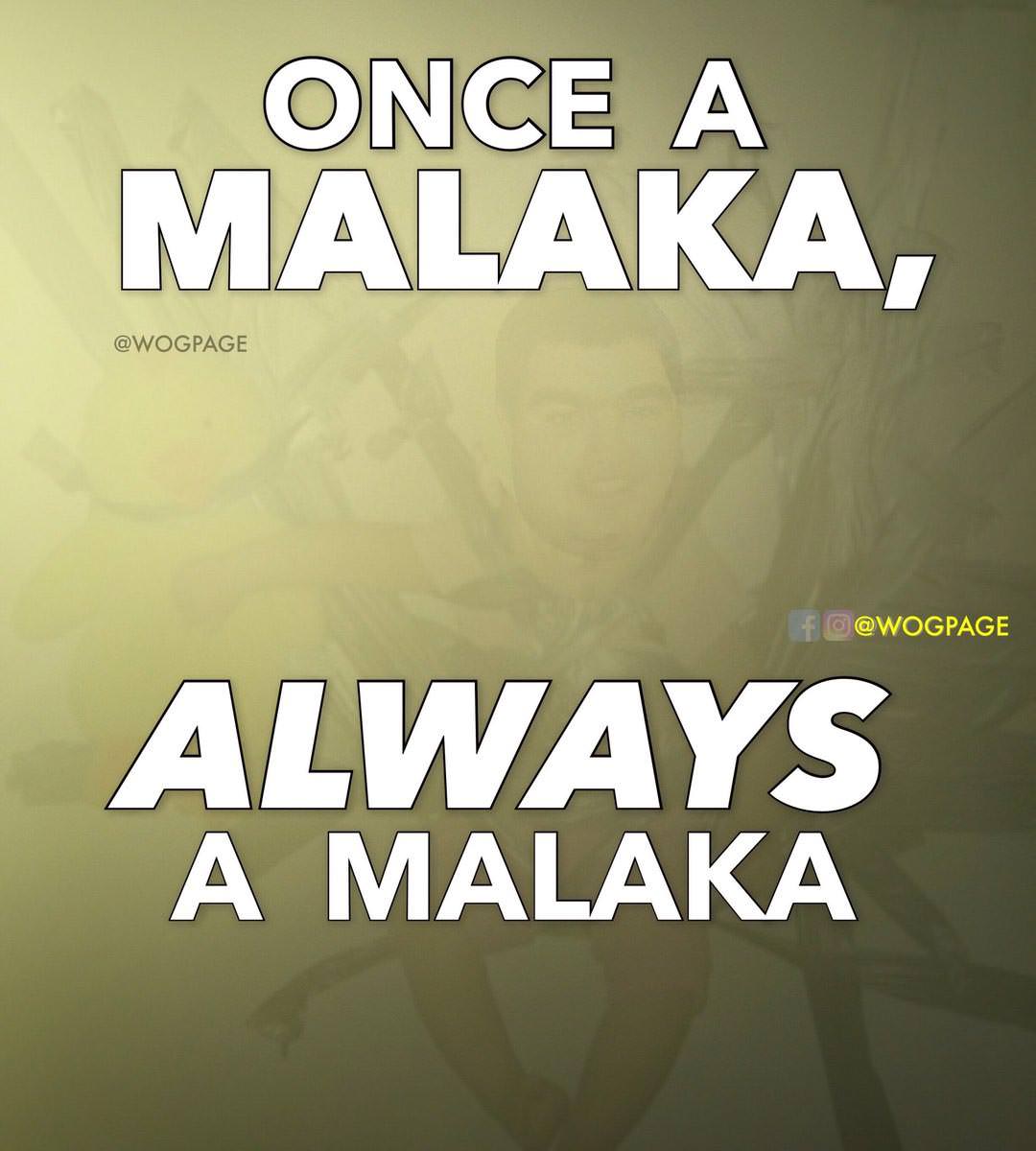
Once malaka always malaka
Greek slang compounds based on “malaka.”
Greeks add other words to the root “malaka” to form many informal slang variations:
intensifiers (e.g., “very / extreme” forms)
descriptive prefixes
context-based exaggeration
These forms are typically:
highly informal
offensive depending on tone
used for emphasis rather than literal meaning
Examples include:
μαλακία (malakia) — masturbation; also used as “nonsense” or “bullshit” in everyday speech
μαλακίζομαι (malakizomai) — to waste time, act stupid, or literally masturbate (slang)
μαλακισμένος (malakismenos) — idiot / stupid person (strong slang insult), it’s literally the same as the root.
αρχιμαλάκας (archimalakas) — “Chief malaka” (intensified form), the most malaka of all.
χοντρομαλάκας (chontromalakas) — “Fat-malaka” / very strong insult (intensifier)
ψιλομαλάκας (psilomalakas) — “tiny-malaka”, mild/“light” insult form (context-dependent)
μαλακιστήρι (malakistiri) — derogatory form implying stupidity or immaturity, used for children.
σκατομαλάκας (skatomalakas) — “shit-malaka”, very strong insult (explicitly offensive as it prefixes the word σκατά, meaning shit)
μαλακοκαύλης (malakokavlis) — “malako-acorn,” a highly offensive compound slang insult with sexual connotations
And many more!
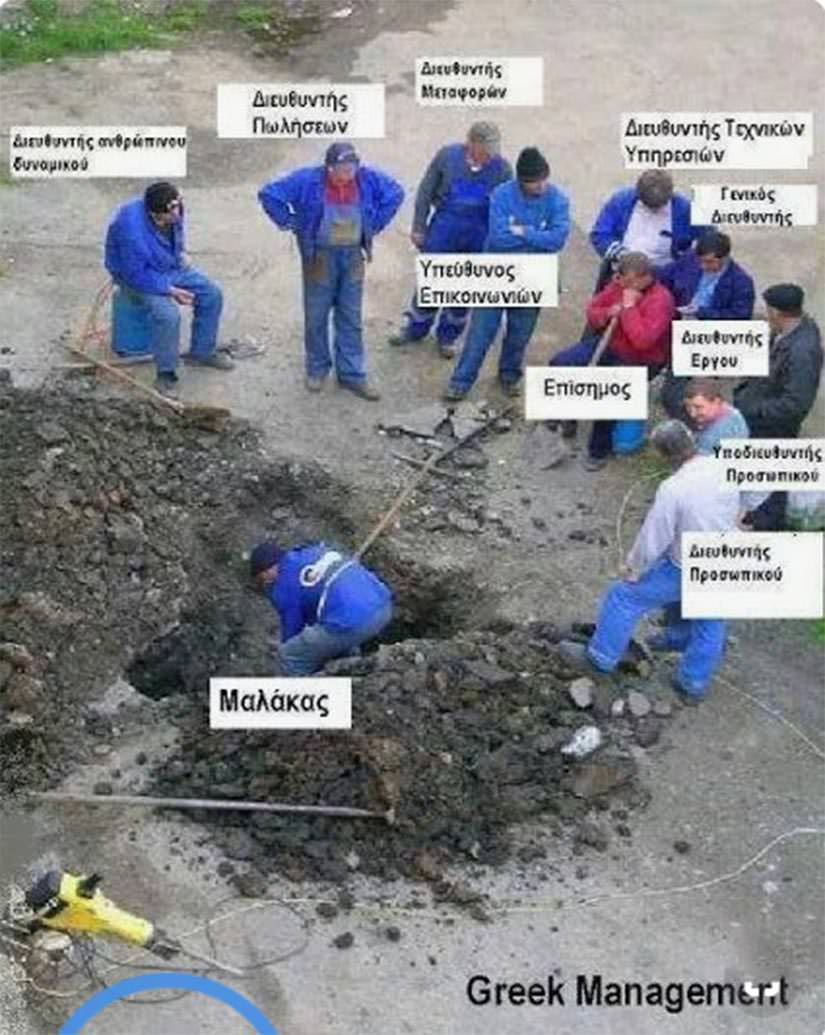
Greek way workshop – Only the malaka works – the rest are just looking.
Why Do Friends Say “Malaka” to Each Other?
Among close friends, it’s not only tolerated — it’s expected. You’ll hear phrases like:
“Ela re malaka” – Come on, man
“Eisai enas malakas” – You’re such a goof (with affection)
Think of it as a Greek badge of trust — but only in familiar company.
Arkas – Behaving as Malakas
Origins of the Word Malaka
Historically, “malaka” comes from “malakia,” meaning softness or weakness. In medieval times, masturbation was linked to mental decline — so the term gradually evolved into a general insult for fools and weaklings.
But Greek culture is flexible. The same word can now carry irony, affection, or contempt — depending on the speaker and the moment — reflecting how the Greek language works in everyday communication.
So… Is “Malaka” a Bad Word?
Yes, it is. It’s vulgar in literal meaning, but softened by social context. Greeks use it like seasoning — sparingly or generously, but always with intent.
So, unless you’re sure of the mood and your relationship with the person, keep it in your linguistic back pocket. Use it wrong, and you might get silence. Or worse — a slap.
Visiting Greece? You’ll Hear It—a Lot.
Especially in casual settings, such as cafés, beaches, and traffic jams. It’s cultural shorthand. Don’t try to master it — just observe and enjoy.
But wait, Malaka is just the tip of the iceberg; there are thousands more swear words in Greek that you will definitely enjoy!
Tourist Tip – Can Foreigners Use It Safely?
If you’re an English-speaking adventurer hoping to bond with the locals, chances are you’ve already heard malaka tossed around like confetti. The good news? Tourists usually get a free pass — think of it like an amusement park wristband. But fair warning: there’s always a tiny risk of stepping into friendly fire.
Heading to Corfu? Don’t be surprised if Malaka pops up in cafés, on beaches, or from a smiling driver stuck in traffic. Around here, it’s often more playful than rude. Use it with care, and you might just pass for a local (or at least make someone laugh).
Bottom line: Malaka is like a secret handshake — it can open doors or accidentally start a duel. Unless you’ve cracked the code, it’s probably smarter to keep it in your back pocket. And hey, when in doubt, focus on pronouncing moussaka properly — fewer risks, more rewards.
Final Thoughts
“Malaka” is more than slang — it’s a window into the Greek psyche. It’s about emotion, timing, and relationships. It’s a mask word for almost everything.
And yes, here in Corfu, we might just say it more than anywhere else. But don’t worry — if we call you one, it might mean we like you.
Want more? See real-world examples from Greece, England, and France here:
So, buckle up, fellow adventurers, because the world of “Malaka” in Malaka’s country is just a click away.
And remember, when in doubt, embrace the spirit, the slang, and the unforgettable journey that comes with it. It’s all part of the glorious Greek experience, Malaka-style!
Excuse our lack of good sources, but who needs sources when an original Greek Malaka writes this post? Right?
Contains information related to marketing campaigns of the user. These are shared with Google AdWords / Google Ads when the Google Ads and Google Analytics accounts are linked together.
90 days
__utma
ID used to identify users and sessions
2 years after last activity
__utmt
Used to monitor number of Google Analytics server requests
10 minutes
__utmb
Used to distinguish new sessions and visits. This cookie is set when the GA.js javascript library is loaded and there is no existing __utmb cookie. The cookie is updated every time data is sent to the Google Analytics server.
30 minutes after last activity
__utmc
Used only with old Urchin versions of Google Analytics and not with GA.js. Was used to distinguish between new sessions and visits at the end of a session.
End of session (browser)
__utmz
Contains information about the traffic source or campaign that directed user to the website. The cookie is set when the GA.js javascript is loaded and updated when data is sent to the Google Anaytics server
6 months after last activity
__utmv
Contains custom information set by the web developer via the _setCustomVar method in Google Analytics. This cookie is updated every time new data is sent to the Google Analytics server.
2 years after last activity
__utmx
Used to determine whether a user is included in an A / B or Multivariate test.
18 months
_ga
ID used to identify users
2 years
_gali
Used by Google Analytics to determine which links on a page are being clicked
30 seconds
_ga_
ID used to identify users
2 years
_gid
ID used to identify users for 24 hours after last activity
24 hours
_gat
Used to monitor number of Google Analytics server requests when using Google Tag Manager