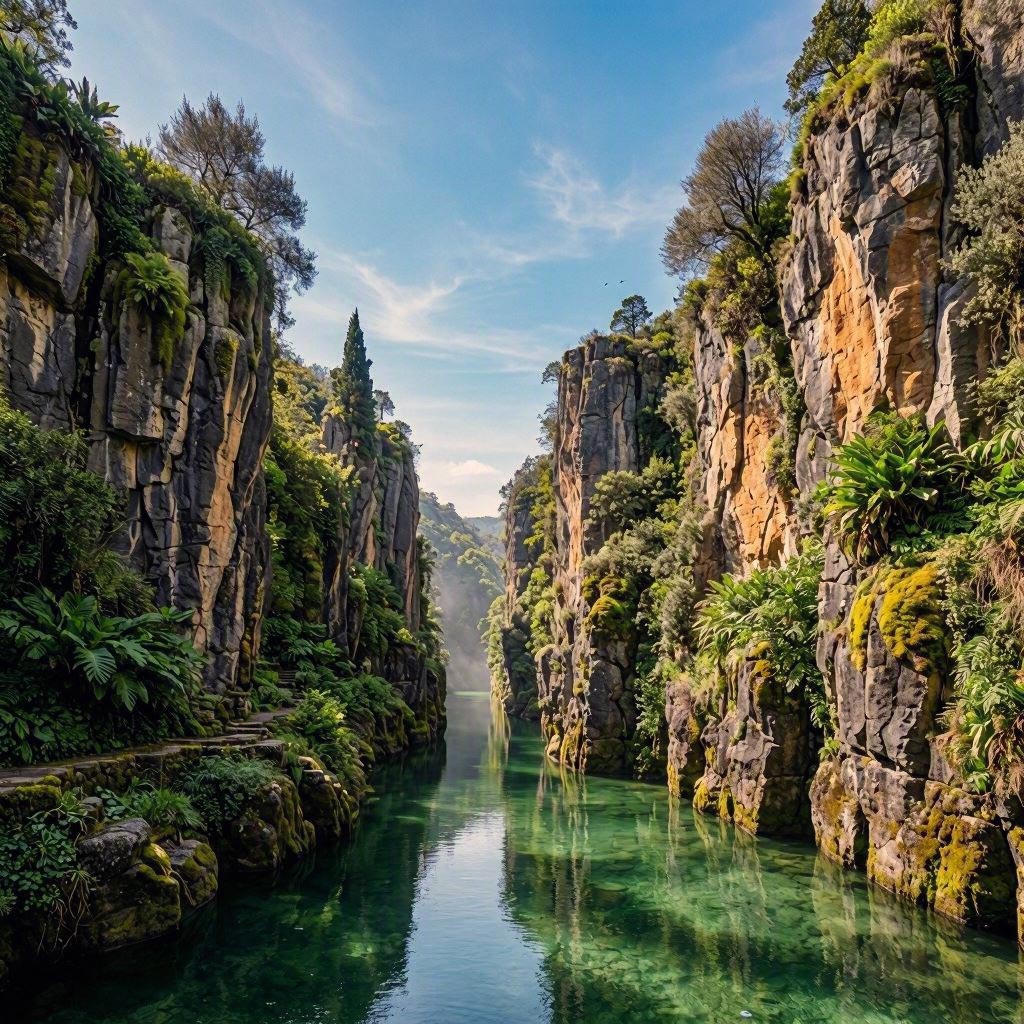
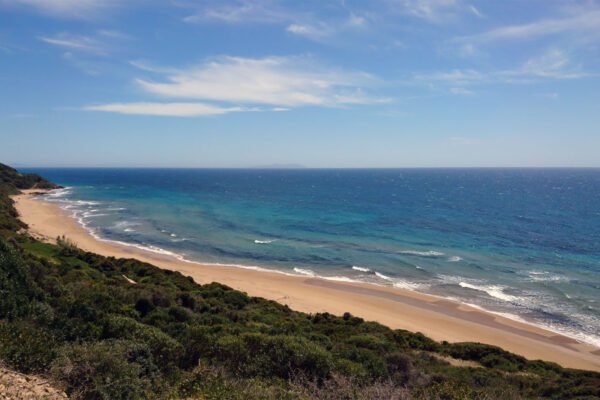
The Acheron is a real river in Epirus, northwestern Greece. It rises in the mountains and flows through a wild landscape of springs, gorges, and wetlands before reaching the Ionian Sea.
For the ancient Greeks, however, the Acheron was much more than a geographical feature. It was the river of the Underworld, associated with Hades and the passage of the dead. This is one of the most remarkable cases in Greek mythology where an actual landscape became inseparably connected with the world of the gods and the dead.
The name Acheron is usually connected with grief or woe, and the river appears in the ancient literary tradition as one of the waters of the Underworld. In later tradition, Charon carries the souls of the dead across its waters toward Hades.
The association was not simply the invention of poets. Ancient Greeks knew the Acheron of Epirus as a real river, and the strange, remote character of its landscape helped create its connection with the Underworld. The nearby Nekromanteion, the ancient “Oracle of the Dead”, is further evidence of how strongly this particular region became associated with the world of the dead.
And what about the Styx?
The Styx is often presented today as the river of the Greek Underworld. This is misleading when applied to the older Greek tradition.
In early Greek mythology, Styx had a different significance. In Hesiod, Styx is a divine river and a goddess, and the gods swear their most solemn oaths by its waters. It was a small river, more like a series of waterfalls in Arcadia, not simply another name for the Acheron.
The familiar image of Styx as the river crossed by the dead became particularly influential through later literature, especially Roman literature such as Virgil. It should therefore not be used to erase the much older and more direct Greek association between Acheron and the Underworld.
The Acheron remains a real river that can still be visited today — a physical landscape in Epirus that the ancient Greeks connected with one of the deepest ideas in their mythology: the boundary between the world of the living and the world of the dead.
Charon, the Ferryman of the Dead
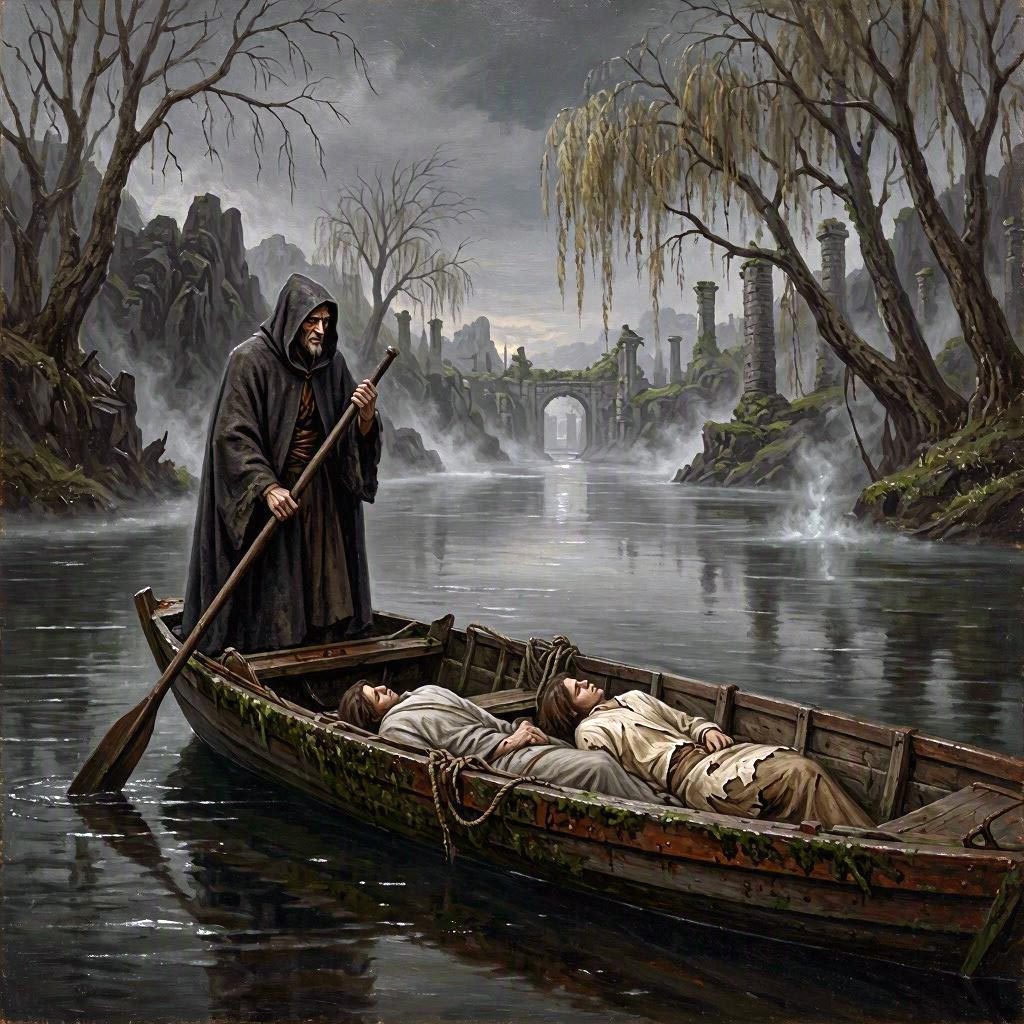
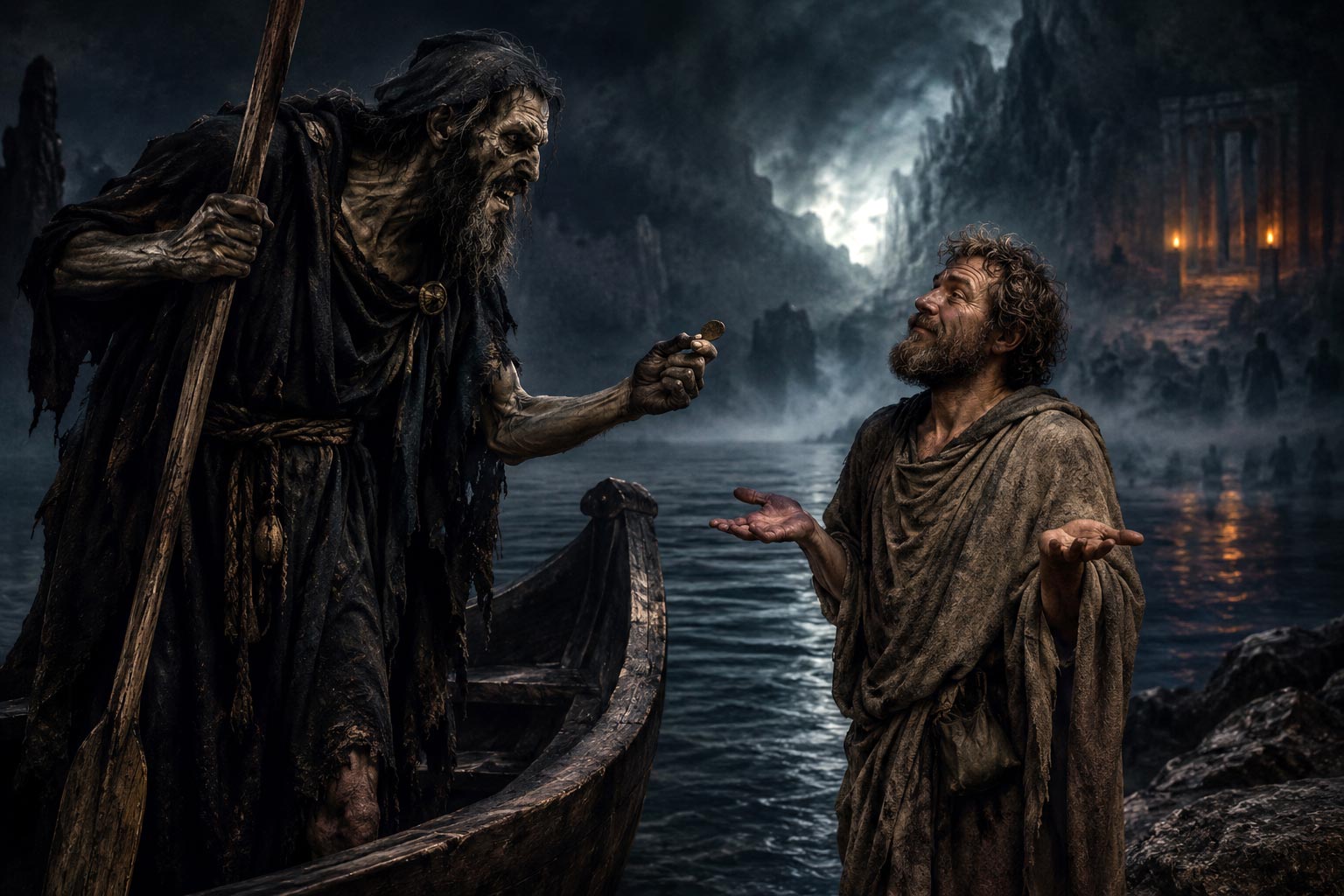
Charon carrying deads in Underworld
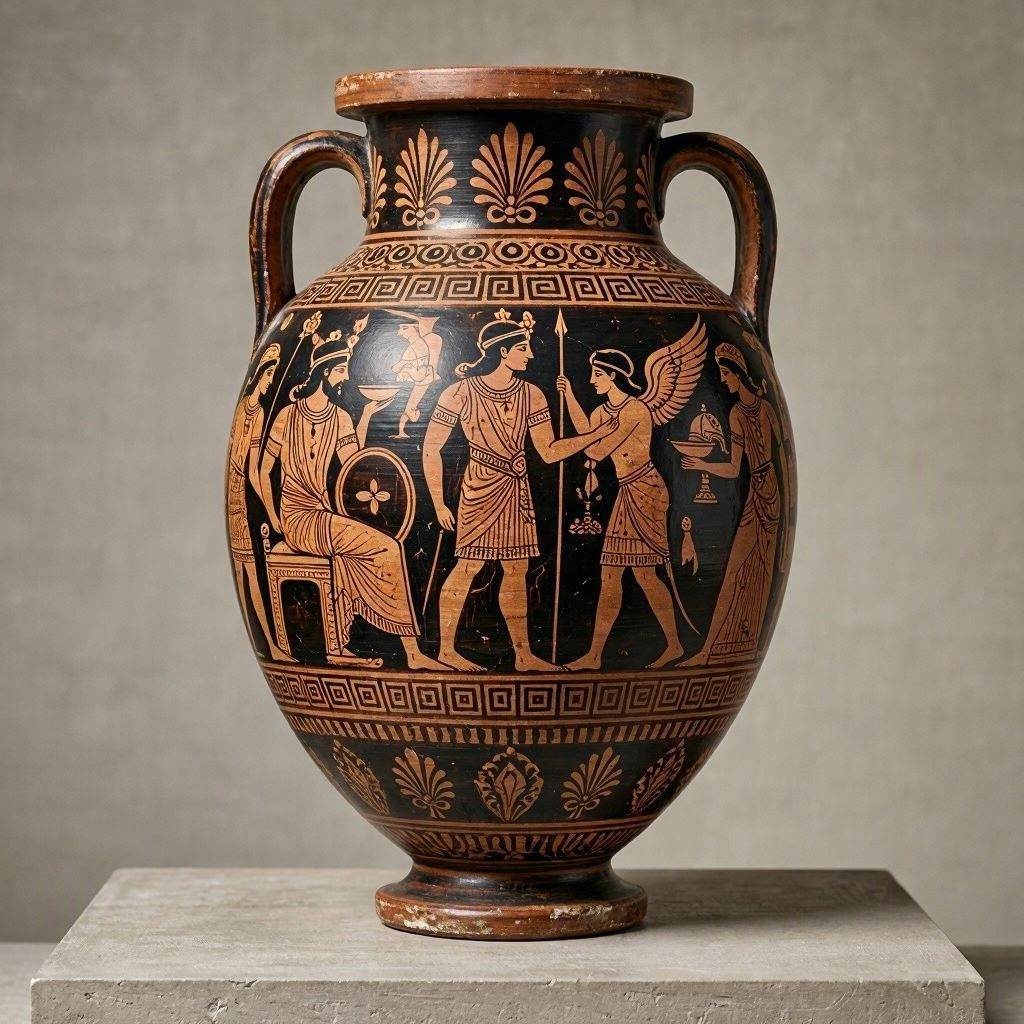
According to the ancient Greek conception of the journey to the Underworld, the dead did not simply disappear into Hades. Their souls had to make a journey.
Hermes, in his role as Psychopompos — the Guide of Souls — led the dead from the world of the living to the waters of the Underworld. There, Charon (Χάρων), the grim ferryman, waited in his boat to carry them across.
Charon was not offering his service for free.
The traditional fare was one obol, a small Greek coin. This explains the ancient funerary custom of placing a coin with the dead, most famously in the mouth, so that the deceased would have the means to pay Charon for the crossing. Archaeological evidence confirms that coins were indeed placed with the dead, although in practice the denomination and exact position could vary.
Menippus, the Cynic philosopher who died without money
The idea produced one of the most memorable pieces of humour in ancient Greek literature.
In Lucian’s Dialogues of the Dead, the Cynic philosopher Menippus arrives at Charon’s boat without an obol. After carrying him across, Charon demands his fare:
“Pay me for carrying you across.” “You cannot take it from someone who does not have it.”
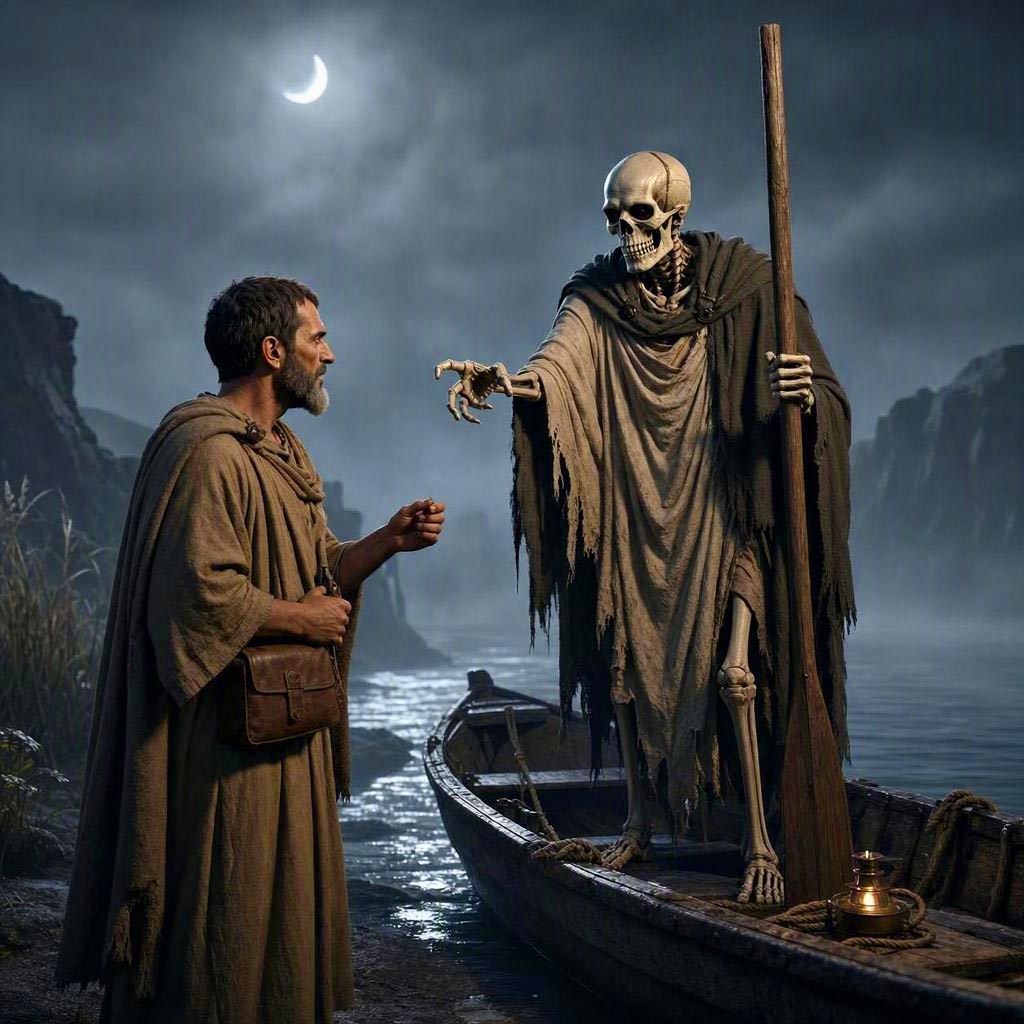
Charon asking Menipus for money
Charon cannot believe that anyone could arrive at his boat without the necessary obol. Menippus simply tells him that he has none. When Charon threatens him, Menippus threatens him back. When Charon insists that everyone must pay, Menippus replies that if he has no money, there is nothing Charon can take.
He even tells Charon that Hermes should pay for him, since Hermes was the one who brought him there. Hermes, naturally, refuses to pay the fares of the dead.
Menippus then points out that he did not cross entirely for free anyway: he helped with the oar and bailed water from the boat. Finally, when Charon asks what he has in his wallet, Menippus reveals that he has only some beans and food for Hecate.
Charon swearing to Menipus for money
This satirical scene gave us the famous Greek saying:
«Οὐκ ἂν λάβοις παρὰ τοῦ μὴ ἔχοντος.»
Literally:
“You cannot take from one who has nothing.”
It became the proverbial «ουκ αν λάβοις παρά του μη έχοντος», still used today when someone demands something from a person who simply does not possess it.
There is something particularly appropriate about the joke. Even at the gates of the Underworld, Menippus refuses to accept that a rule can create something that does not exist. Charon can demand his obol as much as he likes. A man without an obol cannot pay an obol.
And so, in Lucian’s wonderfully irreverent version of the journey to the dead, the great ferryman of Hades meets a problem that no god, law, or threat can solve:
Medousa was not the monster that mythology says. In reality, she was a beautiful woman and a priestess of Athena, serving the goddess in her temple. All priestesses of Athena should remain virgins!
Poseidon desired her, but Medousa resisted him. In the end, Poseidon raped her inside Athena’s temple. A horrible act and example of a male-dominated society.
Yet it was not Poseidon who was punished.
Athena turned her own priestess into a monster. Her beautiful hair became living snakes, and her gaze became so deadly that anyone who looked directly at her was turned to stone.
Medousa was condemned for the violence committed against her.
It is one of the most disturbing stories in Greek mythology: the woman is punished, while the powerful male god escapes punishment.
Medousa’s transformation can therefore be seen as one of mythology’s starkest examples of injustice against women, reflecting a society in which the woman could bear the blame for a man’s actions.
Medousa’s fate was given a remarkable new interpretation
Almost three thousand years after the ancient story first appeared, Medousa’s fate was given a remarkable new interpretation.
In 2008, the Italian-Argentine sculptor Luciano Garbati created a sculpture called Medusa with the Head of Perseus. Instead of showing Perseus holding the severed head of Medousa, as the traditional story does, Garbati reversed the scene.
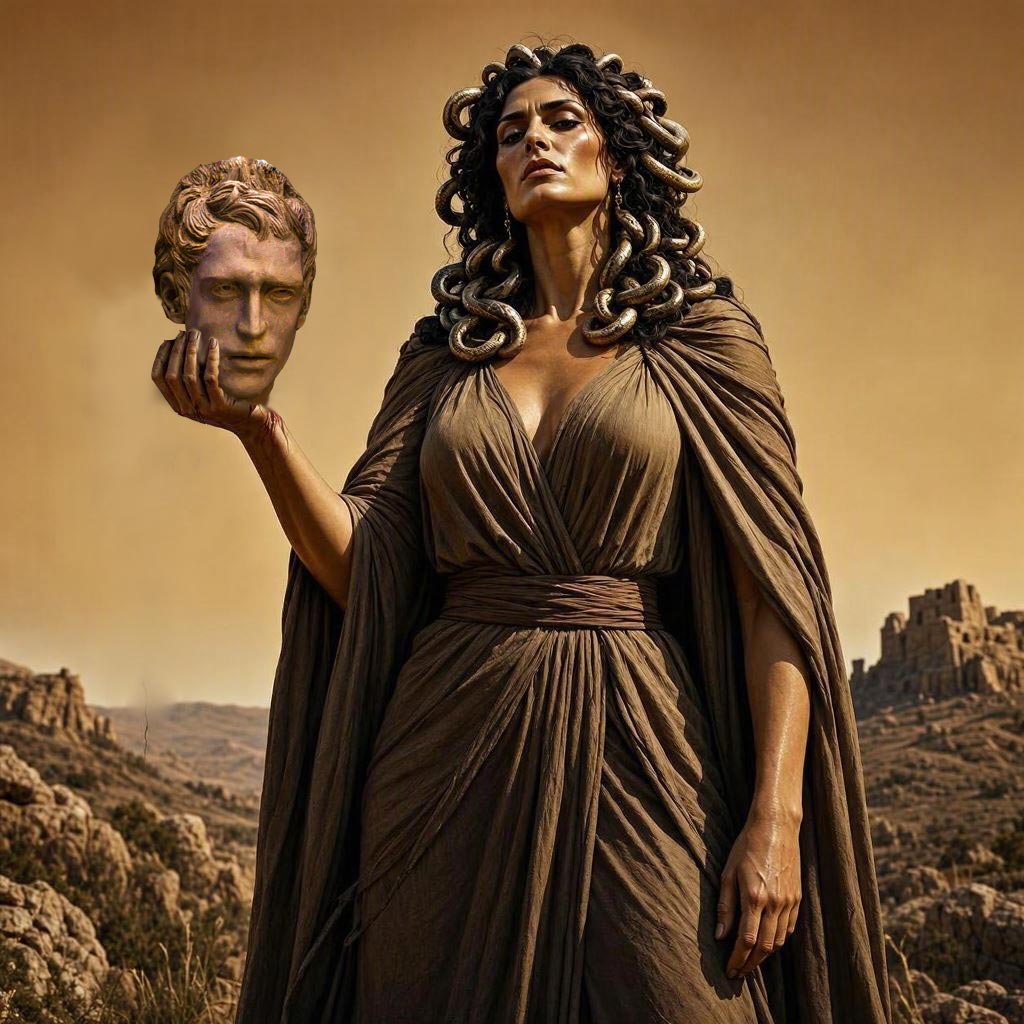
Medousa (Medusa) is standing with the severed head of Perseus in one hand and a sword in the other.
The sculpture was conceived as a response to one of the most famous representations of the myth: **Benvenuto Cellini’s **Perseus with the Head of Medusa, the celebrated Renaissance bronze displayed in Florence’s Loggia dei Lanzi. Garbati had grown up near Florence and knew Cellini’s sculpture well. His work deliberately turns Cellini’s composition and the ancient story upside down.
Garbati’s Medousa is not portrayed as the hideous monster of the ancient images. Apart from her serpentine hair, she has the body and appearance of a beautiful woman. She does not look triumphant or bloodthirsty. Instead, she appears calm and determined, holding the head of the man who came to kill her.
The sculpture was created in 2008, but it became widely known a decade later. In 2018, a photograph of the work circulated widely on social media, accompanied by the words “Be thankful we only want equality and not payback.” The image attracted considerable attention and eventually led to a New York exhibition.
Then came the most striking setting imaginable.
In October 2020, a seven-foot bronze version of Medusa with the Head of Perseus was installed in Collect Pond Park in Lower Manhattan, directly across from the New York County Criminal Court. The sculpture was part of the NYC Parks Art in the Parks programme and remained on display for several months.
The location was not accidental in its symbolism.
The New York County Criminal Court had been the setting for numerous criminal cases, and the installation came during the period when the #MeToo movement had brought sexual violence, abuse and the treatment of victims into worldwide public discussion. The location also carried a particularly strong association with the sexual-assault case against Harvey Weinstein, whose trial had taken place at the courthouse.
The ancient story had placed Medousa on trial without ever giving her a voice. She was violated, transformed into a monster, hunted, and finally killed.
The modern sculpture puts her in front of a courthouse.
But this time, Medousa is not the accused. She is the one standing with the sword.
The symbolism was quickly embraced by many people as a representation of women’s anger, resistance, and self-defence, and the sculpture became associated with #MeToo. The MWTH Project described the work as an inversion of the traditional narrative, presenting Medousa at a moment of empowered self-defence.
There is an interesting irony in this modern interpretation. Garbati has said that when he created the sculpture, he was not aware that Medousa had already become a feminist icon. His starting point was much simpler: he admired Cellini’s Perseus with the Head of Medusa and wanted to reverse the roles of the two figures.
Yet the reversal gave the ancient story a completely different meaning.
For centuries, the image was:
Perseus → holding Medousa’s head.
Garbati changed it to:
Medousa → holding Perseus’ head.
Medousa with the head of Perseus
The monster becomes the survivor.
The victim becomes the one holding the sword.
And the woman who was once blamed and punished is finally given the power to tell the story from her own side.
Whether one sees the ancient myth as a reflection of its society or simply as a story that changed through the centuries, the modern Medousa has acquired a meaning far beyond the original legend.
The woman who was once turned into a monster has become, for many, a symbol of resistance.
Corfu Driving & Shopping Guide: How to Beat the Summer Gridlock
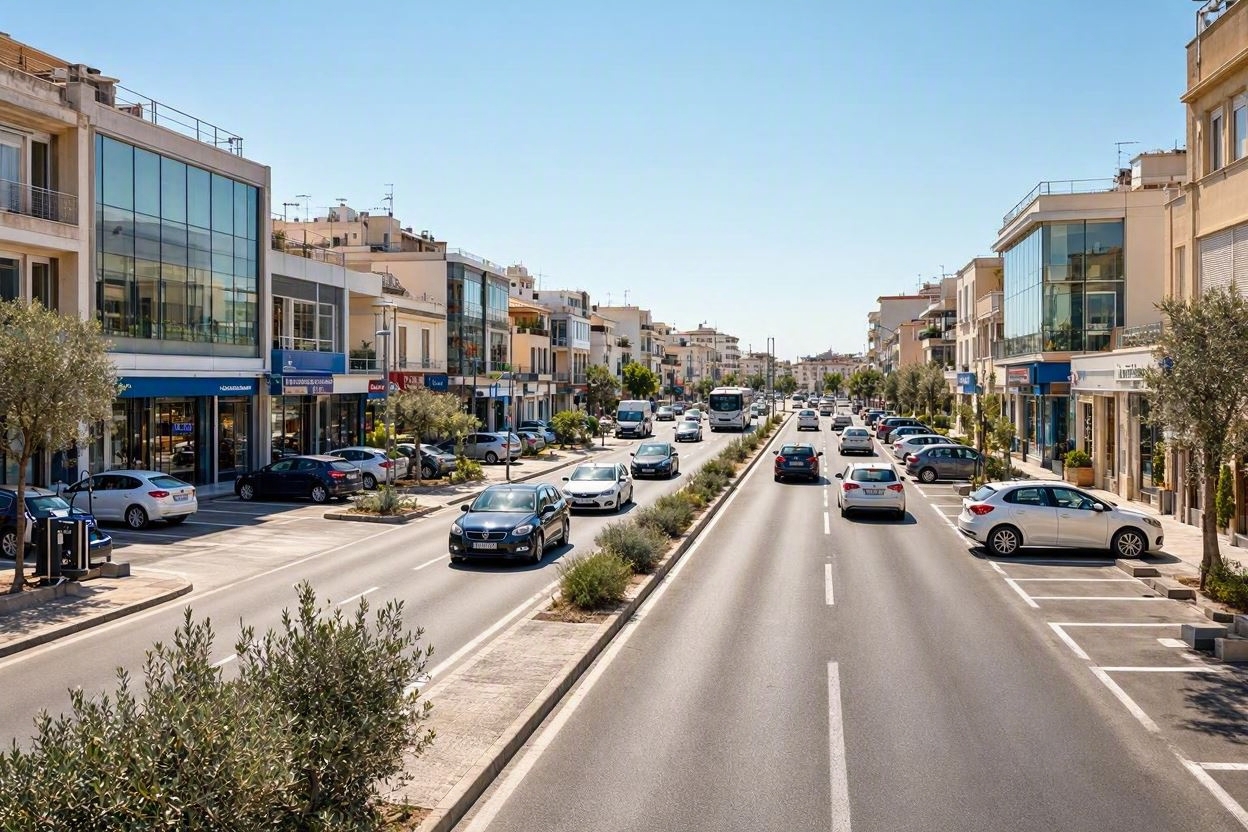
Visiting Corfu by car during the peak summer months is a fantastic way to reach remote beaches, but driving around the Corfu Town perimeter requires a serious reality check. The island’s infrastructure stretches along radial roads like an endless urban net.
Today, every major countrywide Greek retail chain has at least one massive store here, but they are scattered across very different corridors. If you are a domestic road-tripper or a foreign visitor, you need to know exactly which roads to target—and which ones will trap you for hours.
We decided to add this new resource to our Corfu Island Guide to give you a true sense of the local reality and warn you about some traffic and shopping challenges you might face during your visit.
The South Artery (Lefkimis Road): Corfu’s 5-Kilometer Nightmare
If you are staying south of town in places like Benitses, brace yourself.
The real summer nightmare is heavily concentrated strictly in the first 5 kilometers leading out of Corfu Town along Lefkimis National Road.
The root cause of this massive bottleneck comes down to sheer numbers: this narrow, single-lane road is the only lifeline serving nearly 20,000 year-round residents living in the south and middle Corfu.
The Achilleion municipality alone is the most populous region on the island after Corfu Town, boasting over 10,000 citizens.
Because of this high local population, this bottleneck is an all-year-round problem, not just a seasonal issue.
However, when you inject thousands of summer rental cars into the mix, the infrastructure completely collapses under the weight.
To make matters worse, this initial 5km stretch is packed with major commercial destinations that cause constant turn-off delays, including specialized fast-food pickups, car repair shops, and an intense concentration of major supermarkets, including:
Masoutis
Lidl
Diellas
AB Vassilopoulos (Branch No. 2)
Sklavenitis
METRO Cash & Carry (Note: This is strictly for wholesale/professionals only)
During August, the gridlock hits a breaking point that leaves every resident wishing the month would go away quickly, as the traffic frequently backs up all the way to Perama.
Covering the short 11km distance from Benitses to town can easily take up to 2 hours, which is why locals prefer not to touch their cars at all during peak season.
This road desperately needs a modern expansion to handle the island’s growth, but until that happens, you must prepare for massive delays or avoid peak hours entirely.
The Southern Highway Relief: Once you finally clear the town perimeter and get past Messonghi, the script completely flips.
From there down to the southern tip, the road is brand new. It is wide, fast, and lets you reach Lefkimi Town and its ferry port in 30 minutes easily.
If you are catching a ferry to the mainland from the south, which is cheaper than those from Corfu town port, just make sure to budget all your extra time for that messy first 5km bottleneck near town.
The North Artery (Solari): The Easy-Traffic Electronics & Banking Hub
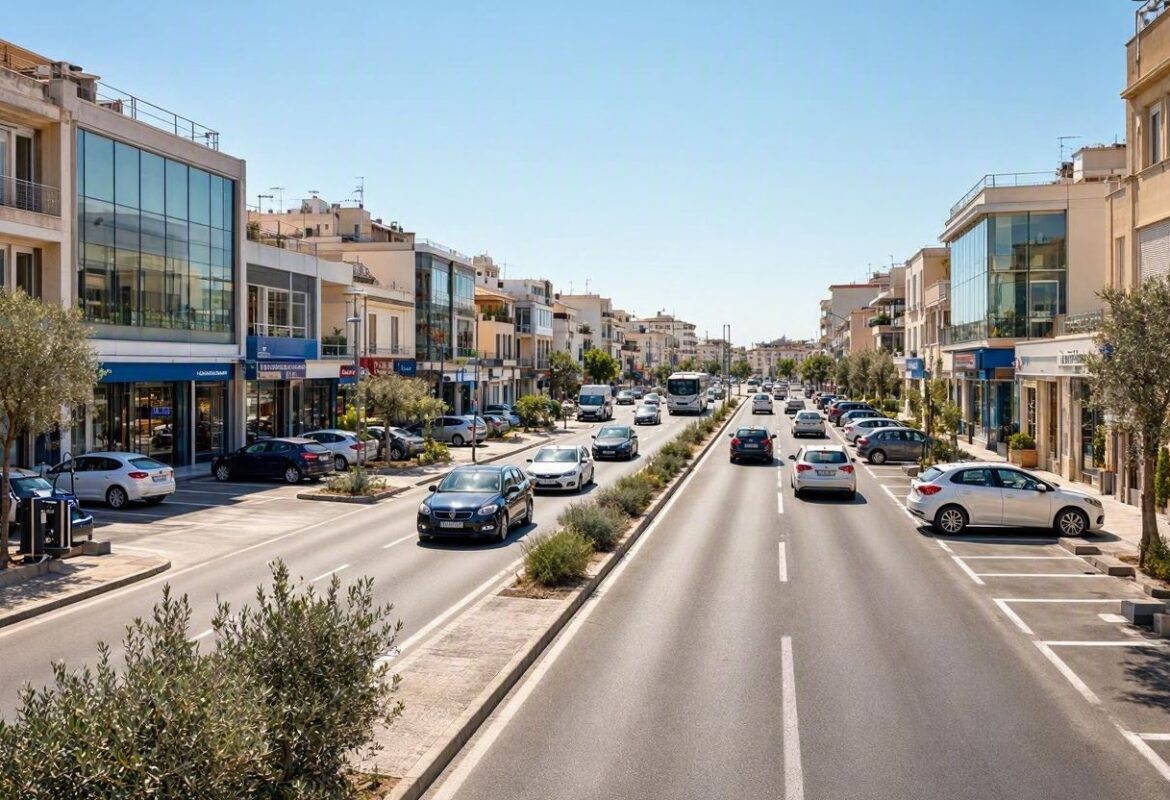
Solari road in Corfu
In stark contrast to the south, the Paleokastritsa National Road—known universally by its local nickname, “Solari”—is wide and handles its heavy traffic flow with ease, even though it acts as the primary vein connecting most of North Corfu with the town.
If you choose accommodation in the North of the island, your driving experience will be completely different and significantly easier because of this road.
Years ago, clothing and fashion shops were found exclusively inside the narrow alleys of the Old Town.
Today, apparel stores are rapidly increasing along Solari, choosing the strip because it offers the physical space they need.
More importantly, Solari is the island’s undisputed hub for electronics and appliances.
If you need a TV, a phone charger, or electrical supplies, this is where you will find major tech retailers like Kotsovolos, Electronet, Kafkas, and the Cooperative (Συνεταιρισμός) of Corfu Electricians.
The strip is also a vital corridor for automotive care, lined with numerous car repair shops.
The Banking & Grocery Scene at Solari: While many banks across the island have consolidated or closed branches lately, Solari remains a functional banking hub where you can still find active branches of Alpha Bank and Trapeza Pisteos (Credit Bank / Alpha Bank network).
For your primary grocery shopping, this wide highway also hosts a major, spacious branch of the AB Vassilopoulos supermarket chain, complete with large, free parking lots.
The West Roads (Pelekas National Road): Low Traffic & Quiet Shopping
The roads radiating out toward the west side of the island—specifically the Pelekas National Road are significantly less busy, making the West another excellent, stress-free area to choose for accommodation. Because traffic is so light, you will experience virtually zero driving delays here.
It’s the road leading to the sandy beaches of the west of Corfu, such as Glyfada, Agios Gordis, and Pelekas.
Due to the lower traffic volume, this western corridor has experienced some economic decline over recent years, meaning it lacks the high-energy commercial rush of Solari.
However, for a visitor, this is a major advantage: it is incredibly easy to visit, navigate, and park. It serves as an excellent, quiet alternative for finding specific local shops, essential supermarkets, and various food shops without fighting any central town congestion.
The Corfu Town Parking Reality (The 5€ Trap & Sudden Price Spikes)
Before looking for a spot, you must understand the layout: cars are strictly forbidden inside the historic Old Corfu town. The entire historic center is pedestrianized. Vehicle traffic is forced onto a peripheral road system that encircles the ancient borders:
The East Route (Mouragia): Traffic hugs the coast, running outside the Old Fortress. It then loops uniquely through a scenic palace gate at a point right next to the famous Liston area, moving through the Mouragia area behind the Palace of St. Michael and St. George. This is your primary route if you are aiming for the Old Fortress, the Palace, or the Liston.
The West Border: To the west, the border is defined by the massive walls of the New Fortress, with the road wrapping completely around the western walls of it, surrounding the Old Town until it reconnects with the East route at the northern point of Esplanade square, toward the Old Fortress.
The largest problem that every driver faces in the town is finding a place to park. It’s almost impossible in normal circumstances, so the options left are parking lots around the new city, but with caveats.
The 2-Hour Penalty (Private Lots): Small, ultra-central private lots capitalize on driver desperation. They will gladly charge you 5€ for just 1 to 2 hours, turning a quick errand into an expensive chore.
Unwarned “On-the-Fly” Price Changes: The worst part about central private operators is their complete lack of transparency. They regularly change their prices on the fly without any warning. A lot that charges a reasonable rate on a quiet morning can suddenly double its fee by 8:00 PM when the dinner rush hits or when a cruise ship unloads.
The 8:00 PM Gridlock: By mid-evening in July and August, central streets completely lock up. Drivers waste hours idling in tight, narrow side streets hoping for a miracle, only to find every lot turned away with a “FULL” sign.
The Workaround: Skip the inner grid completely. Drive straight to the larger public options, like the open parking lot at the Old Port (Palio Limani) or the areas near the New Fortress. They are much easier to access, cheaper, and put you just a pleasant 10-minute walk away from the historic alleys.
Where to Find the Cheapest, Most Convenient Parking: To beat the traps and avoid unexpected price gouging, you need to target the larger municipal perimeter lots that offer stable, predictable pricing. The two largest and most reliable parking lots in town both belong directly to the municipality, making them your best choices for safety and fair rates:
The Giant New Fortress Perimeter Lot (The Local Favorite): This is the largest and most convenient municipal parking area serving the town perimeter, capable of holding hundreds of vehicles. Situated just west of the New Fortress in the New Town, it sits in a perfect strategic location—close enough to San Rocco Square, the central local market, and the port area. It offers highly reasonable, stable flat prices (often running around €5 to €7 for the whole day), and you don’t have to surrender your keys like in tight private garages.
The Spianada Square Municipal Lot (Best for the Old Fortress, Palace & Liston): Located right at the Town Square (Kato Platia) near the Liston. This is a massive municipal lot equipped with automatic barriers. It charges an unbeatable, fixed flat fee of only €3 for 24 hours. If your primary destination is the Old Fortress or the Palace, this is the absolute closest spot. The Catch: Because it is the best deal in the absolute center, it fills up rapidly. By evening, wait times at the gate barrier can easily exceed 20 to 30 minutes.
The Free Local Secret: “Dasaki” (Το Δασάκι): For budget travelers who don’t mind a bit of a rustic parking experience, there is a completely free option hidden inside a small wooded area located on a low hill just after the Courthouse, behind the Corfu prison. To get there, simply follow Kolokotroni Street at the start of M. Methodiou. This dirt-and-tree lot stretches all the way down until it sits just meters from the National Football Stadium and close to the airport. Older generations of Corfiots affectionately nicknamed this spot “Το Δασάκι” (The Little Forest), historically known as a local “love refugee” hideaway. The Catch: It is completely free, but it is not very comfortable. You must carefully navigate your car in between trees, roots, and uneven dirt tracks to carve out a spot.
The Old Port Lot (Palio Limani): Located right by the seafront promenade. This area typically charges a stable flat rate of €5 per day. It puts you just a 3-to-5-minute walk away from the historic Old Town alleys and is much easier to exit when leaving town.
Parking89 (Donatou Dimoulitsa): An open-air lot located just about 1km from the city center, right near the southern town entrance. It offers a rock-bottom rate of €3 to €4 for all-day parking. Even better, parking here is completely free on Saturday afternoons and Sundays, making it a highly reliable backup!
A Final Tip for Domestic Visitors
If you are arriving via the mainland ferry, do not overpack your vehicle with heavy crates of water or bulk groceries from the mainland. Every trusted national brand, superstore, and chain you rely on at home is operating right here on Corfu’s outer arteries.
Drop your heavy luggage at your accommodation first, navigate away from the narrow south bottlenecks, and do your heavy shopping comfortably on the wider commercial strips where parking is free and easy.
No single poet sat down and invented the gods. No ancient book exists from which every myth descended. What we call Greek mythology is the surviving edge of traditions that were already old when Homer and Hesiod gave them the shapes we still recognize today.
Its roots likely reach back past the first Greek literary texts — into the early Bronze Age, and possibly further, to inheritances from peoples who lived centuries before the Greeks of the classical era. Some of it may belong to a much older Indo-European past; other parts grew locally in the Aegean, or arrived through contact with neighboring civilizations.
This mythology wasn’t born. It evolved.
Before Homer, There Was Already a Tradition
Read the Iliad and the Odyssey today, and it’s tempting to treat them as the starting point of Greek mythology.
They aren’t. They’re among the earliest surviving large-scale literary versions of stories that had already been circulating for generations — gods, heroes, monsters, kings, battles, journeys, betrayals, passed by word of mouth long before anyone wrote them down. Each generation of storytellers kept some elements, dropped others, merged traditions, and reshaped familiar characters for new audiences. An oral tradition survives precisely because it’s flexible enough to keep changing.
By the time the Homeric poems reached the form we know, the material behind them could already have been extremely old — meaning Homer wasn’t an originator so much as one of the great shapers of something inherited. Even the identity of “Homer” stays open to debate: a historical poet, a poetic tradition, or material accumulated across generations. What matters for the history of mythology is simpler — the world in the poems clearly didn’t begin with them.
The Mycenaean Gods Were Already There
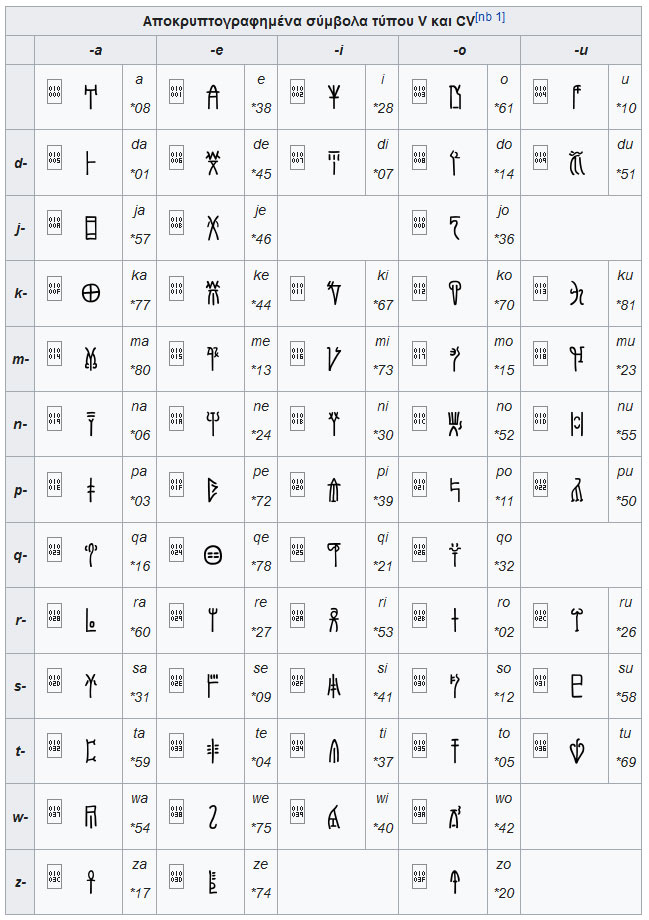
Linear B
One of the strongest clues comes from the Mycenaean world.
The Linear B tablets, written in the second millennium BCE, predate Homer by centuries. They’re administrative records, not mythology — but scattered among them are religious references, including names that carry straight through into later Greek religion. Zeus appears in Mycenaean form; so does Poseidon.
That matters. It means these gods were already part of Aegean religious life long before the poems that made them famous.
Even so, Linear B isn’t the true beginning either — just the earliest written evidence we can currently read. The underlying traditions were almost certainly older than the clay they were pressed into.
What About Linear A?
The mystery deepens in Minoan Crete.
Linear A, used before and alongside Linear B, remains undeciphered. We can’t read its religious vocabulary or name its gods with any confidence. It’s entirely plausible that some traditions later folded into Greek mythology had Aegean ancestors stretching back into Minoan Crete — but plausibility isn’t proof. We simply can’t read the script well enough to say.
This is where the history of mythology gets genuinely fascinating: the further back you go, the more evidence vanishes, and the more everything has to be pieced together from fragments.
A Common Indo-European Heritage
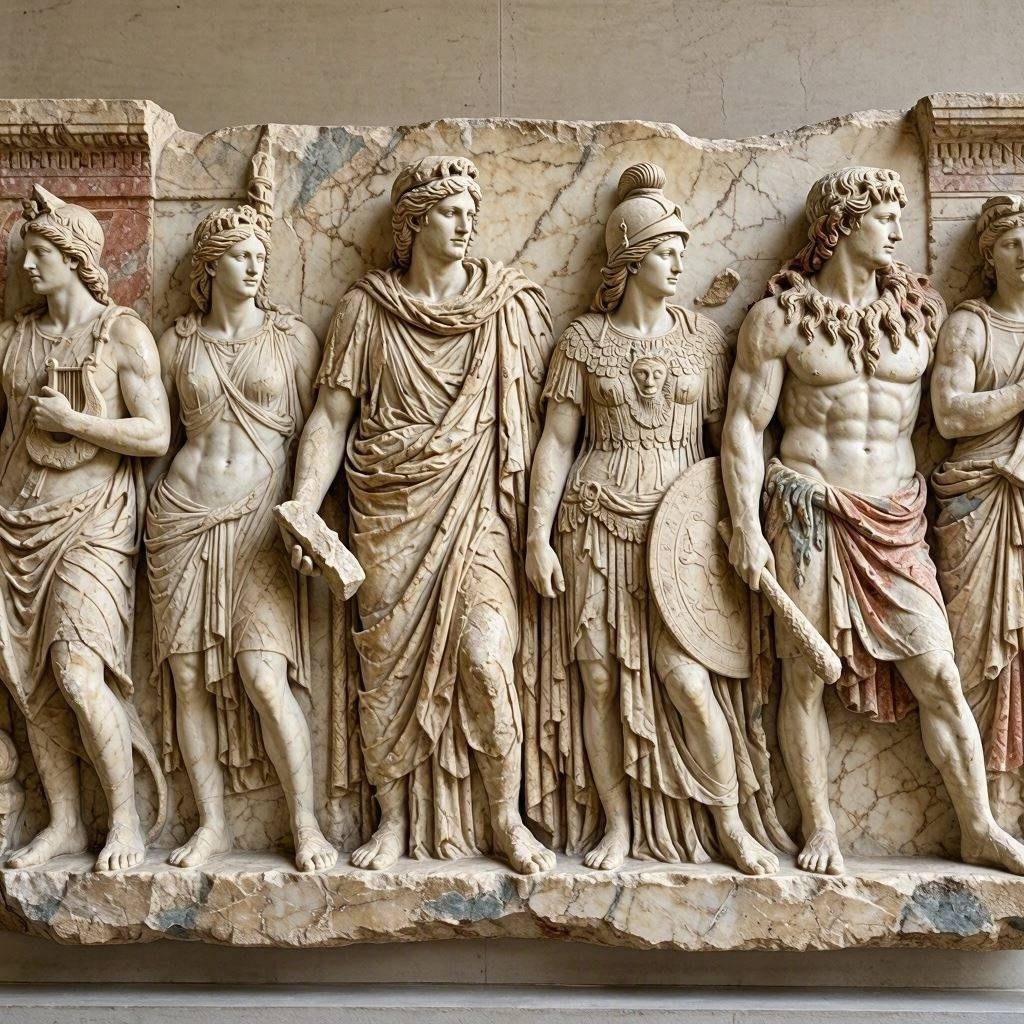
A classical scene with gods and heroes
The Greek-speaking world was never sealed off from the rest of Eurasia.
Greek belongs to the Indo-European language family, alongside Sanskrit, the Iranian languages, Latin, and the Germanic, Celtic, and Slavic branches — all descended from a much older common ancestor. That doesn’t mean Greek mythology was imported wholesale from India or Persia. It means something subtler: certain religious concepts, names, and narrative patterns may have been inherited from a shared Indo-European past, then developed independently by each people who carried them forward.
Zeus is the clearest example. Linguistically, the name connects to the reconstructed Indo-European Dyēus, echoed in Vedic Dyaus and the first element of Latin Jupiter. These aren’t copies of one another — they’re distant, separate growths from the same root.
The same logic may apply more broadly. Greeks, Indo-Iranian peoples, and various Anatolian cultures didn’t share a single mythology; they inherited fragments of something older and built very different worlds out of them.
The Greeks Were Also Part of an Older Eastern Mediterranean World
Indo-European inheritance is only half the picture.
For thousands of years, the Aegean stayed connected to Anatolia, the Levant, Egypt, and Mesopotamia through trade, war, migration, and the exchange of ideas that travel with people. So Greek mythology carries elements that Indo-European descent alone can’t explain — creation stories, divine successions, monstrous beings, floods, and battles between gods and cosmic forces all echo across the ancient Near East in different forms.
Put the pieces together, and a single-origin story stops making sense. Some material likely came from deep Indo-European roots. Some grew locally in the Aegean. Some arrived through contact with Anatolia or the Near East. And some emerged independently in multiple places at once, simply because different societies kept confronting the same questions — about gods, death, kingship, and how the world began — and arrived at strikingly similar answers.
Not a single source, then, but a layered one.
Myths Changed Because People Changed
There’s another reason chasing the “original” Greek myth can mislead you: these were never museum pieces. They were living stories.
A storyteller could reshape a detail because it landed better with a particular audience. A local tradition could merge with a rival one. A god could pick up a new role; a hero could get adopted by a new city; a monster could migrate from one tale into another.
Over centuries, the same figure could accumulate wildly different, even contradictory, stories — which is exactly why Greek mythology is full of contradictions. Different versions disagree about genealogies, locations, relationships, even the identity of characters, and that’s not a sign the ancient Greeks were careless about their own mythology.
It’s evidence that for most of its history, there simply was no single canonical version. The idea of one fixed body of “Greek myths” only emerges later, after generations of oral tradition, poetry, art, and eventually scholarship got stitched together into something that looks unified from a distance.
Then Came the Great Poets
Eventually, a vast oral inheritance found its way into poetry.
Homer and Hesiod matter because they preserve some of the earliest large-scale literary structures we have for Greek myth — but neither stood at the beginning. They stood near the end of a very long process of transformation. In the Iliad and Odyssey, Zeus, Hera, Athena, Apollo, Poseidon, and Aphrodite already arrive with established identities and relationships fully intact. Hesiod’s Theogony goes a step further, organizing the generations of gods into something like a genealogy.
What these poets did wasn’t invention — it was distillation. They took an enormous inherited tradition and gave it memorable, durable literary form. And because that poetry survived while so much of the oral material around it didn’t, their versions became disproportionately influential in shaping what later generations would think of as “Greek mythology.”
The Myths Were Not History, Not Reality
All of this also explains why it’s risky to treat Greek mythology as distorted historical record.
Some myths likely preserve real memories — of places, rulers, conflicts, or ancient customs. Troy was real. Crete was real. Mycenae was real. The Aegean world behind many of these stories genuinely existed. But that doesn’t make the stories themselves history. The Minotaur doesn’t need to have been an actual half-man, half-bull for the myth to carry echoes of Bronze Age Crete; the labyrinth might preserve the memory of a sprawling palace complex, or it might simply have become a powerful symbol in its own right, independent of any specific building. Daedalus and Icarus likely combine older narrative motifs with places and technologies that felt familiar to a Greek audience.
Why Was the Story of Daedalus and Icarus Told?
Daedalus and Icarus flying with wax wings
Here’s a useful test case: what’s the actual connection between Minos, the Labyrinth, and Daedalus — and why tell this particular story at all?
Not to preserve history. To teach a lesson: never let ambition outrun capability.
Picture it from Daedalus’s side. You’re the greatest craftsman of your age. You build Minos a secret labyrinth — and then betray him. In the world these tyrants actually ruled, betraying a king who guards state secrets ends one way: death. But the myth doesn’t kill Daedalus. Minos merely imprisons him on Crete. That gap between what a real tyrant would do and what the story lets happen is the tell — this is a constructed narrative doing deliberate work, not a plausible account of events.
The myth needs Daedalus alive because it has a second lesson to deliver. He builds wings from feathers and wax, escapes with his son, and it goes catastrophically wrong: Icarus flies past the limit he was warned about and falls to his death.
The story was never required to be plausible. It was required to be unforgettable: human ingenuity can achieve extraordinary things, but ambition that outstrips its limits ends in disaster. That’s the real trap in Greek mythology — the events can be implausible while the lesson stays true.
Myths like this preserved fragments of reality without functioning as records of it. More often, they existed to explain the world, teach lessons, probe human weakness, entertain a crowd, and hand young listeners working models of courage, arrogance, loyalty, betrayal, and consequence. The old poets were extraordinary storytellers and teachers — not historians, and they were never trying to be.
A Mythology Without a Beginning
Greek mythology never had a single starting point. It behaves less like a book with a first page and more like a river — fed by ancient streams and later ones alike, changing course, picking up new water, carrying old stories into new territory long after their original tellers were gone.
Homer didn’t create Greek mythology. Centuries did.
And that might be the most compelling thing about it: what we call Greek mythology isn’t the work of one people, one poet, or one age. It’s what’s left over from an enormous, ongoing act of human storytelling — still being read, still being reshaped, thousands of years on.
Ancient Greek has influenced the English language in ways that most people do not realize. Thousands of years after the world of Homer, the Olympian gods, and classical Athens, many Greek names, stories, and ideas continue to live in everyday English.
Some words come directly from Greek mythology, while others come from ancient history, literature, philosophy, and science. Behind many familiar expressions there is a fascinating story: a hero’s weakness, a king’s punishment, a god’s power, or an event that became a symbol for all time.
Unlike many ancient languages, Greek has remained continuously spoken for over 3,000 years. As a result, many expressions that entered English from Ancient Greek are still used in Modern Greek today, often with the same meaning.
Greeks encounter them in everyday conversation, newspapers, books, television, and education. This makes Greek a unique bridge between the ancient world and modern English.
This guide explores the origins of famous English words and expressions with roots in Ancient Greece and explains the stories behind them.
Famous Greek Mythology Expressions
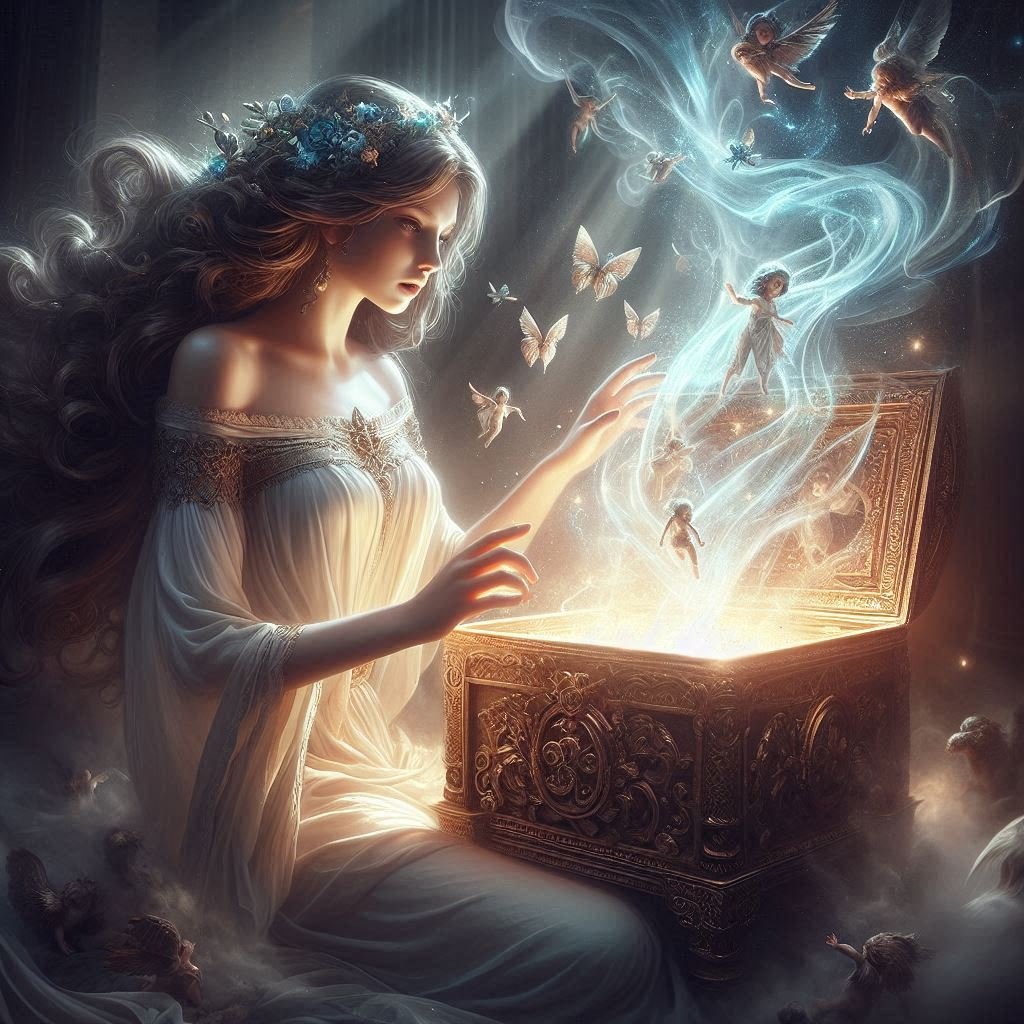
Pandora open the box
1. Pandora’s Box (Το Κουτί της Πανδώρας)
The Meaning Today: After a period of disasters, you are in a situation where hope is literally the only thing you have left to hold on to. Hope is the last to die.
The Origin Story: Zeus gifted Pandora, the first mortal woman, a sealed jar containing all the world’s miseries. Overcome by intense curiosity, she lifted the lid, letting loose disease, war, and suffering upon humanity.
She slammed the lid just in time to trap Hope (Ελπίδα) at the very bottom, ensuring mankind always has a shield against despair. As the Greek proverb says, “Hope dies last” (Η ελπίδα πεθαίνει τελευταία).
👉 Read the Full Myth of Pandora here
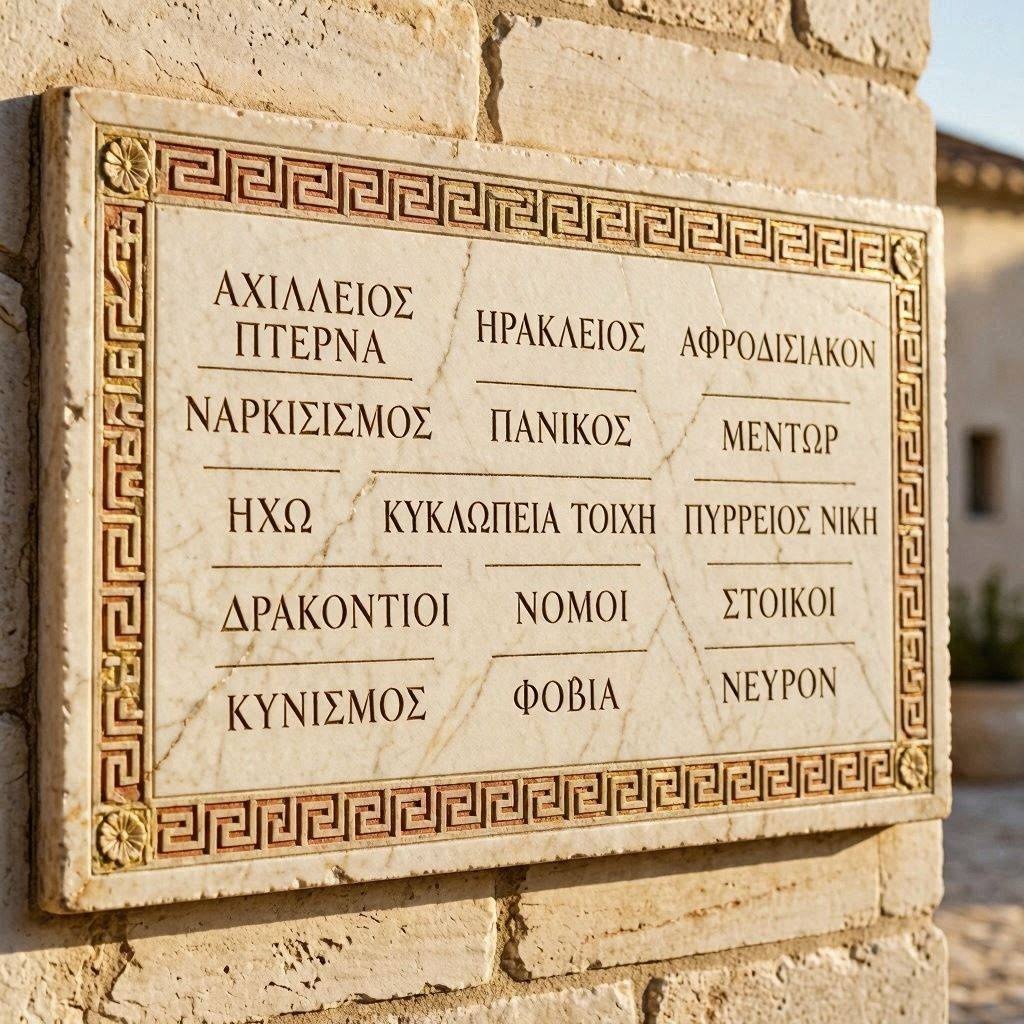
2. Achilles’ Heel (Αχίλλειος Πτέρνα)
The Meaning Today: A fatal vulnerability, blind spot, or weakness in an otherwise completely strong character, business, or system.
The Origin Story: The sea-nymph Thetis dipped her infant son Achilles into the magical River Styx to make him completely invulnerable to harm. However, she held him tightly by his heel, leaving that one single spot dry and unprotected.
Achilles grew into Greece’s greatest warrior, but was ultimately killed during the Trojan War when a poisoned arrow struck his unprotected heel.
👉 Read the Full History of Achilles here
3. Trojan Horse (Δούρειος Ίππος)
The Meaning Today: A deceptive strategy or trick that allows an enemy inside a protected area; in technology, malicious software disguised as a safe program.
The Origin Story: Unable to breach the walls of Troy for ten years, the Greeks built a massive, hollow wooden horse, hid an elite squad of soldiers inside, and pretended to sail away in defeat.
The Trojans pulled the horse inside as a victory trophy. That night, the hidden soldiers crept out, opened the city gates, and destroyed Troy from within.
4. Sisyphean (Σισύφειο Έργο)
The Meaning Today: A task that is completely pointless, endless, and repetitive, where immense effort is entirely wiped out and reset to zero over and over.
The Origin Story: King Sisyphus was punished by the gods for his clever deceit. His eternal sentence in the underworld was to push a massive boulder up a steep hill. Every single time he neared the absolute peak, the stone would slip from his grip and roll all the way back to the bottom, forcing him to start again forever.
5. Midas Touch (Το Άγγιγμα του Μίδα)
The Meaning Today: The uncanny ability to make any business venture, investment, or project highly profitable and successful.
The Origin Story: King Midas of Phrygia was granted a wish by the god Dionysus for showing hospitality to a satyr. Midas foolishly wished that everything he touched would turn to pure gold. While thrilled at first, he quickly realized his mistake when his food, drinks, and eventually his own beloved daughter transformed into solid, lifeless metal. He was freed from the curse only by washing in the waters of the Pactolus River.
6. Herculean (Ηράκλειος Άθλος)
The Meaning Today: A task requiring immense physical strength, extraordinary effort, or seemingly impossible determination to complete.
The Origin Story: Driven to temporary madness by the goddess Hera, the hero Heracles (Hercules) committed terrible crimes. To redeem himself, he was sentenced to serve King Eurystheus, who commanded him to complete twelve legendary, impossible tasks. These included slaying the Nemean Lion, capturing Cerberus from the underworld, and cleaning the massive Augean stables in a single day.
The Meaning Today: Doing something under the direct protection, sponsorship, guidance, or shield of a powerful individual or organization.
The Origin Story: In classical myths, the Aegis was a divine protective garment or shield carried by Zeus and later lent to his daughter, Athena. Forged by Hephaestus, it was covered in indestructible goat skin and often bore the terrifying severed head of the Gorgon Medusa, freezing enemies in their tracks and completely sheltering those under its cover.
8. Lethargy (Λήθαργος)
The Meaning Today: A state of extreme sluggishness, lack of energy, deep tiredness, or total indifference.
The Origin Story: Derived from the mystical river Lethe (Λήθη), one of the five rivers of the ancient Greek underworld. Dead souls arriving in Hades were required to drink from its waters to completely erase all memories of their mortal lives. The act of drinking brought on a state of total forgetfulness, numbness, and heavy sleep.
9. Tantalize (Τανταλίζω)
Literal Meaning: Cursed like King Tantalus was.
The Meaning Today: Tormenting someone by showing them something they want, but keeping it out of reach.
The Origin Story: King Tantalus was punished by Zeus to stand in a pool of water beneath fruit trees. Whenever he reached for the fruit, the wind blew the branches away. Whenever he bent down to drink, the water drained into the earth.
10. Narcissism (Ναρκισσισμός)
Literal Meaning: The fixation on Narcissus.
The Meaning Today: Excessive self-admiration, egotism, and a total obsession with one’s own physical appearance.
The Origin Story: Narcissus was a hunter renowned for his breathtaking beauty. He rejected all who loved him until he saw his own reflection in a pool of water. He fell so deeply in love with his image that he refused to leave, eventually wasting away and dying on the spot.
11. Panic (Πανικός)
Literal Meaning: Terror brought by the god Pan.
The Meaning Today: A sudden, overwhelming, and irrational fear that causes a crowd or individual to lose control.
The Origin Story: The goat-legged god Pan lived in the quiet woodlands of Arcadia. He hated being woken up from his afternoon naps. If a traveler accidentally disturbed him, Pan would let out a terrifying, unearthly scream that caused sudden, blind fear in everyone who heard it.
12. Nemesis (Νέμεσις)
Literal Meaning: Divine retribution or distribution of what is due.
The Meaning Today: An inescapable rival, enemy, or force that causes your ultimate downfall.
The Origin Story: Nemesis was the winged goddess of divine justice and retribution. Her job was to punish human arrogance (hubris) and balance out fortunes. If a mortal became too successful or boastful, Nemesis stepped in to humiliate them and destroy their pride.
13. Mentor (Μέντωρ)
Literal Meaning: A wise counselor, teacher, or thinker.
The Meaning Today: A trusted guide, teacher, or experienced advisor who helps a younger or less experienced person.
The Origin Story: Before King Odysseus left for the ten-year Trojan War, he placed his young son Telemachus under the care of his trusted old friend, Mentor. Later, the goddess Athena disguised herself as Mentor to give Telemachus wise, life-saving advice during his travels.
14. Labyrinth (Λαβύρινθος)
Literal Meaning: The House of the Double Axe.
The Meaning Today: A highly complicated, intricate network of passages or paths in which it is difficult to find one’s way.
The Origin Story: King Minos of Crete ordered the master inventor Daedalus to construct a massive, confusing maze. The structure was built to permanently confine the Minotaur, a terrifying monster that was half-man and half-bull, preventing it from ever escaping to the outside world.
The Meaning Today: A highly potent, primary narcotic drug used medically to relieve severe, unbearable physical pain.
The Origin Story: Named directly after Morpheus (Μορφέας), the ancient Greek god of sleep and dreams. As the leader of the Oneiroi, Morpheus possessed the unique ability to take human form and enter the dreams of kings and heroes to deliver divine messages. German pharmacist Friedrich Sertürner named the isolated opium alkaloid “morphine” in 1804 because of its profound power to induce deep, dream-filled sleep.
2. Hypnosis (Ύπνωση)
The Meaning Today: A trance-like state of altered consciousness, heightened focus, and deep relaxation where a person becomes highly suggestible.
The Origin Story: Derived from Hypnos (Ύπνος), the primordial personification of Sleep itself. He lived in a dark cave in the underworld alongside his twin brother, Thanatos (Death). Hypnos was viewed as a gentle deity who hovered over the earth, pouring soothing sleep from a horn or fanning his wings to bring peace to exhausted mortals and gods alike.
3. Aphrodisiac (Αφροδισιακό)
The Meaning Today: Any food, drink, or substance that is believed to increase sexual desire or arousal.
The Origin Story: Derived directly from Aphrodite (Αφροδίτη), the ancient Greek goddess of love, beauty, and fertility. Born from the sea foam off the coast of Cyprus, her presence was said to instantly induce passion in both mortals and beasts, making anything associated with her a symbol of romantic attraction.
4. Erotic (Ερωτικός)
The Meaning Today: Relating to, tending to arouse, or focused on romantic love or physical desire.
The Origin Story: Named after Eros (Έρως), the primordial god of physical love and desire. Often depicted as a winged boy carrying a bow and arrows, anyone struck by his golden arrows would immediately fall helplessly in love with the next person they saw, while his lead arrows caused total aversion.
5. Atlas (Άτλας)
The Meaning Today: A bound volume of maps; or structurally, a primary support beam or the top vertebra of the human neck holding up the skull.
The Origin Story: Named after the Titan Atlas (Άτλας), who fought against Zeus in the great war of the gods. After the Titans lost, Zeus punished Atlas by condemning him to stand at the edge of the western earth, physically holding up the weight of the celestial heavens on his shoulders for eternity. In the 1500s, mapmakers began placing drawings of Atlas carrying the world on book covers, making the word synonymous with map collections.
6. Typhoon (Τυφώνας)
The Meaning Today: A massive, violent tropical storm or hurricane that develops with destructive, rotating winds.
The Origin Story: Named after Typhon (Τυφών), the deadliest, most monstrous creature in all of Greek mythology. Described as a giant with a hundred snake heads, fire flashing from his eyes, and a voice of roaring beasts, Typhon challenged Zeus for control of the cosmos. Zeus ultimately trapped him beneath Mount Etna, and the ancient Greeks believed that volcanic eruptions and violent hurricanes were the monster’s angry breath breaking through the earth.
The Meaning Today: A sound that repeats as it reflects off a surface; or the repetition of someone else’s words or ideas.
The Origin Story: Echo was a mountain nymph who used her endless chattering to distract the goddess Hera, allowing other nymphs to escape unnoticed. When Hera discovered the trick, she cursed Echo to lose her voice, leaving her only able to repeat the very last words spoken to her. Heartbroken and unable to tell the beautiful Narcissus she loved him, she wasted away in caves until only her repeating voice remained.
🐲 Greek Creatures and Monsters
1. Cyclopean (Κυκλώπειος)
The Meaning Today: An architectural style utilizing massive, irregular blocks of stone fitted together without mortar; or anything giant and crude.
The Origin Story: Derived from the Cyclopes (Κύκλωπες), a mythical race of savage, one-eyed giants. Classical Greeks looking back at the ancient Mycenaean fortress walls (like those at Mycenae and Tiryns) saw stones so colossal that they believed ordinary humans could never lift them. They concluded that only the Cyclopes could have built them.
2. Chimera (Χίμαιρα)
The Meaning Today: A wild illusion, an impossible or foolish fantasy, or a fabrication of the mind that can never actually happen.
The Origin Story: In mythology, the Chimera (Χίμαιρα) was a fire-breathing monster from Lycia composed of the body parts of multiple animals: the head of a lion, a second head of a goat rising from its back, and a venomous snake for a tail. It was considered an unnatural, impossible creature, eventually killed by the hero Bellerophon riding the winged horse Pegasus.
3. Hydra (Ύδρα)
The Meaning Today: A persistent, complex, multi-faceted problem or evil that keeps growing and seems impossible to destroy because solving one issue creates two more.
The Origin Story: The Lernean Hydra (Λερναία Ύδρα) was a terrifying water monster with multiple serpent heads. Heracles was sent to destroy it as his second labor. The monster was incredibly dangerous because every single time Heracles sliced off one head, two brand-new heads would immediately sprout from the bloody neck stub. He finally defeated it by using fire to sear the neck wounds closed before new heads could emerge.
The Meaning Today: A device that makes a loud, piercing warning sound; or a dangerously beautiful, seductive woman who lures men into traps.
The Origin Story: The Sirens (Σειρήνες) were mythical creatures—half-woman, half-bird—who lived on rocky cliffs surrounded by shipwrecks. They sang an enchanted, heavenly song that completely hypnotized passing sailors. Any mariner who heard the song would lose his mind, steering his ship directly onto the jagged rocks to his death. Odysseus famously survived them by plugging his crew’s ears with wax and tying himself tightly to the ship’s mast.
The Meaning Today: A harsh, terrifying, or fiercely ugly woman whose very look or attitude turns people cold.
The Origin Story: The Gorgons (Γοργόνες) were three monstrous sisters, the most famous being Medusa. They had bronze claws, wings, and a head of living, writhing venomous snakes instead of hair. Their appearance was so horrific that anyone who dared to look directly at a Gorgon’s face was instantly turned into solid stone.
🏺 Ancient Greek History and Culture
1. Pyrrhic Victory (Πύρρειος Νίκη)
The Meaning Today: A victory that is won at such a devastating, ruinous cost to the winner that it feels more like a total defeat.
The Origin Story: King Pyrrhus of Epirus invaded Italy and fought the Roman army at the Battle of Asculum in 279 BC. While Pyrrhus technically won the battle and forced the Romans to retreat, his own elite officers and thousands of his best soldiers were completely wiped out. Surveying the bloody battlefield, Pyrrhus famously declared: “If we win one more such victory against the Romans, we shall be utterly ruined.”
2. Draconian (Δρακόντειος)
The Meaning Today: Laws, rules, or punishments that are excessively harsh, cruel, severe, and completely unreasonable.
The Origin Story: Named after Draco (Δράκων), the first recorded lawmaker of ancient Athens in the 7th century BC. He replaced traditional blood feuds with a written legal code. However, his laws were famously merciless; almost every single crime, from stealing a piece of fruit or being lazy up to cold-blooded murder, carried the same penalty: execution. Ancient Athenians noted that Draco’s laws seemed to be written in blood rather than ink.
3. Marathon (Μαραθώνιος)
The Meaning Today: Any long, demanding undertaking that requires endurance, perseverance, and the determination to overcome challenges.
The Origin Story: In 490 BC, a heavily outnumbered Athenian army miraculously defeated the invading Persian forces at the Battle of Marathon. According to legend, a heroic messenger named Pheidippides was ordered to run all the way from the battlefield of Marathon straight to Athens (42km) without stopping to deliver the news. He sprinted the entire distance, burst into the city assembly shouting “Nenikamen!” (We have won!), and immediately collapsed and died from sheer exhaustion.
4. Gordian Knot (Γόρδιος Δεσμός)
The Meaning Today: An incredibly complex, tangled, and seemingly impossible problem that can only be solved by taking a bold, drastic, and unconventional shortcut.
The Origin Story: King Gordias of Phrygia tied his royal chariot to a post using an incredibly intricate knot made of cornel-bark rope, with its ends hidden inside. An oracle prophesied that whoever could untie this impossible knot would become the master of all Asia. Hundreds of wise men tried and failed for centuries. In 333 BC, Alexander the Great arrived. After studying the knot and finding no ends, he drew his sword and cleanly slashed the knot in half with a single stroke, fulfilling the prophecy through pure action.
The Meaning Today: A long and eventful journey marked by unexpected adventures, hardships, obstacles, and changing fortunes.
The Origin Story: Named after Homer’s epic poem, the Odyssey (Οδύσσεια), which charts the grueling journey of King Odysseus of Ithaca trying to return home after the fall of Troy. Cursed by the sea god Poseidon, Odysseus spends ten long years wandering the Mediterranean Sea, fighting monsters, losing his entire crew, and facing constant setbacks before finally reclaiming his throne.
The Meaning Today: A place or institution of secondary or higher learning, research, or honor.
The Origin Story: Derived from the Akademia (Ακαδημία), a sacred grove of olive trees located just outside the walls of ancient Athens. The land originally belonged to a legendary hero named Akademos. Around 387 BC, the philosopher Plato bought land in this grove and established his famous school of philosophy. Because students gathered in this specific park to learn, the word became the universal standard name for higher education.
🏺 Greek Philosophy and Ideas in English
1. Stoic (Στωικός)
The Meaning Today: A person who can endure severe pain, hardship, or emotional distress without showing their feelings or complaining.
The Origin Story: Founded in Athens by Zeno of Citium around 300 BC, this school of philosophy taught that true happiness comes from mastering your own mind and accepting reality. Because Zeno did not own a building, he gathered his students to debate beneath the public Stoa Poikile (Ποικίλη Στοά)—a famous painted porch in the open Athenian marketplace.
2. Cynic (Κυνικός)
The Meaning Today: A person who believes that humanity is purely motivated by selfishness, greed, and dishonesty, rejecting noble motives.
The Origin Story: Derived from the philosophical school of the Cynics (Κυνικοί), famously led by Diogenes of Sinope. The name comes from Kyon (κύων), the Greek word for “dog.” Diogenes rejected all society, luxury, and manners, choosing to live inside a discarded clay barrel on the street like a stray dog to prove that true freedom requires absolute simplicity.
3. Cosmos (Κόσμος)
The Meaning Today: The entire universe viewed as a complex, orderly, and beautifully harmonious system.
The Origin Story: In ancient Greek, Kosmos (Κόσμος) originally meant “order,” “arrangement,” or “good behavior.” The philosopher Pythagoras was the very first to apply this word to the night sky, arguing that the stars and planets didn’t move at random, but operated in a perfectly balanced, beautiful geometric system.
4. Chaos (Χάος)
Literal Meaning: A state of complete disorder, confusion, or apparent lack of order.
The Meaning Today: Absolute confusion, wild disorder, or a total state of a mess.
The Origin Story: Derived from the ancient Greek verb chasko (χάσκω), meaning “to open wide.” In Hesiod’s Theogony, Chaos was the very first thing to exist—an infinite, dark, formless void from which the rest of the universe was born. It did not mean a chaotic mess; it meant the empty space before creation existed.
5. Philosophy (Φιλοσοφία)
Literal Meaning: The love of wisdom.
The Meaning Today: The fundamental study of the nature of knowledge, reality, existence, and human ethics.
The Origin Story: A direct compound of Philos (φίλος), meaning “friend,” and Sophia (σοφία), meaning “wisdom.” The mathematician Pythagoras was historically the first to use the term, humbly stating that he was not a “wise man” (sophist), but merely a lifelong lover and pursuer of wisdom.
6. Democracy (Δημοκρατία)
Literal Meaning: The power or rule of the citizens.
The Meaning Today: A system of government where the political power rests with the population, typically exercised through elected representatives.
The Origin Story: Developed in classical Athens, this word combines Demos (δήμος), meaning “the people/citizens,” and Kratos (κράτος), meaning “power” or “rule.” It marked a historic, revolutionary shift away from tyrants, allowing regular citizens to vote directly on state laws and policies for the first time.
🧬 Scientific and Medical Words with Greek Roots
Medicine
1. Phobia (Φοβία)
The Meaning Today: An extreme, irrational, and paralyzing fear of a specific object, animal, or situation.
The Origin Story: Derived directly from Phobos (Φόβος), the mythological god of fear and panic. He was the son of Ares (the god of war) and accompanied his father into battle to strip enemies of their courage and cause armies to break ranks in blind terror.
2. Anatomy (Ανατομία)
The Meaning Today: The scientific branch of biology dealing with the structural physical makeup of humans, animals, and plants.
The Origin Story: A direct translation of the Greek compound Anatomia (Ανατομία). It combines Ana (ανά), meaning “up” or “apart,” and Temnein (τέμνω), meaning “to cut.” The word literally translates to “cutting apart”—referencing the physical process of early medical dissections to look inside the body.
3. Hygiene (Υγιεινή)
The Meaning Today: Conditions or practices, especially cleanliness, that actively preserve health and prevent the spread of diseases.
The Origin Story: Named after Hygieia (Υγιεία), the ancient Greek goddess of health, cleanliness, and sanitation. She was the daughter of Asclepius, the god of medicine. While her father focused on curing sick people after they fell ill, Hygieia focused entirely on preventing illness through proper diet, washing, and lifestyle.
4. Cardiology (Καρδιολογία)
The Meaning Today: Anything relating to the heart or the circulatory system. Example: “Cardiology”
The Origin Story: The word combines the ancient Greek kardia (καρδία), meaning “heart,” with -logia (λογία), from logos (λόγος), meaning “word,” “discourse,” or “account.” It originally referred to discourse or knowledge concerning the heart and later became the name of the medical specialty devoted to it.
5. Neurology (Νευρολογία)
The Meaning Today: Relating to nerves, the nervous system, brain functions, or medical neurology.
The Origin Story: Derived from Neuron (νεύρον), which originally referred to a sinew, tendon, or bowstring in ancient Greek. As early physicians began dissecting bodies and discovering the thin, string-like pathways that send signals from the brain throughout the body, the word, along with “λόγος”, naturally evolved into the scientific term for nerves.
6. Gastrology (Γαστρολογία)
The Meaning Today: Relating to the stomach, digestive system, or culinary arts (like gastronomy).
The Origin Story: Comes from the ancient Greek word Gaster (γαστήρ), which meant the stomach, belly, or womb. In ancient literature, it was often used to describe hunger, appetite, or the processing of food inside the human body.
7. Psychology (Ψυχολογία)
The Meaning Today: Relating to the human mind, soul, mental processes, or psychological behaviors.
The Origin Story: Named after Psyche (Ψυχή), the ancient Greek word for the human soul, spirit, or breath of life. In mythology, Psyche was a mortal princess who had to endure grueling trials before marrying Eros (the god of love) and becoming immortalized as the goddess of the soul. Today, medicine uses the root to describe how the mind functions.
8. Osteoporosis (Οστεοπόρωση)
The Meaning Today: A medical condition where bones become fragile, brittle, and highly susceptible to fractures due to loss of tissue.
The Origin Story: A brilliant scientific combination of three Greek words: Osteon (οστούν) meaning “bone,” Poros (πόρος) meaning “a passage or pore,” and the suffix -osis (-ωσις) meaning “a medical condition.” It literally translates to “the condition of porous bones”—describing exactly what happens inside the skeleton under a microscope.
Megas Choros, also locally known as “Great Dance,” is a quiet, sandy beach in the Kritika area, near Agios Georgios South in Corfu—approximately 41 kilometers from the Town and the airport.
It forms part of the wider sandy coastal belt of western Corfu, characterised by long open beaches and a natural, undeveloped landscape.
The beach is relatively secluded, with soft sand, shallow waters, and a peaceful atmosphere. It remains largely unorganized, without tourist infrastructure, making it suitable for visitors seeking a more natural and less crowded seaside environment.
The name “Megas Choros” is subject to local interpretation. It may be understood either as deriving from χώρος (meaning “large open space”) or from χορός (meaning “dance”), reflecting linguistic variation in spoken Greek. The name is sometimes associated in local tradition with open coastal gatherings, although its exact origin is not formally documented.
Access to the beach is typically via nearby rural roads and paths from the Kritika and Agios Georgios South area.
Connection with old Pirate activities
According to an oral version from the old residents, it used to be a place where pirates usually gathered to share their loot from the raids on the nearby villages of South Corfu.
This was a frequent phenomenon a few centuries ago, and residents were forced to abandon coastal villages and move to the mountains. One example is the village of Agios Mattheos, which is built in a place invisible from the sea.
Contains information related to marketing campaigns of the user. These are shared with Google AdWords / Google Ads when the Google Ads and Google Analytics accounts are linked together.
90 days
__utma
ID used to identify users and sessions
2 years after last activity
__utmt
Used to monitor number of Google Analytics server requests
10 minutes
__utmb
Used to distinguish new sessions and visits. This cookie is set when the GA.js javascript library is loaded and there is no existing __utmb cookie. The cookie is updated every time data is sent to the Google Analytics server.
30 minutes after last activity
__utmc
Used only with old Urchin versions of Google Analytics and not with GA.js. Was used to distinguish between new sessions and visits at the end of a session.
End of session (browser)
__utmz
Contains information about the traffic source or campaign that directed user to the website. The cookie is set when the GA.js javascript is loaded and updated when data is sent to the Google Anaytics server
6 months after last activity
__utmv
Contains custom information set by the web developer via the _setCustomVar method in Google Analytics. This cookie is updated every time new data is sent to the Google Analytics server.
2 years after last activity
__utmx
Used to determine whether a user is included in an A / B or Multivariate test.
18 months
_ga
ID used to identify users
2 years
_gali
Used by Google Analytics to determine which links on a page are being clicked
30 seconds
_ga_
ID used to identify users
2 years
_gid
ID used to identify users for 24 hours after last activity
24 hours
_gat
Used to monitor number of Google Analytics server requests when using Google Tag Manager