

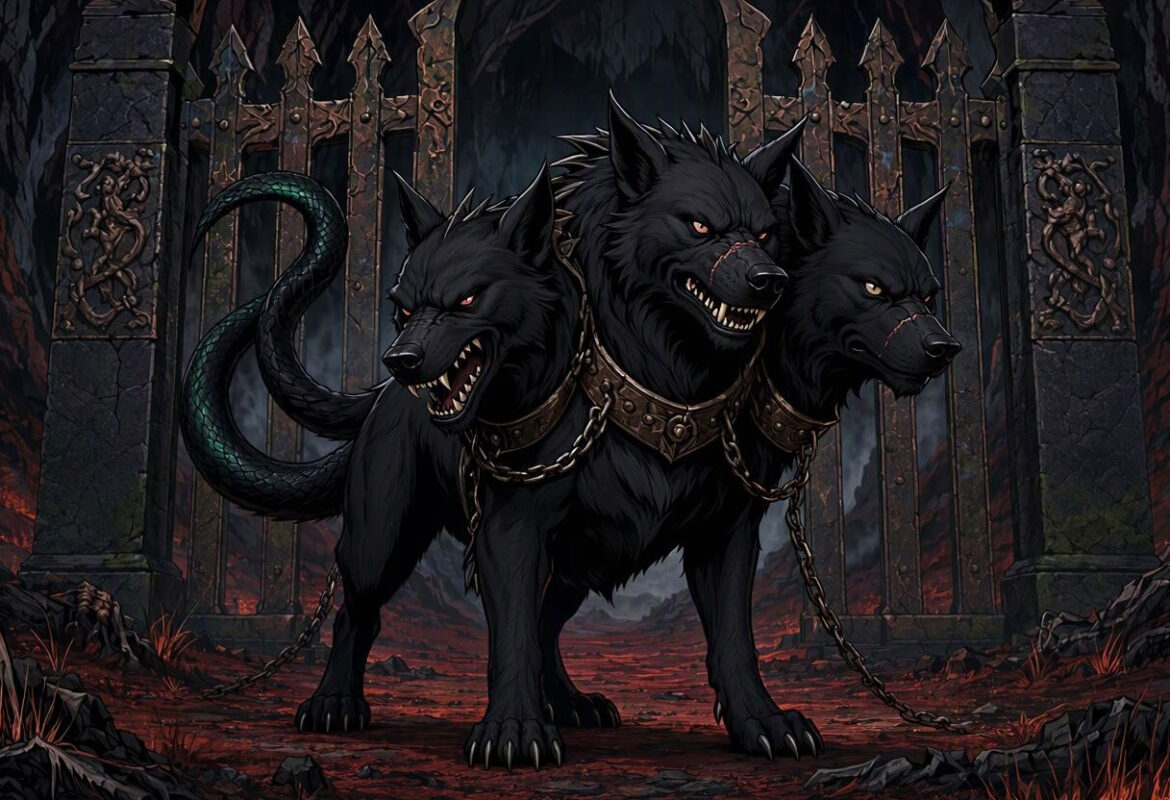


Our first journey into the earth ended at Typhon, but the caves go deeper. This time we take the other passage, the one the Greeks believed led to the kingdom of Hades, and we meet the lesser horrors who live there: the spirits that wait on battlefields, the bogey that frightened children, the avengers, the eater of the dead, the jailer of the Titans, and the hound at the gate.
If you have not made the first descent, you can start with Meet Empousa, Phantasos, and 5 Monsters of Greek Mythology. The torch is the same.
Into the Realm of the Dead
In Greek belief, the dead went down to the kingdom of Hades and Persephone, ferried across the river Acheron, whose real-world counterpart you can still visit in Epirus (see Acheron and the Journey to the Underworld). But the dead were not alone down there. Greek writers also put into the underworld demons, hounds, avengers, and spirits that appear in no single story, and we have to look for them in pieces: a poem here, a description of a painting there.
A note before we go. In each chamber we say what the ancient sources tell us, and mark the source at the end. Whenever the cave adds its own atmosphere, you will know it is our imagination.
Here we go. Keep the torch low.
The Keres: Spirits of Violent Death
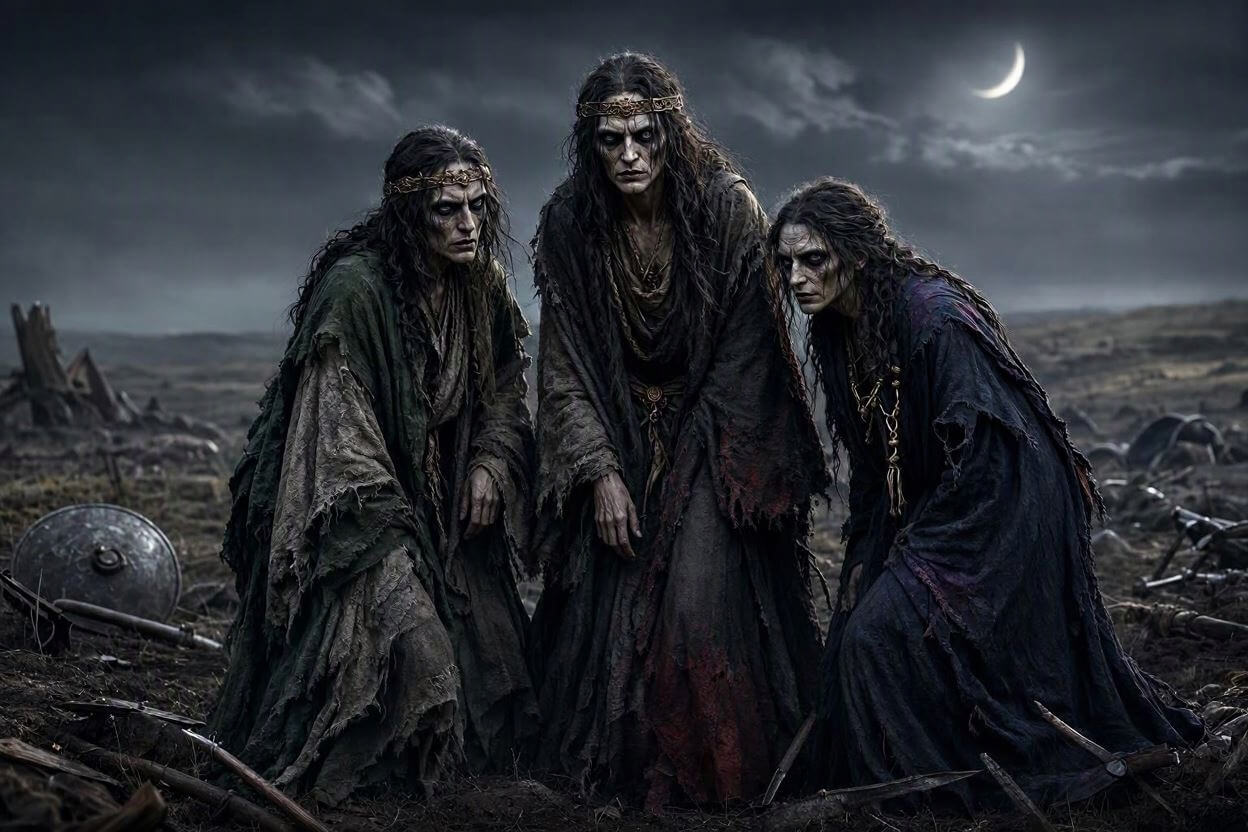
The first chamber is cold, and it smells of iron. Broken shields lie in the dust, and something dark moves just above them.
These are the Keres, the spirits of violent death. In Hesiod’s Theogony, they are daughters of Night, sisters of Doom, Death and Sleep (see The Children of Nyx in Greek Mythology). In the poem called the Shield of Heracles, the Keres hover over a battlefield with white teeth and grim faces, fighting one another to be first to seize the wounded and the dying and drink their blood. In the Iliad, the word is almost a person’s fate: before the last duel between Achilles and Hector, Zeus weighs their two Keres on golden scales to see whose death is nearer.
They do not kill; they wait. They are what a violent death looks like once it has been given a face.
Sources: Hesiod, Theogony and Shield of Heracles; Homer, Iliad.
Mormo: The Bogey Who Bites
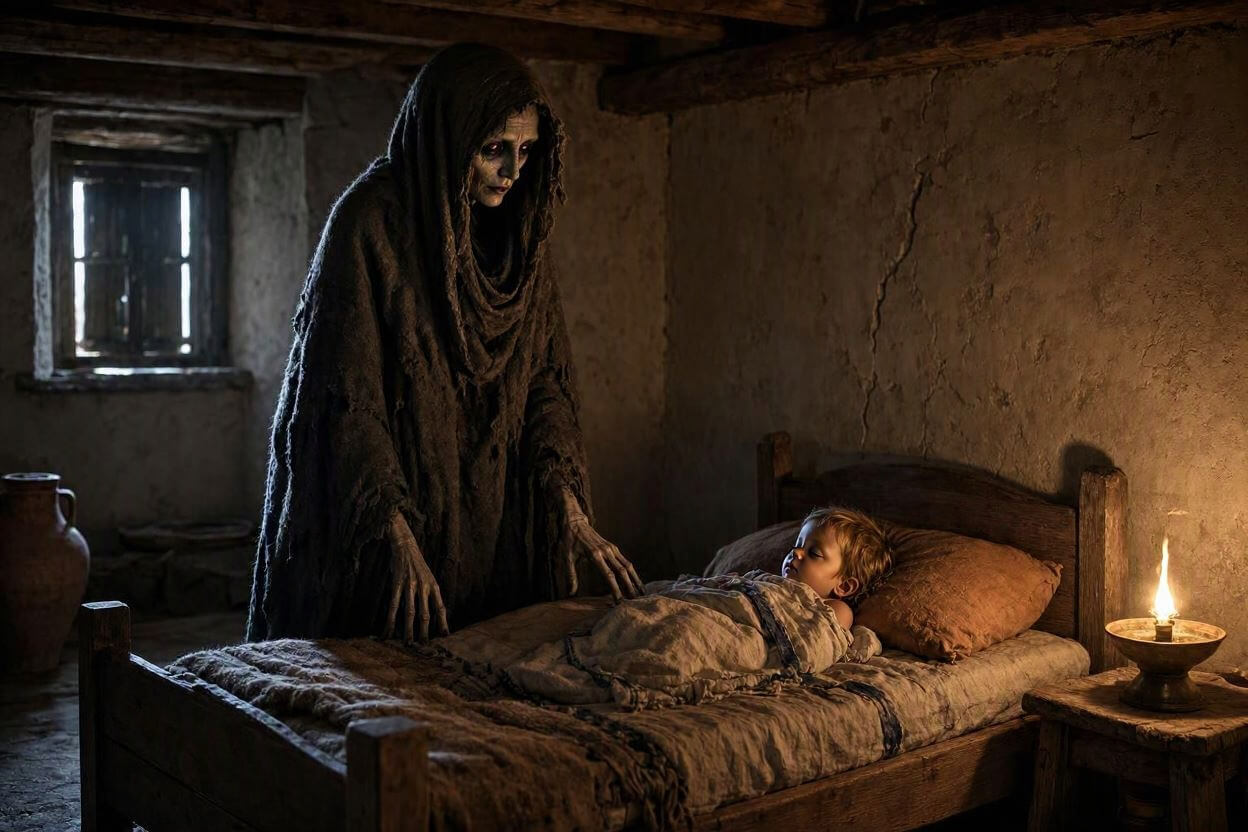
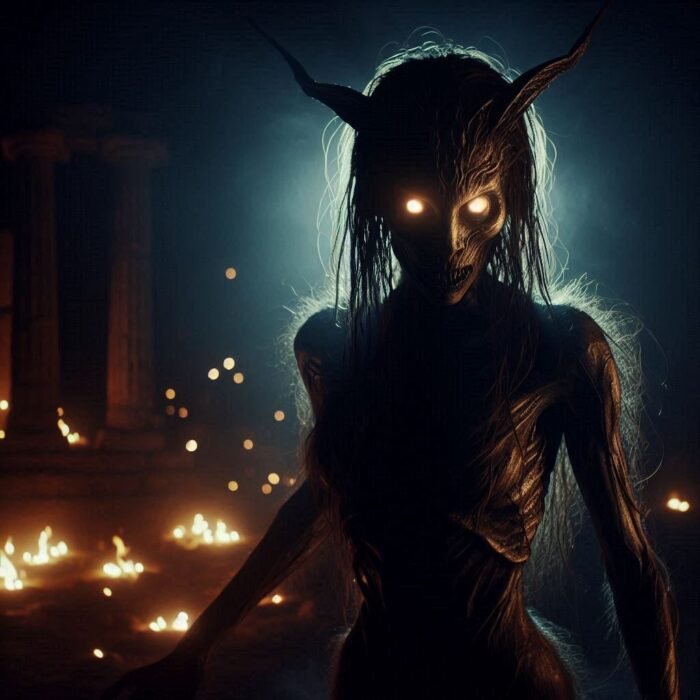
We climb down through a narrow passage that looks like the foot of a bed. In the second chamber, the shadows are small, and they have teeth.
Mormo was no hero’s enemy. She was a bogey, a female monster that Greek mothers and nurses used to frighten children into behaving. Ancient writers such as Strabo and Theocritus mention her, usually in the company of the Lamia and Empousa, the other scarecrows of the nursery. She was said to bite naughty children, and the later form of the name, Mormolyke, suggests a she-wolf.
Her stories are almost entirely lost, and that may be the point. A bogey is more frightening when nobody tells you exactly what it does.
Sources: Strabo, Geography; Theocritus, Idylls.
Poine: The Avenger of Argos
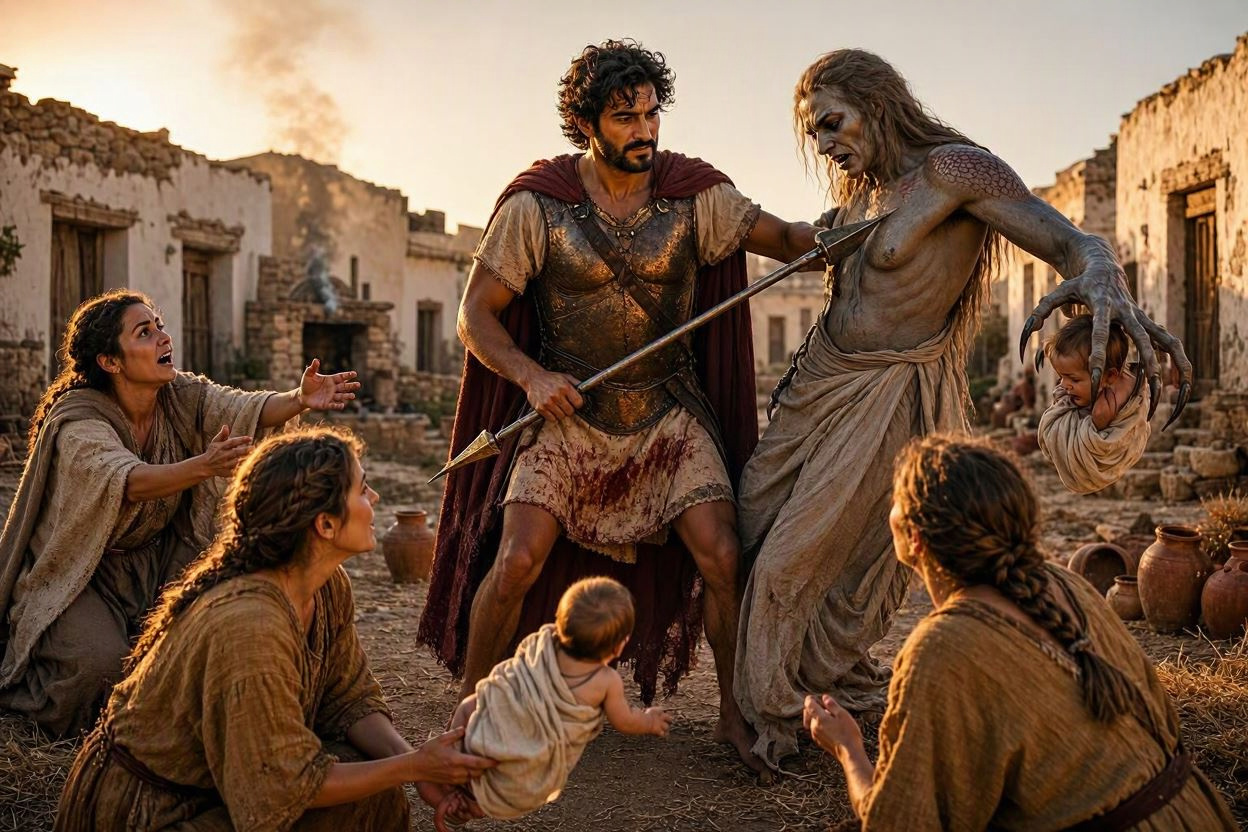
The third chamber is full of cradles, and they are all empty.
Poine, whose name means penalty or vengeance, is a monster born from a crime. In the story told by Pausanias and by the Roman poet Statius, the infant Linus, a son of Apollo, was raised by shepherds and torn apart by their dogs. His mother Psamathe died of grief, and Apollo sent Poine to the city of Argos as punishment. She snatched babies from the arms of their mothers until the hero Coroebus killed her.
But even that was not the end. Apollo sent a plague against the city for the death of his avenger, and Coroebus went to Delphi to be cleansed. The oracle told him to carry a tripod until it fell from his hands, and to build a sanctuary where it fell, which he did near Megara.
It is a very Greek story. Even the monster who punishes a crime has to be cleansed away.
Sources: Pausanias 1.43; Statius, Thebaid 1.
The Erinyes: The Furies Who Never Rest
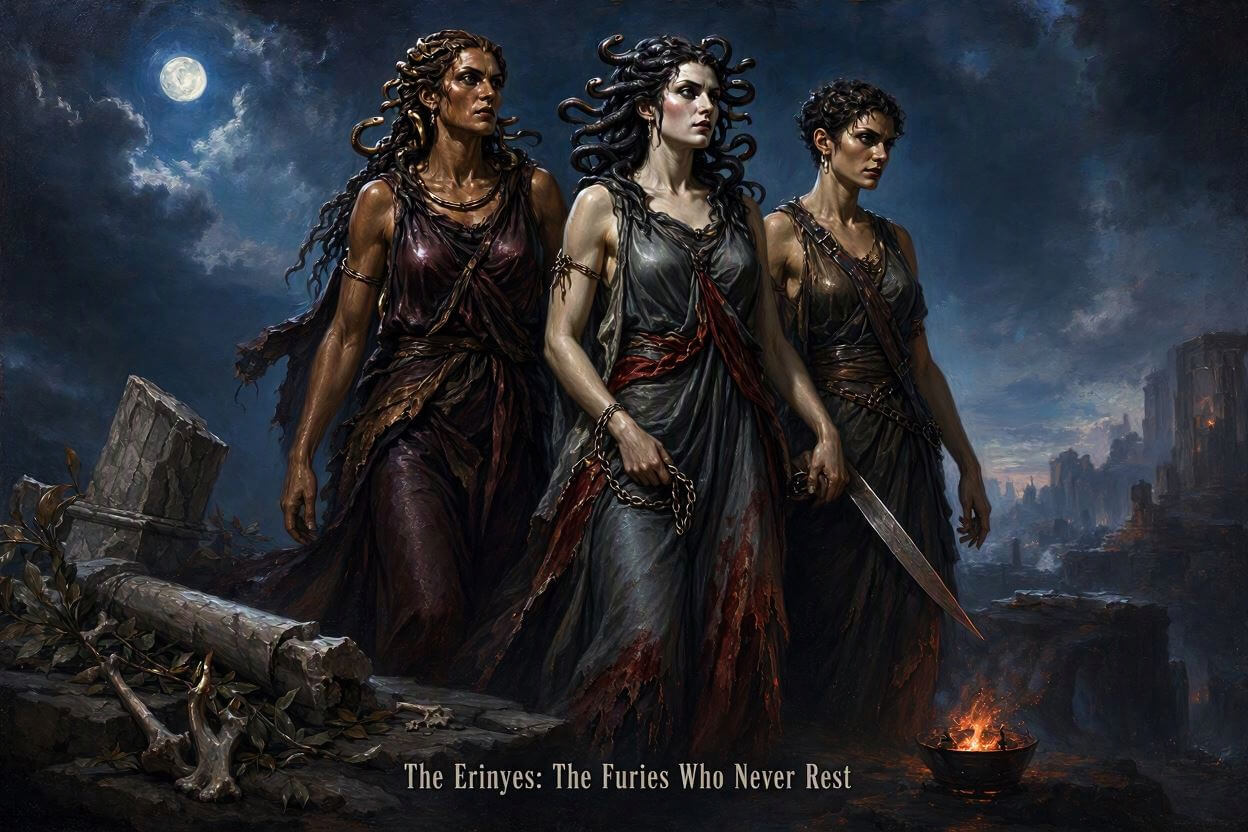
In the fourth chamber, the torch burns blue. Something is pacing behind us.
The Erinyes, the Furies, are the avengers of the Underworld. In Hesiod, they are born from the blood that fell from Uranus when Cronus mutilated him, which makes them older than the Olympian gods. Later writers name three of them: Alecto, Tisiphone, and Megaera. They pursue those guilty of the worst crimes, above all the murder of a kinsman and the breaking of an oath, and they do not tire.
The most famous chase is in Aeschylus’ tragedy Eumenides, where the Furies hound Orestes across the world for killing his mother. At the end of the play, the goddess Athena persuades them to settle at Athens as the Eumenides, the kindly ones.
One ancient philosopher, Heraclitus, even said that if the Sun overstepped its measure, the Erinyes would find it out.
Sources: Hesiod, Theogony; Aeschylus, Eumenides; Apollodorus; Heraclitus.
Eurynomos: The Eater of the Dead
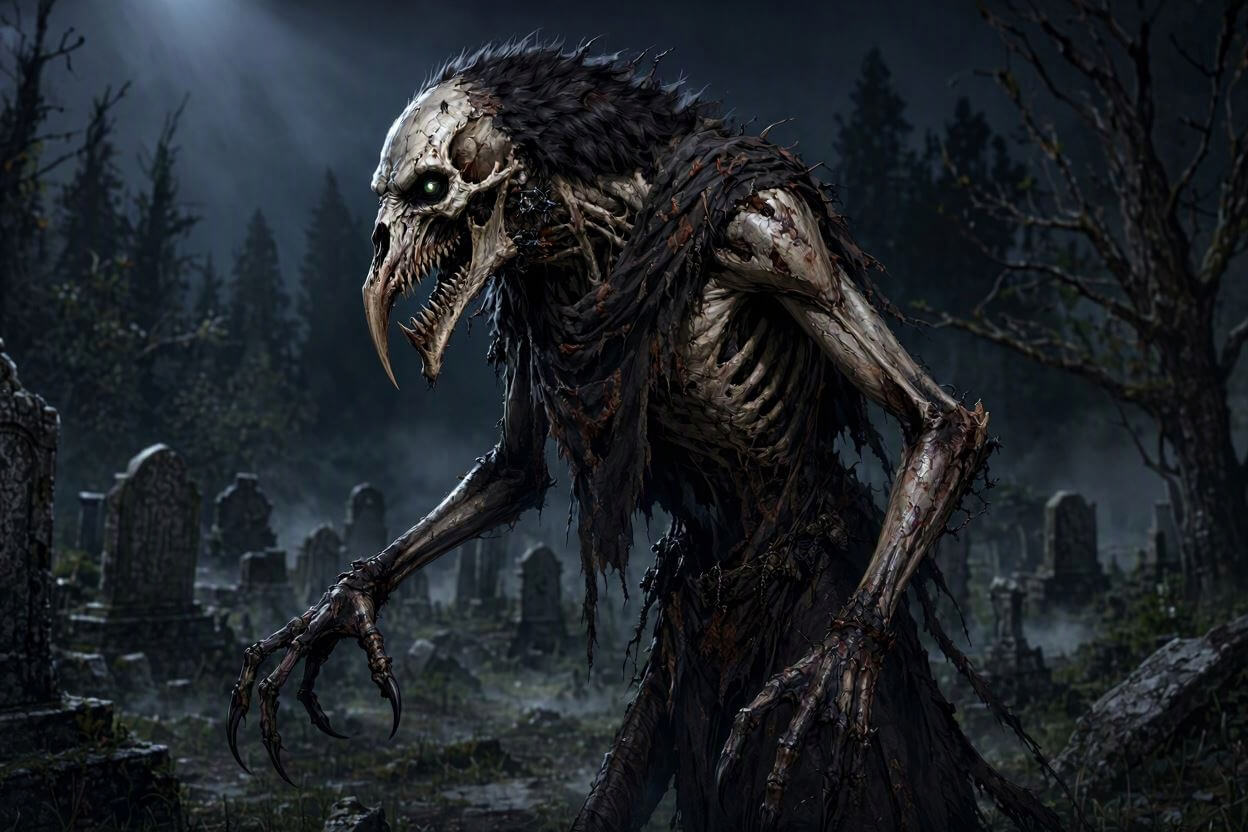
We reach the fifth chamber, and the air thickens. This is the kingdom of the dead itself, and it is not quiet.
Eurynomos is one of the strangest figures in the underworld, and we know him from a single description. Pausanias saw a great painting of the Underworld at Delphi, by the artist Polygnotos, and in it he found a figure that the local guides called Eurynomos, a demon of Hades who eats the flesh of the corpses and leaves only the bones. His skin was a color between blue and black, like the color of a meat fly. He bared his teeth, and he sat on a vulture’s skin.
Pausanias adds that the demon was not in Homer. We are looking at a figure of local lore, caught for a moment in a painting that has been lost for centuries.
Sources: Pausanias 10.28.
Campe: The Jailer of Tartarus
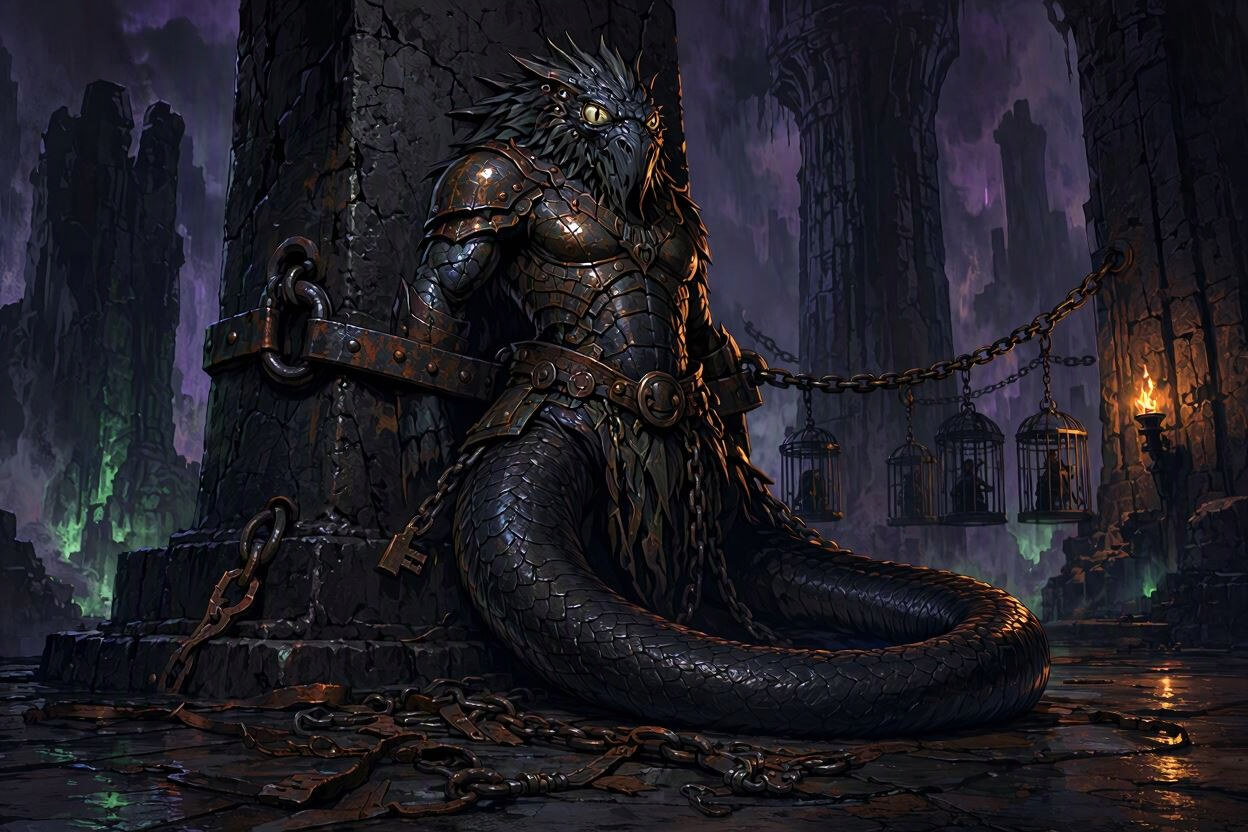
The sixth chamber is the deepest yet. The floor drops away, and we can hear the chains of Tartarus, the prison below Hades where the Titans lie.
Before they were freed, the Cyclopes and the Hecatoncheires, whom we met in the first descent, were locked down here, and someone had to guard them. In Apollodorus, that jailer is Campe, a monstrous female dragon set there by Cronus. Gaia told Zeus that he could win the war against the Titans only if he released the prisoners. So he killed Campe, set them free, and the Cyclopes forged for him his thunderbolt.
Hesiod does not name her. Her appearance comes from much later, from the poet Nonnus, who imagined her as a nightmare mixture of beasts and serpents with a scorpion’s tail.
Sources: Apollodorus 1.2.1; Nonnus, Dionysiaca 18.
Cerberus: The Hound at the Gate
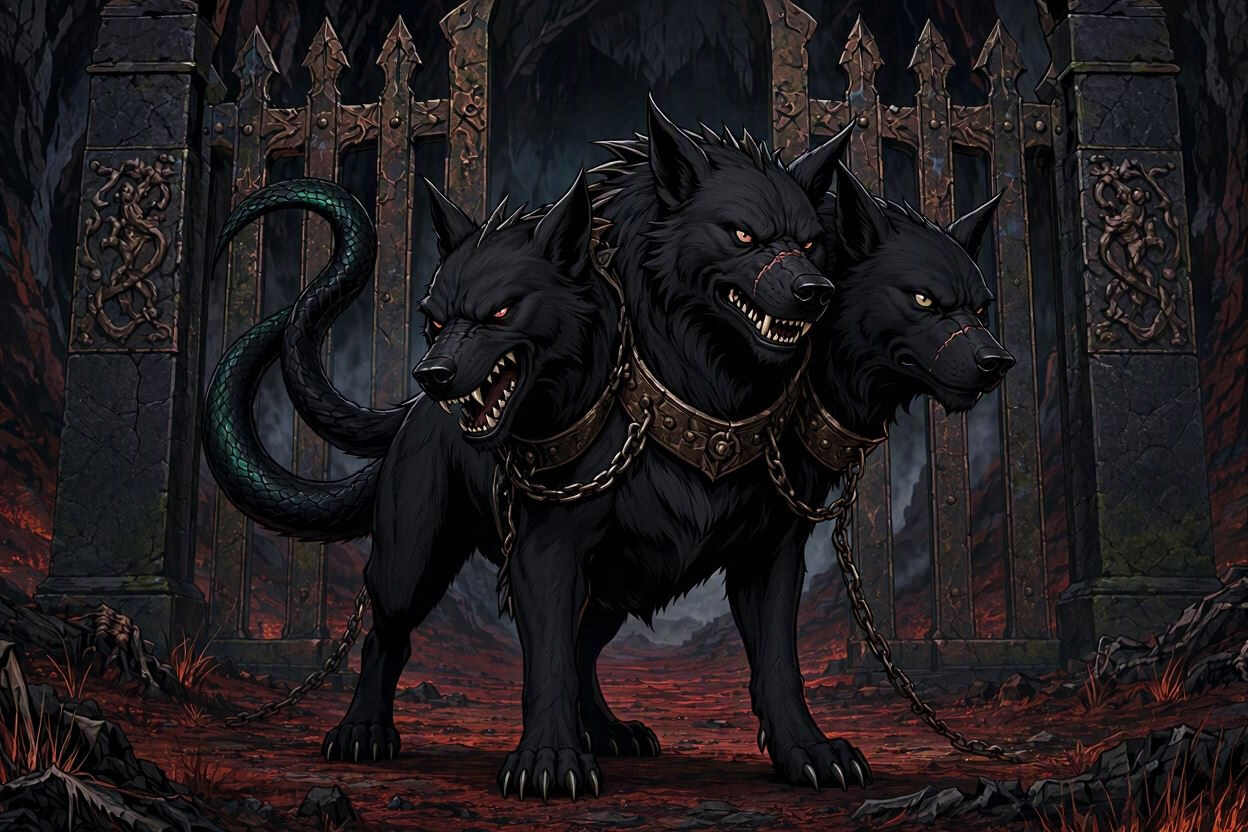
We have seen what the underworld holds. Now we must leave, and that is the hard part.
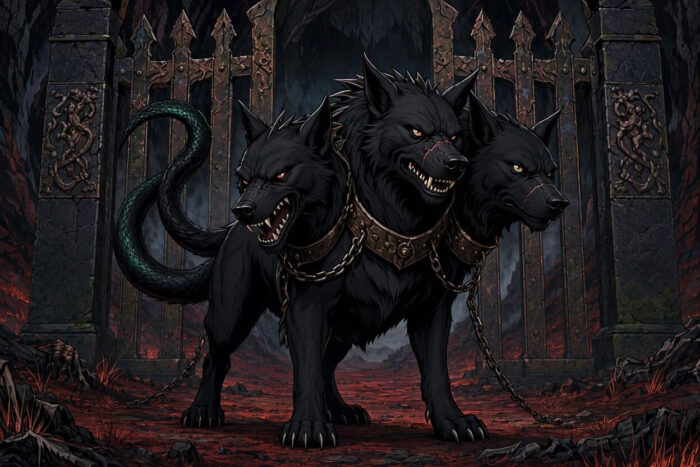
In the last chamber, Cerberus waits at the gate. He is the child of Typhon and Echidna (see Typhon and His Terrifying Offspring). Hesiod calls him the bronze-voiced hound of Hades, a shameless and powerful flesh-eater with fifty heads, and he says something chilling about his habits: Cerberus fawns on everyone who enters the house of Hades, wagging his tail and ears, but he will not let anyone go out again, and he devours anyone he catches trying to leave.
Later writers settled on three heads and a serpent’s tail. A few heroes got past him. Heracles dragged him up to the light as the twelfth of his labours, in The 12 Labours of Hercules, and the Roman poet Virgil has the Sibyl throw him a honey cake laced with drugs so that Aeneas can pass.
We have no honey cake, and no hero. So we do what the old ones advised, and we keep our eyes forward, and we do not run.
Sources: Hesiod, Theogony; Apollodorus 2.5.12; Virgil, Aeneid 6.
Back to the Light
We climb. The torch gives its last flicker, and the cave opens onto daylight. We stand blinking in the sun, with a few ghosts still clinging to our sleeves.
The Greeks believed that these demons were real, in the dark places under their feet. They did not need them to be so. They needed them to give a shape to violent death, to guilt, to fear in the nursery, and to the fate that waits for us all.
If you want to go further down, the Greek underworld is waiting in Persephone and Hades and Chthonic and Lesser Gods in Greek Mythology. Some of these places can still be visited, among them Acheron and Cape Tainaron, in Mythological Places in Greece You Can Visit Today. For the famous monsters, see the guide to the monsters of Greek mythology.
Comments