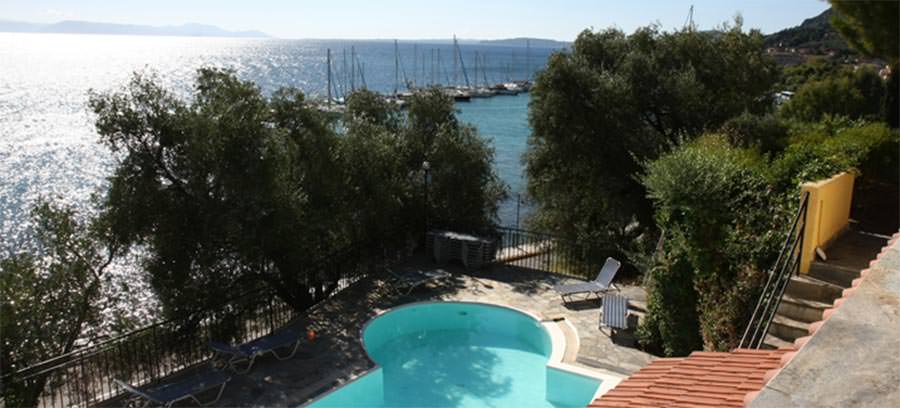
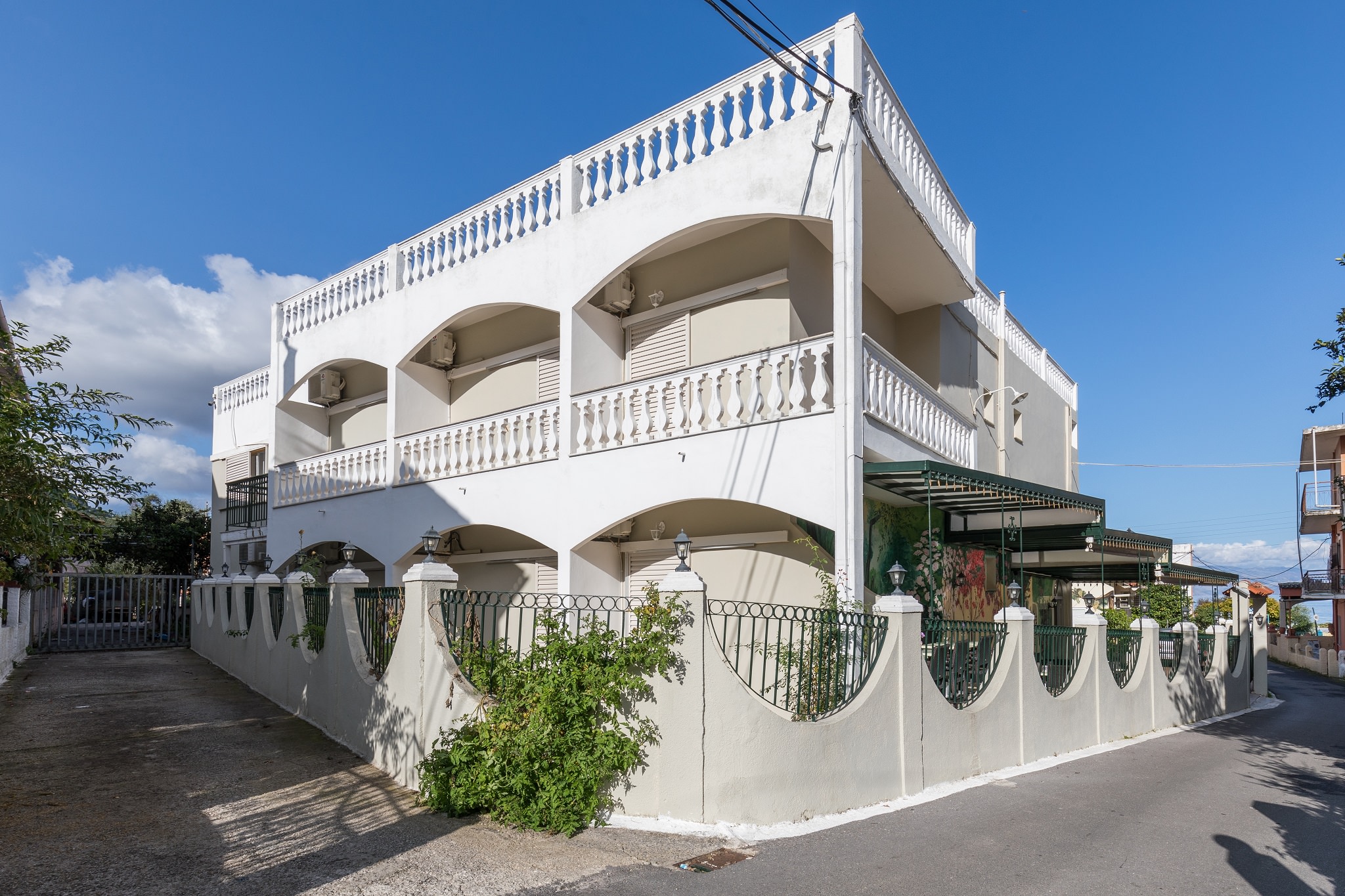
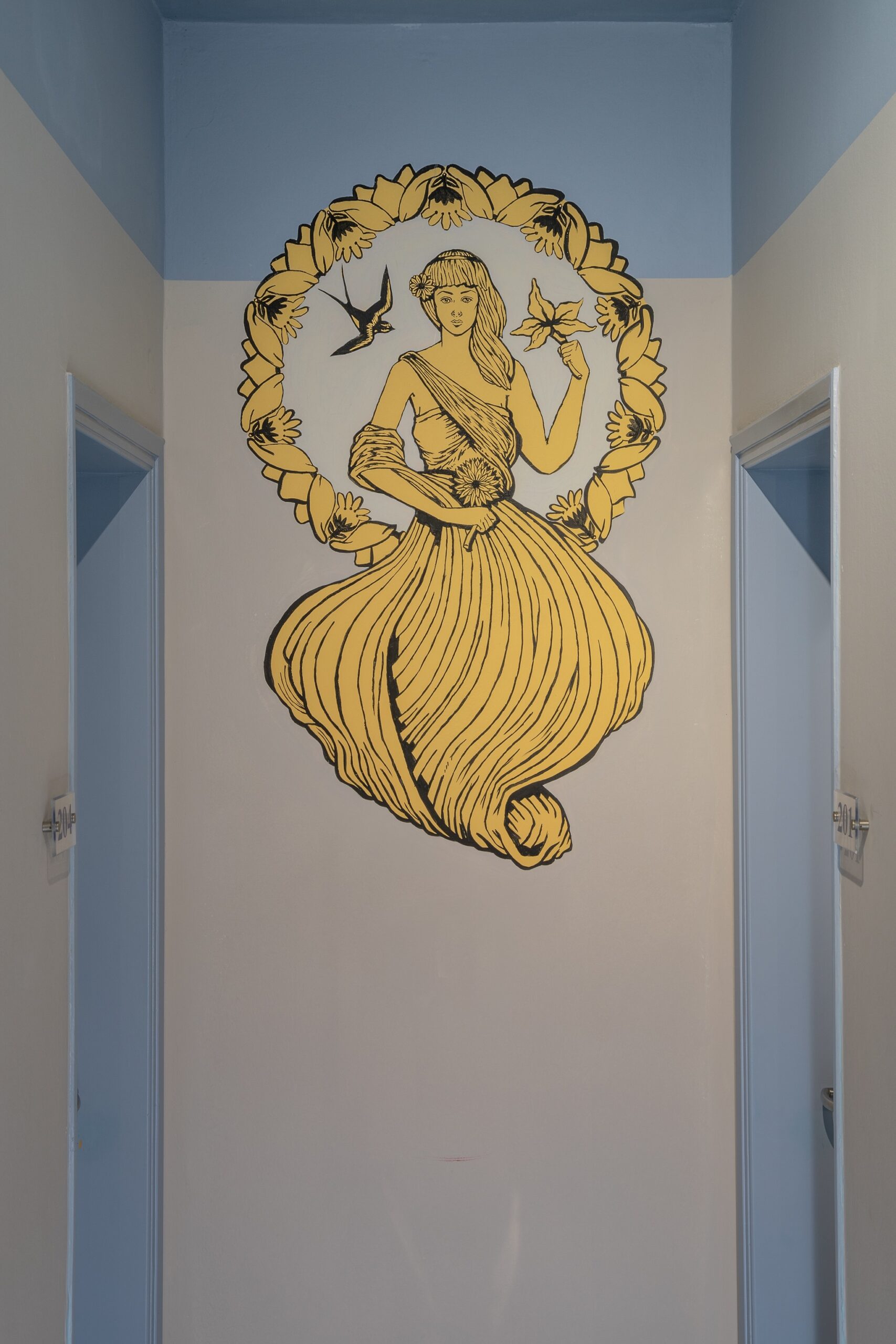
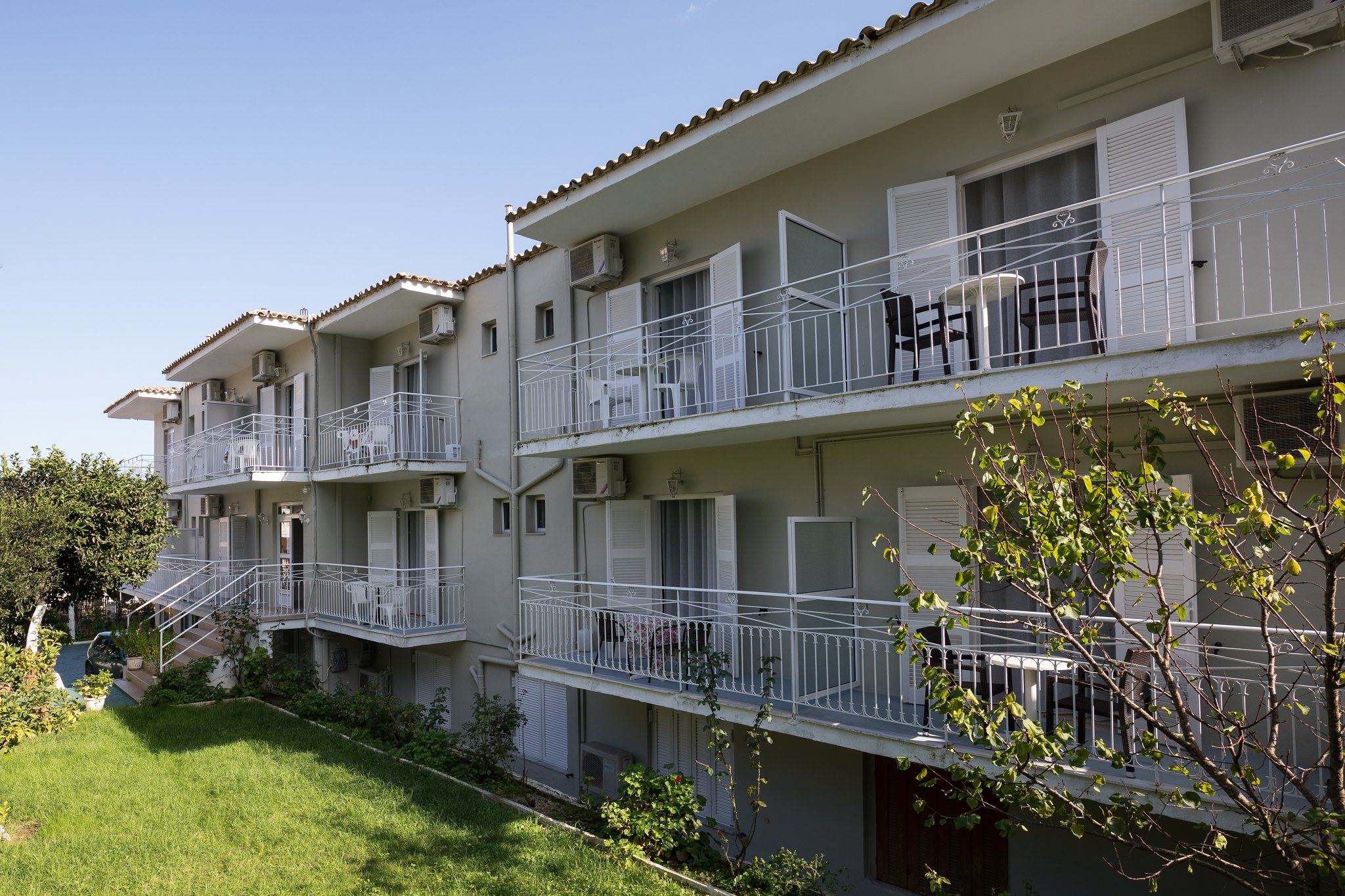
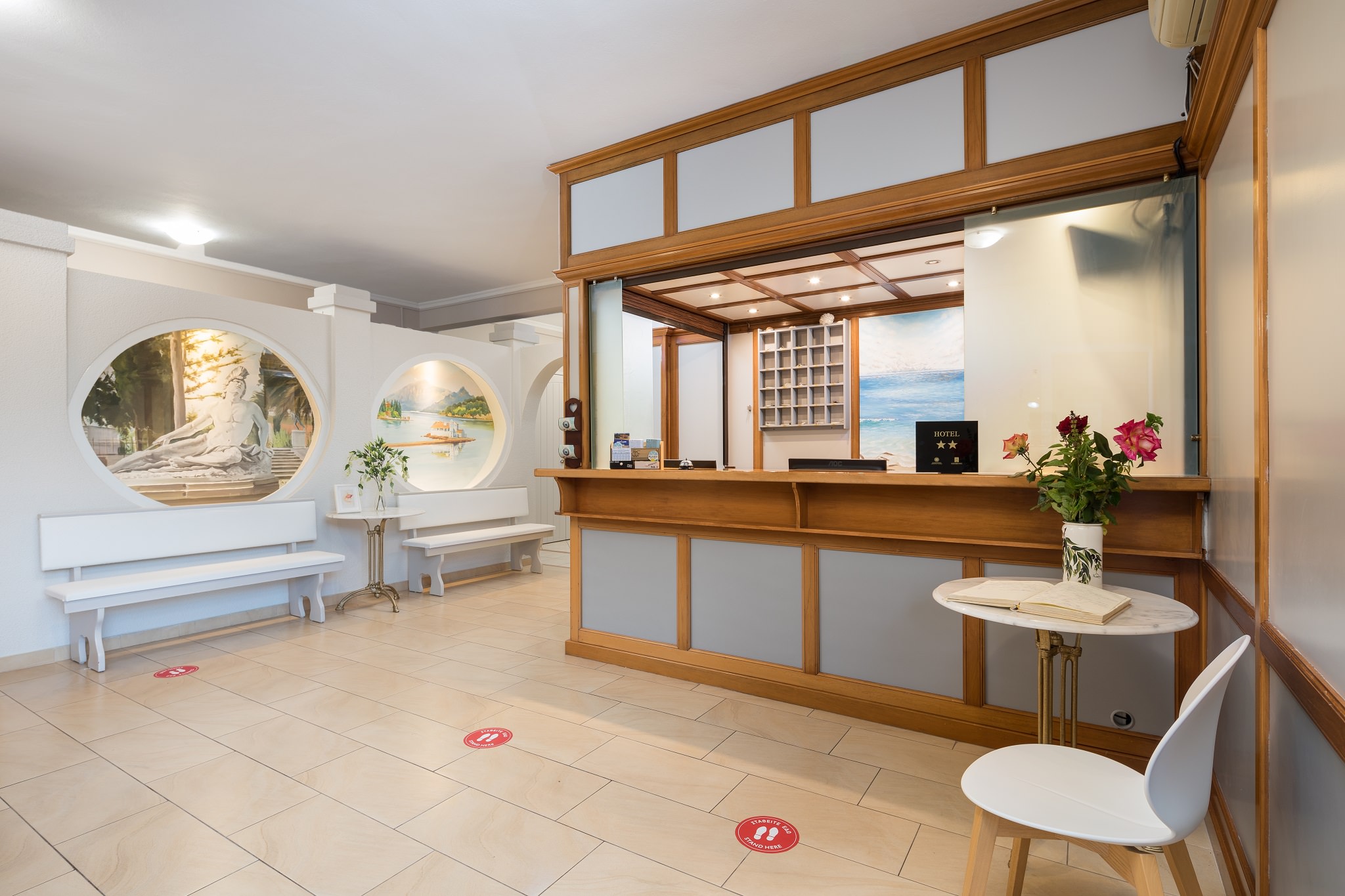
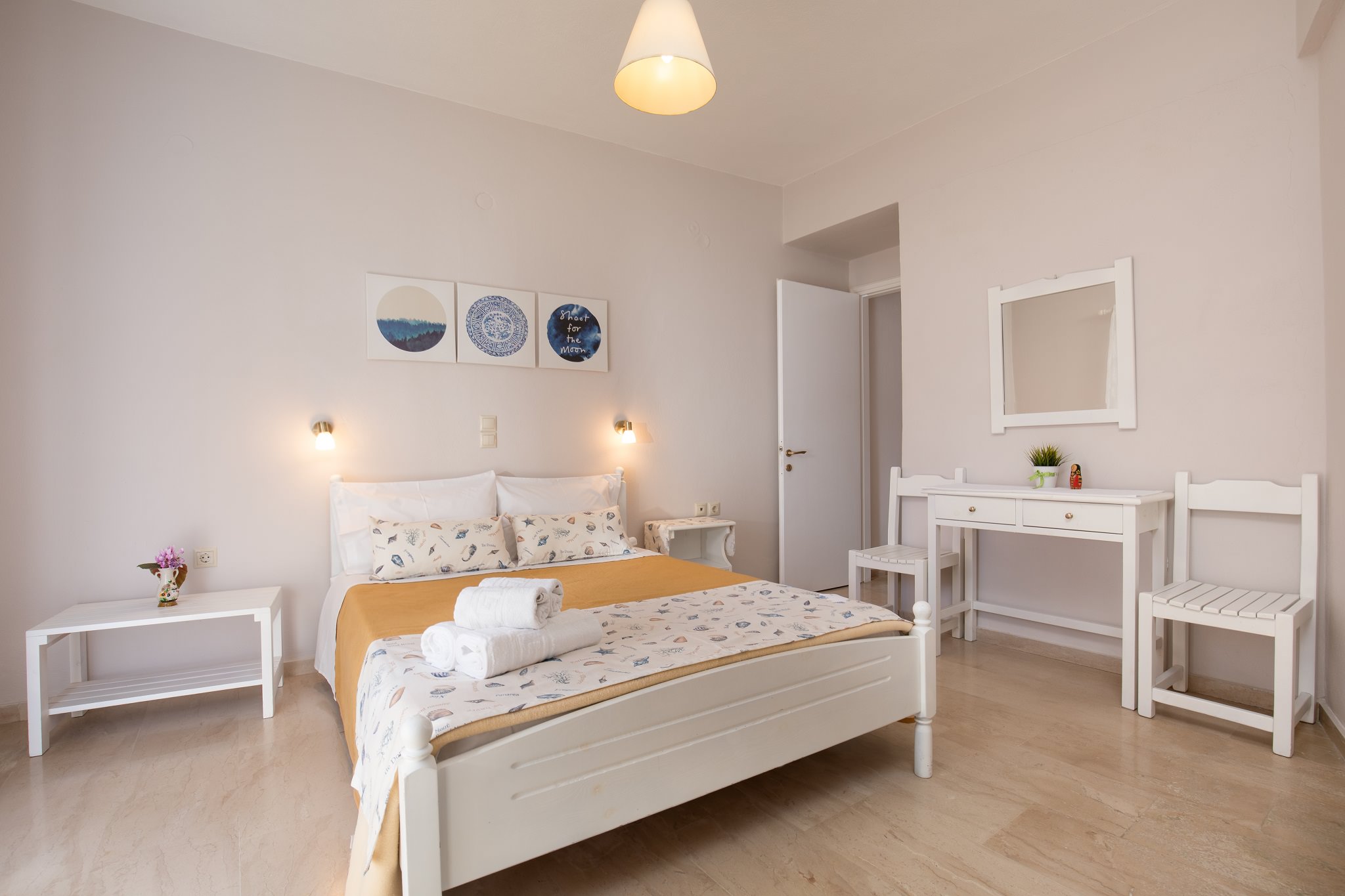
Dimitra Studios offers a relaxing stay in Benitses, ideal for couples or small families seeking comfort and stunning sea views. Guests highlight the clean rooms, daily housekeeping, and friendly staff, creating a welcoming and enjoyable atmosphere. Each studio comes with air conditioning, a balcony, and basic amenities like a coffee maker, kettle, and fridge.
The property features convenient on-site parking and a well-maintained swimming pool, perfect for cooling off after exploring the village. Dimitra Studios is just a short walk from the beach and local taverns, shops, and the harbor, making it easy to enjoy everything Benitses has to offer.
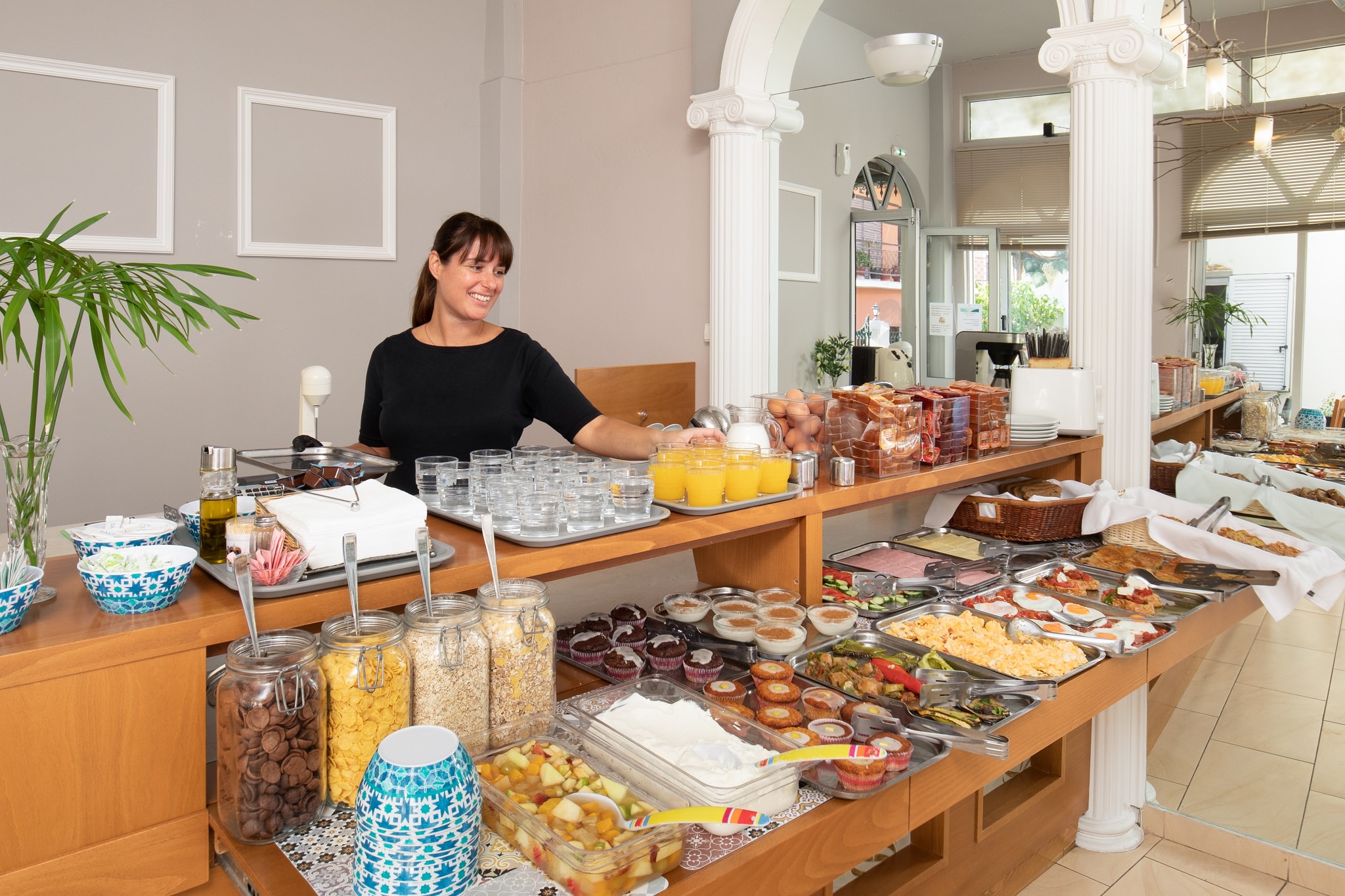
Whether you’re starting your day with breakfast on the terrace or exploring the nearby sights, Dimitra Studios combines great value and comfort with beautiful views, ensuring a memorable stay in Corfu.
For nearby accommodations, check out our hubs on Benitses Hotels and Corfu Apartments to plan your perfect Corfu getaway.
The charming Corfu Hotel Bella Vista offers air-conditioned accommodation and a hearty Greek breakfast. It is just only 30 meters from Benitses Beach and offers free Wi-Fi in public hotel areas.
Decorated in bright and cheerful colors, rooms have a balcony or patio. Rooms are cleaned daily and include a satellite TV and a fridge. Self-catering studios and apartments with kitchenettes are also available within 50 meters from the main building.
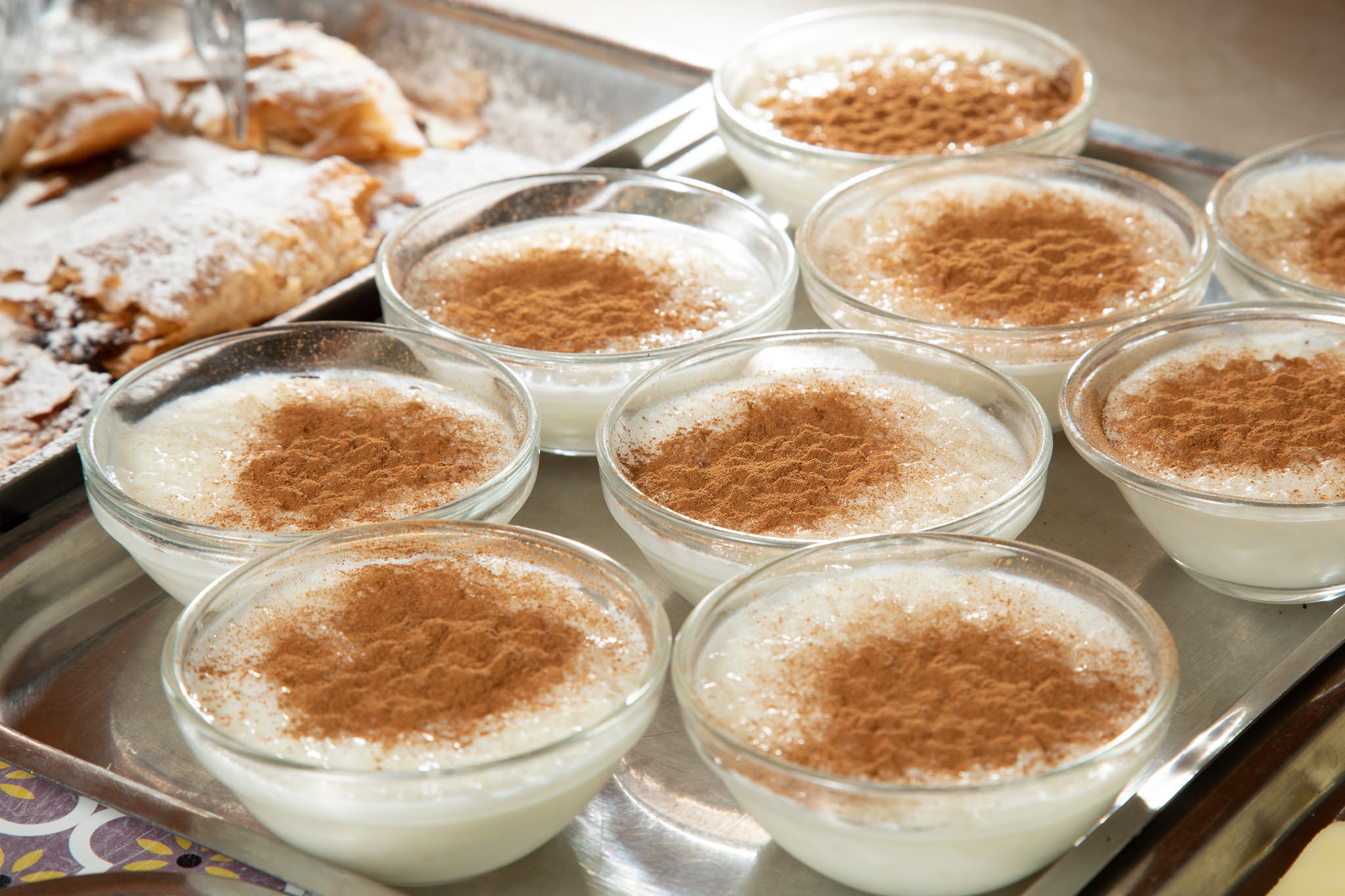
A breakfast buffet enriched with traditional Greek pies, yogurt, and fresh homemade cakes is served at Bella Cafe Room. Room service is also provided.
The 24-hour reception can arrange for car rental, luggage storage, or fax services. Car parking is free at the local car park, 150 meters from the hotel.
The Bella Vista Beach Hotel is 12km south of Corfu Town and 11 km from Corfu Airport. There is regular public transport, while the hotel provides two-way transfers to Corfu airport at a charge.
Influence of the Greek(Hellenic) language in today’s world
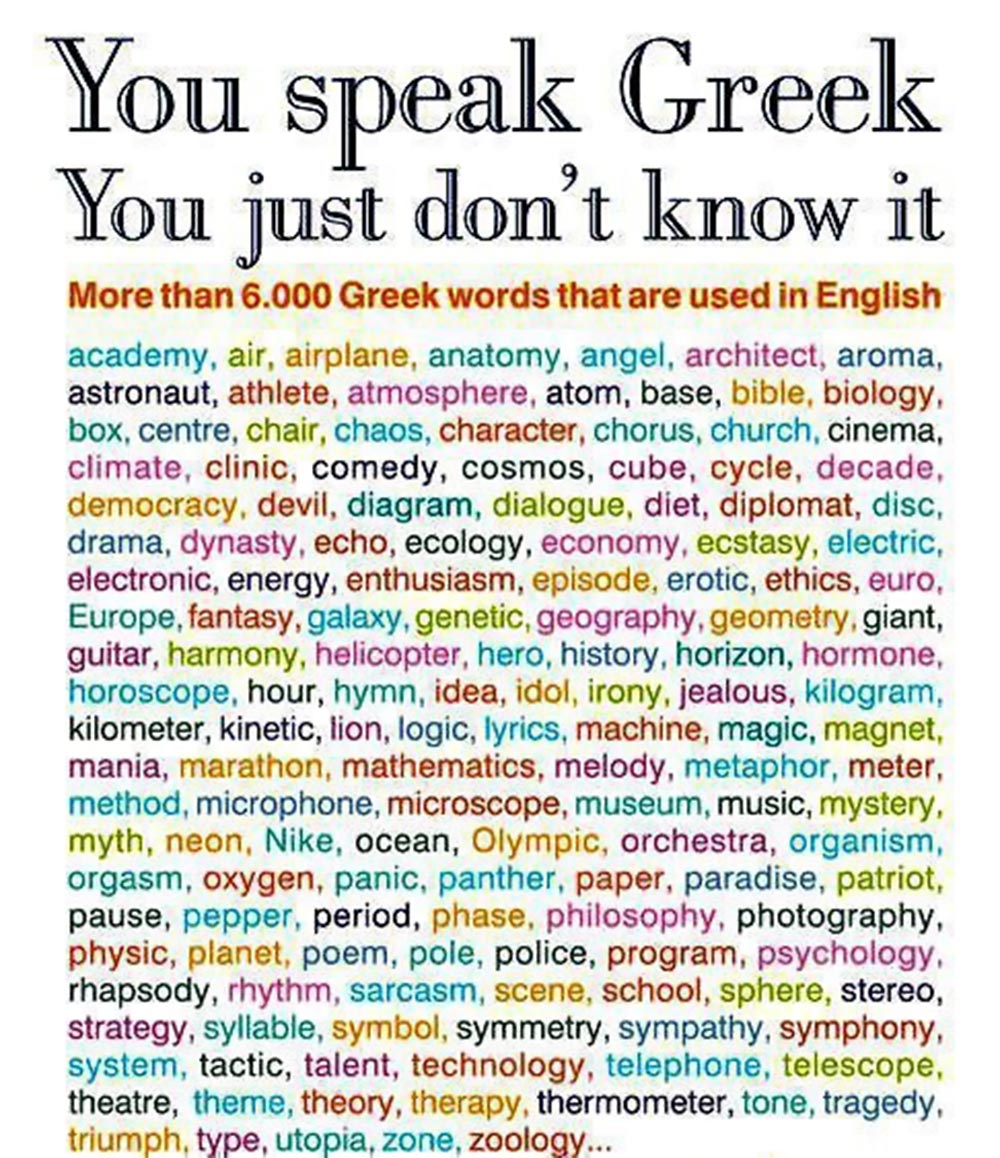
According to the Guinness Book of Records, the Hellenic (Greek) language is among the richest in the world, with over 5 million words. Many English words come from Hellenic roots, especially in science and medicine.
Mathematics, physics, astronomy, democracy, philosophy, athletics, theatre, rhetoric, baptism, and hundreds of other words are of Hellenic(Greek) roots. I bet that you all know that!
Click here for basic Greek words
But if you’re looking for a practical list, this page is not for you. See instead our 100 Greek words and phrases with meanings, pronunciation, and everyday usage, including commonly used words such as “malaka.”…
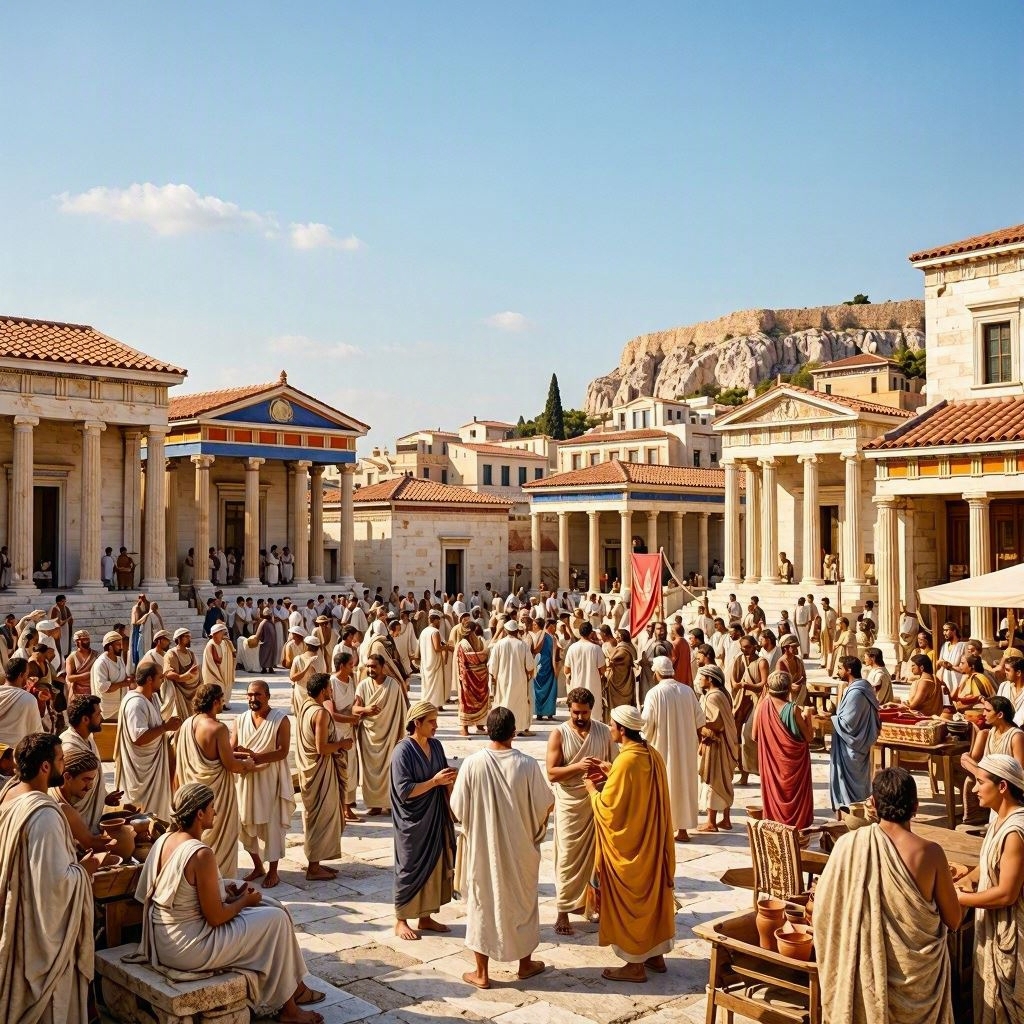
Parthenon
Greek words and word elements continue to be productive as a basis for coinages: anthropology, photography, telephony, isomer, biomechanics, cinematography, etc…
In a typical everyday 80,000-word English dictionary, about 5% of the words are directly borrowed from Greek (for example, “phenomenon” is a Hellenic word and even obeys Hellenic grammar rules as the plural is “phenomena”), and another 25% are borrowed indirectly.
Many terms in science, philosophy, and the arts have Greek roots. According to one estimate, about 150,000 English words, directly or indirectly, are derived from Greek words…source:www.britishcouncil.org
It’s estimated that a significant portion of English words—around 30%—have Greek origins, directly or indirectly.
This is because there were many Hellenic words borrowed from Latin originally, which then filtered down into English. After all, English borrowed so many words from Latin (for example, “elaiwa” in Greek evolved into the Latin “oliva”, which in turn became “olive” in English).
Hellenic and Latin are the predominant sources of the international scientific vocabulary; however, the percentage of words borrowed from Greek rises much higher than Latin when considering highly scientific vocabulary (for example, “oxytetracycline” is a medical term that has three Hellenic roots).
And finally, have you ever wondered how the world would be if the Greek language had never existed? If we consider English without its Greek, Latin, and French roots, its vocabulary would be considerably smaller.
However, we must acknowledge the English language’s ability to assimilate words from other languages. This adaptability, combined with its widespread use globally, has contributed to its status as today’s international language.
Most of the ideas in this article are borrowed from eurotalk.com, so greetings belong to them.
If you’re fascinated by Greek culture and history, why not take your knowledge further while exploring a Greek island itself? Our complete Corfu Island Guide offers practical tips, hidden gems, and insights into the landscapes, monuments, and traditions that make Corfu a must-visit destination.
Greek words in the English language
Some samples of English texts with Greek roots
(Bolded and underlined words are of Greek origin, all unchanged in time, and most importantly, easily understood by any uneducated Greek)
Sample 1
The cosmos, an extensive expanse, is the domain of astronomers who explore the phenomena of the celestial. Using telescopes, these scientists examine the orbits and magnitudes of various planets and stars. In the microcosm, biologists study organisms, analyzing their anatomy and physiology to understand abiogenesis, symbiosis, and metabolism within ecosystems.
In the realm of medicine, diagnosis and therapy are paramount. Physicians use clinical methods to identify symptoms and prescribe pharmacological remedies. Pathologists investigate the etiology of diseases, often employing microscopy to observe cellular pathology via biopsy. The synthesis of antibiotics has revolutionized the prognosis of bacterial infections.
Physics, another fundamental science, delves into the dynamics of energy and matter. The study of mechanics, optics, and acoustics has led to innovations in technology. Meanwhile, chemists explore the properties and reactions of chemical elements, discovering catalysts that accelerate synthesis processes.
In geology, the stratigraphy of the Earth is examined, revealing the chronology of tectonic activities. Seismologists monitor seismic waves to predict earthquakes, safeguarding populations from potential catastrophes. Paleontologists, on the other hand, unearth fossils, contributing to the chronology of life on Earth.
Psychology, a discipline examining the psyche(soul), focuses on cognition and behavior. Psychiatrists treat mental disorders, utilizing psychotherapy and psychopharmacology. The synergy of these sciences enhances our comprehension of the natural and human world, fostering a symbiotic relationship between knowledge and application.
Sample 2
Philosophy is a profound discipline that examines the fundamental nature of existence, knowledge, and ethics. Philosophers engage in dialectics, employing logic and reason to explore metaphysical questions about reality and ontology. The dialogues of Socrates, as documented by Plato, remain seminal texts in epistemology and ethics.
Metaphysics, a branch of philosophy, delves into the essence of being and the cosmos. It addresses questions of substance, causality, and the infinite. Epistemology investigates the nature and scope of knowledge and belief, differentiating between empirical and a priori knowledge.
Ethics, or moral philosophy, explores the concepts of virtue, justice, and the good life. Aristotle‘s Nicomachean Ethics offers a systematic examination of virtue ethics, proposing that eudaimonia, or human flourishing, is achieved through the cultivation of moral and intellectual virtues.
Aesthetics, another vital branch, analyzes the nature of beauty, art, and taste. Plato‘s theory of forms posits that aesthetic qualities are reflections of idealforms. Aristotle‘s Poetics dissects the elements of tragedy and dramatic structure, influencing literary criticism for centuries.
The Socratic method, characterized by elenchus or refutation, is a form of dialecticalinquiry that seeks to expose contradictions in an interlocutor’s arguments, promoting philosophical clarity and self-examination. Heraclitus and Parmenides contributed significantly to the ontology and cosmology debates, with their doctrines on change and permanence.
In the modern era, phenomenology, founded by Edmund Husserl, investigates the structures of consciousness and intentionality. Existentialism, with figures like Sartre and Heidegger, explores the human condition, freedom, and authenticity.
The study of philosophy remains essential for the comprehension of abstract concepts and the development of critical thinking. Through analysis, synthesis, and speculation, philosophers continue to contribute to the intellectual tradition and the quest for wisdom.
And an extreme example, understood by Academics
The philosopher and theorist utilized logic and ethics in their analysis of the cosmos. In their dialogue, they explored phenomena and ideas of metaphysics and epistemology. The dynamicsynthesis of theories on psychology and aesthetics created a paradox in the paradigm of democracy and autonomy.
Their methodology included techniques of dialectics and rhetoric, aiming to achieve symmetry and harmony in their systematichypothesis. The philosopher‘s critique of dogmaemphasized the importance of rational analysis and empiricalcriteria. They debated the axioms of geometry and mathematics, focusing on the axiomatic principles and logic.
In ethics, the philosopher examined virtue, charisma, and hedonism, proposing a synthesis of principles for eudaimonia. The cosmopolitanethos integrated aspects of democracy, autonomy, and sympathy. The philosopher‘s systematic approach combined hypothesis, theorem, and axiom, striving for clarity and coherence.
The scholar presented their thesis in a symposium, utilizing logic and rhetoric to convey the dynamic interplay of ideas and theories. They emphasized the synthesis of philosophicalconcepts, promoting dialogue and debate for the development of knowledge and wisdom.
Surprised? Don’t worry, you still have the rest of the words…but wait, 90% of the rest are Latin (directly or via French)! Αlso, you use the Latin alphabet, which, in turn, is a variation of the Ancient Greek Alphabet used in Euboea.
These Euboeans were the first colonists of Italy, and they brought their alphabet along, which was later adopted by Rome.
List of words of Greek origin used in English
Only an example of a few words of Greek origin is below, with their writing in the modern Greek language and their spelling with Latin characters. Practically unchanged since antiquity.
NOTE: The words on this list are not clickable; if you click on them, nothing will happen!
Academy = Ακαδημία (Akademia)
Acrobat = Ακροβάτης (Akrovates)
Air = Αέρας, Αήρ (Aeras)
Airplane = Αεροπλάνο (Aeroplano)
Anatomy = Ανατομία (Anatomia)
Angel = Άγγελος (Aggelos)
Abnormal = Ανώμαλος (Anomalos)
Anti = Αντι (Anti)
Archaeo = Αρχαιο (Archaeo)
Architect = Αρχιτέκτων (Architekton)
Aroma = Άρωμα (Aroma)
Astronaut = Αστροναύτης (Astronaftis)
Athlete = Αθλητής (Athleetees)
Atlas = Άτλας (Atlas)
Atmosphere = Ατμόσφαιρα (Atmosphera)
Atom = Άτομο (Atomo)
Auto = Αυτο (Afto)
Bacterium = Βακτήριον (Vakterion)
Base = Βάση (Vasee)
Bible = Βίβλος (Veevlos)
Bio = Βιο (Veeo)
Biology = Βιολογία (Viologia)
Box = Βοξ (Vox)
Cemetery = Κοιμητήριο (Keemeeteerio)
Centre = Κέντρο (Kentro)
Centro = Κέντρο (Kentro)
Chair = Καρέκλα (Karekla)
Chaos = Χάος (Chaos)
Character = Χαρακτήρ (Characteer)
Chorus = Χορός (Choros)
Chromo = Χρωμο (Chromo)
Chronological = Χρονολογικό (Chronologiko)
Cinema = Κινημα (Kinima)
Climate = Κλιμα, Κλιματικό (Klimatiko)
Clinic = Κλινική (Kliniki)
Comedy = Κωμωδία (Komodeea)
Cosmos = Κόσμος (Kosmos)
Cube = Κύβος (Kyvos)
Cycle = Κύκλος (Kyklos)
Cyclo = Κυκλο (Kyklo)
Decade = Δεκάδα (Decada)
Demo = Δημο (Deemo)
Democracy = Δημοκρατία (Deemokrateea)
Devil = Διάβολος (Diavolos)
Diagram = Διάγραμμα (Diagrama)
Dialogue = Διάλογος (Dialogos)
Diet = Δίαιτα (Dieta)
Diplomat = Διπλωμάτης (Diplomates)
Dinosaur = Δεινόσαυρος (Dinosavros)
Disc = Δίσκος (Diskos)
Drama = Δράμα (Drama)
Dynasty = Δυναστεία (Dynasteia)
Dys = Δυσ (Dys)
Echo = Ηχώ (Echo)
Ecology = Οικολογία (Ekologia)
Economy = Οικονομία (Ekonomia)
Ecstasy = Έκσταση (Ekstasi)
Electric = Ηλεκτρικό (Elektriko)
Electronic = Ηλεκτρονικό (Eelektroniko)
Energy = Ενέργεια (Energeia)
Enthusiasm = Ενθουσιασμός (Enthousiasmos)
Episode = Επεισόδιο (Episodeio)
Erotic = Ερωτικό (Erotiko)
Ethics = ‘Ηθη (Ethe)
Eu = Ευ (Ef)
Euro = Ευρώ (Evro)
Europe = Ευρώπη (Evropee)
Fantasy = Φαντασία (Fantasia)
Galaxy = Γαλαξίας (Galaxias)
Genetic = Γενετικός (Genetikos)
Geography = Γεωγραφία (Geographia)
Geometry = Γεωμετρία (Geometria)
Giant = Γίγαντας (Gigantas)
Grammatical = Γραμματικό (Grammatiko)
Graph = Γραφ (Graph)
Guitar = Κιθάρα (Kithara)
Harmony = Αρμονία (Armonia), the “h” is rejected in modern Greek.
Helicopter = Ελικόπτερο (Elikoptero), the “h” is rejected in modern Greek.
Hercules = Ηρακλής (Eraklees), the “h” is rejected in modern Greek.
Hero = Ήρως (Iros), the “h” is rejected in modern Greek.
Hippopotamus = Ιπποπόταμος (Ipopotamos), the “h” is rejected in modern Greek.
History = Ιστορία (Eestoreea), the “h” is rejected in modern Greek.
Horizon = Ορίζοντας (Orizontas), the “h” is rejected in modern Greek.
Hormone = Ορμόνη (Ormonee), the “h” is rejected in modern Greek.
Horoscope = Ωροσκόπιο (Oroskopio), the “h” is rejected in modern Greek.
Hour = Ώρα (Ora), the “h” is rejected in modern Greek.
Hydro = Υδρο (Ydro), the “h” is rejected in modern Greek.
Hymn = Ύμνος (Ymnos), the “h” is rejected in modern Greek.
Hypo = Υπο (Ypo), the “h” is rejected in modern Greek.
Hyper = Υπερ (Yper), the “h” is rejected in modern Greek.
Hypnotic = Υπνωτικό(Ypnotiko), the “h” is rejected in modern Greek.
Idea = Ιδέα (Idea)
Idiot = Ιδιώτης (Idiotes)
Idol = Είδωλο (Idolo)
Irony = Ειρωνία (Ironea)
Jealous = Ζήλεια (Zelia)
Kilogram = Χιλιόγραμμο (Chiliogrammo)
Kilometer = Χιλιόμετρο (Chiliometro)
Kinetic = Κινητικό (Kinetiko)
Lion = Λέων (Leon)
Logic = Λογικό (Logiko)
Logo = Λογο (Logo)
Lyrics = Λυρισμός (Lyrismos)
Machine = Μηχανή (Mechane)
Macro = Μακρο (Makro)
Mega = Μεγα (Mega)
Magic = Μαγικό (Magiko)
Meta = Μετα (Meta)
Metaphor = Μεταφορά (Metaphora)
Metropolis = Μητρόπολις (Metropolis)
Micro = Μικρο (Mikro)
Mono = Μονο (Mono)
Muse = Μούσα (Musa)
Mystery = Μυστήριο (Mysterio)
Myth = Μύθος (Mythos)
Nectar = Νεκταρ (Nektar)
Neon = Νέον (Neon)
Nike = Νίκη (Nike)
Nine = Εννέα (Enea)
Ocean = Ωκεανός (Okeanos)
Olympic = Ολυμπιακός (Olympiakos)
Orchestra = Ορχήστρα (Orcheestra)
Organism = Οργανισμός (Organismos)
Orgasm = Οργασμός (Orgasmos)
Oxyzen = Οχυγόνο (Oxygono)
Paleo = Παλαιο (Paleo)
Panic = Πανικός (Panikos)
Panther = Πάνθηρας (Pantheras)
Paper = Πάπυρος (Papeeros)
Para = Παρα (Para)
Paradise = Παράδεισος (Paradeisos)
Patriot = Πατριώτης (Patriotes)
Pause = Παύση (Pafsi)
Pepper = Πιπέρι (Peperi)
Period = Περίοδος (Periodos)
Phase = Φάση (Phasee)
Philo = Φιλο (Philo)
Philosophy = Φιλοσοφία (Philosophia)
Photo = Φωτο (Photo)
Photography = Φωτογραφία (Photografia)
Physic = Φυσική (Physike)
Planet = Πλανήτης (Planeetes)
Poem = Ποίημα (Peema)
Pole = Πόλος (Polos)
Poly = Πολυ (Poly)
Pro = Προ (Pro)
Program = Πρόγραμμα (Programma)
Pseudo = Ψευδο (Psevdo)
Psycho = Ψυχο (Psycho)
Psychology = Ψυχολογία (Psychologia)
Pyro = Πυρο (Pyro)
Rhapsody = Ραψωδία (Rapsodia)
Rhythm = Ρυθμός (Rythmos)
Rhinoceros = Ρινόκερως (Rinokeros)
Sarcasm = Σαρκασμός (Sarkasmos)
Scene = Σκηνή (Skene)
Schizophrenia = Σχιζοφρένεια (Schizophrenia)
School = Σχολείο (Scholeeo)
Sphere = Σφαίρα (Sphera)
Star = Αστήρ (Asteer)
Stereo = Στέρεο (Stereo)
Strategy = Στρατηγική (Strategiki)
Sycophant = Συκοφάντης (Sykophantes)
Syllable = Συλλαβή (Syllavee)
Symbol = Σύμβολο (Symvolo)
Symmetry = Συμμετρία (Symmetria)
Sympathy = Συμπάθεια (Sympatheia)
Symphony = Συμφωνία (Symphonia)
Syntax = Σύνταξη (Syntaksi)
System = Σύστημα (Systeema)
Tactic = Τακτική (Taktikee)
Talent = Ταλέντο (Talento)
Techno = Τεχνο (Techno)
Technology = Τεχνολογία (Technologia)
Telescope = Τηλεσκόπιο (Teleskopio)
Telephone = Τηλέφωνο (Telephono)
Television = Τηλεόραση (Teleorasi)
Theatre = Θέατρο (Theatro)
Theme = Θέμα (Thema)
Theory = Θεωρία (Theoria)
Therapy = Θεραπεία (Therapia)
Thermo = Θερμο (Thermo)
Thermometer = Θερμόμετρο (Thermometro)
Third = Τρίτο (Treeto)
Tone = Τόνος (Tonos)
Tragedy = Τραγωδία (Tragodia)
Triumph = Θρίαμβος (Thriamvos)
Type = Τύπος (Typos)
Utopia = Ουτοπία (Utopeea)
Zone = Ζώνη (Zonee)
Zoo = Ζωο (Zoo)
Zoology = Ζωολογία (Zoologia)
Also, almost all words that start with “PH” are of Greek origin!
For my fellow Musicians
Of course, you all know that the word ‘Music‘ is Greek, don’t tell me that you don’t!
And if you play Guitar(another Greek word), you are familiar with tones, semitones, musical scales, etc, as well as with Heptatonic and pentatonic scales made in antiquity, such as Ionian, Dorian, Aeolian, Phrygian, Lydian, Mixolydian, Hypolydian, Hypodorian, or Locrian…these terms have Greek origins, reflecting the influence of ancient Greek musical theory.
We must stop here; these are already very good samples, and it is impossible to write down all the 150,000 Greek words used in English! But if you click this Wiktionary link, you can discover thousands more Greek words in English than you ever imagined.
Language tips
So, if you are one of those who say, “It’s all Greek to me,” it’s time to reconsider it; it will help if you follow a couple of simple tips.
The Latin letter “C” does not exist in Greek. Greek has separate letters for the sounds represented by C in English: “K” (Κ) for the hard sound, and “S” (Σ) for the soft sound.
A C-shaped form of the Greek letter Sigma (Ϲ) was used in some Greek manuscripts, especially during the Byzantine period, but it was not the Latin letter C.
Keep in mind that the “TH” sound is written with the Greek letter “Θ” (theta).
In ancient Greek, the letter ‘B’ originally sounded like what ‘B’ sounds in the word “bee” (at least this is what scholars claim, as if they were there!). But in modern Greek, it sounds like ‘V’. The sound of ‘B’ (like in bee) exists today but is written with two distinct letters, “MΠ” (M+P), and is pronounced like the Latin ‘B’.
Ancient Greek words beginning with a vowel could have a rough breathing mark, representing an initial “h” sound. When these words entered Latin, this sound was often represented with the letter “H”; for example, ἱστορία became historia, giving English “history”.
This aspirate is abolished in modern Greek, and the sound of “H” is not pronounced long before the abolisment, but the letter ‘H’ remained in English.
Wherever you see “Ω” or “Ο”, both are pronounced as “O” in modern Greek. In ancient Greek, however, Ω (Omega, the “big O”) represented a long vowel, while Ο (Omicron, the “small O”) represented a shorter sound.
There are more minor differences, but slowly you will find out that you start to make sense.
Differences in the alphabet are minor. The Latin alphabet, after all, is the natural evolution of the Greek Euboean alphabet, which in turn was a local variation of the Greek alphabet.
Before 800 BCE, the Greeks borrowed the Phoenician alphabet to replace their Linear B script. It’s worth noting that they changed many letters to fit their pronunciation and added vowels, as the Phoenician alphabet did not have any vowels.
So, while the Phoenician alphabet may be considered the common ancestor of all European alphabets today, without the modifications by the Greeks, it would not fit at all.
Finally, you will see that saying “It’s all Greek to me” is a nonsensical expression. Therefore, it’s good to abandon this expression as it can be seen as a sign of ignorance; change it instead by saying: ‘It’s all Chinese to me’.
Now that you’ve seen how many Greek words you already know, it’s no surprise that English speakers use many words of Greek origin every day—even without realizing it!
📄 Download the Full PDF
If you enjoyed this guide, scan the QR code below to instantly download the “List of Greek Words in English – Free PDF”:
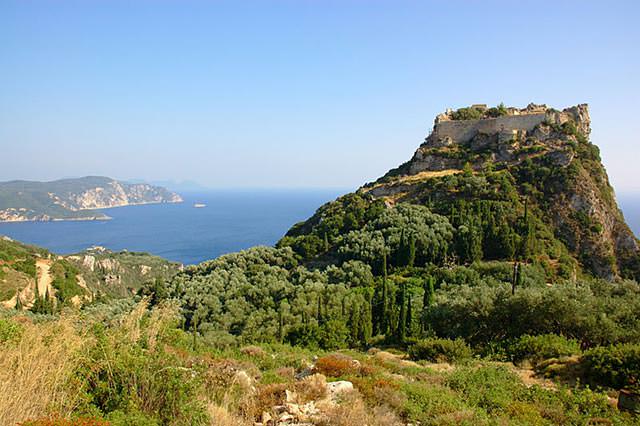
Angelokastro was the westernmost outpost of the Byzantine Empire and the Despotate of Epirus to which Corfu belonged until 1267 AD, it is near the village of Krini north of Paleokastritsa next to a monastery.
Built in the early 12th century AD by the Despot of Epirus Duke Michael-Angelos Komnenos the second, therefore the name Angel’s Castle, and in its prime, in an emergency, it could protect the entire population of the region, about 4000 people.
Inside the castle, two large water tanks and the churches of the Holy Archangels and Agia Kiriaki are preserved.
The church of the Archangels was built in 1784 on the site of an older church.
Agia Kiriaki was built inside a small cave and has 18th-century paintings.
Angelokastro(Angel’s castle) saw many sieges but never fell except once to the Venetians after a six-month siege in 1386.
In 1537 only 8 soldiers of his guard with the help of the residents were needed in order to repel the attack of Barbarossa.
The Turks tried again and failed to conquer the Castle in 1571.
The villages around got their names from the soldiers who took pieces of land to settle on when they retired.
Examples are Makris-Makrades, Vistonas-Vistonas, Doukas-Doukades, Aspiotis-Aspiotades, Kabbadias-Kabbadades, etc.
Today the castle is still standing at the top of the rock and it is a strong tourist attraction, a well-preserved piece of history for this magnificent island.
Byzantine Stradioti and the Villages Around Angelokastro
The area around Angelokastro hosted many villages with the suffix -ades, names derived from family groups of soldier-farmers known as Byzantine Stradioti. These settlements had a defensive role and maintained the organization of the rural landscape.
Examples
Peroulades → from the name Peroulis
Avliotes → from the surname Avlonitis
Gousades → from the name Gousis
Poulimades → from the name Poulimas
Karousades → from the name Karousis
Kopsoheilades → from the nickname Kopsaheilis
Velonades → from the name Velonas
Rachtades → from the name Rachtas
Gavrades → from the surname Gavras
Magoulades → from the name Magoulas
Kavvades → from the surname Kavvadias
Kouvanades → from the name Kouvas
Armenades → from the name Armenis
Termenades → from the name Termenas
Aspiotades → from the name Aspiotis
Manatades → from the name Manatos
Arkadades → from the name Arkoudis
Aleimatades → from the name Aleimatas
Makrades → from the name Makris
Doukades → from the name Doukas
Gardelades → from the name Gardelis
Liapades → from the name Liapis
Kanakades → from the name Kanakis
Yiannades → from the name Giannis
Poulades → from the name Poulis
Argyrades → from the name Argyros
The suffix -ades is not just a linguistic feature; it preserves the memory of an old social and military organization in the Corfiot countryside, marking the families or clans that settled in the area.
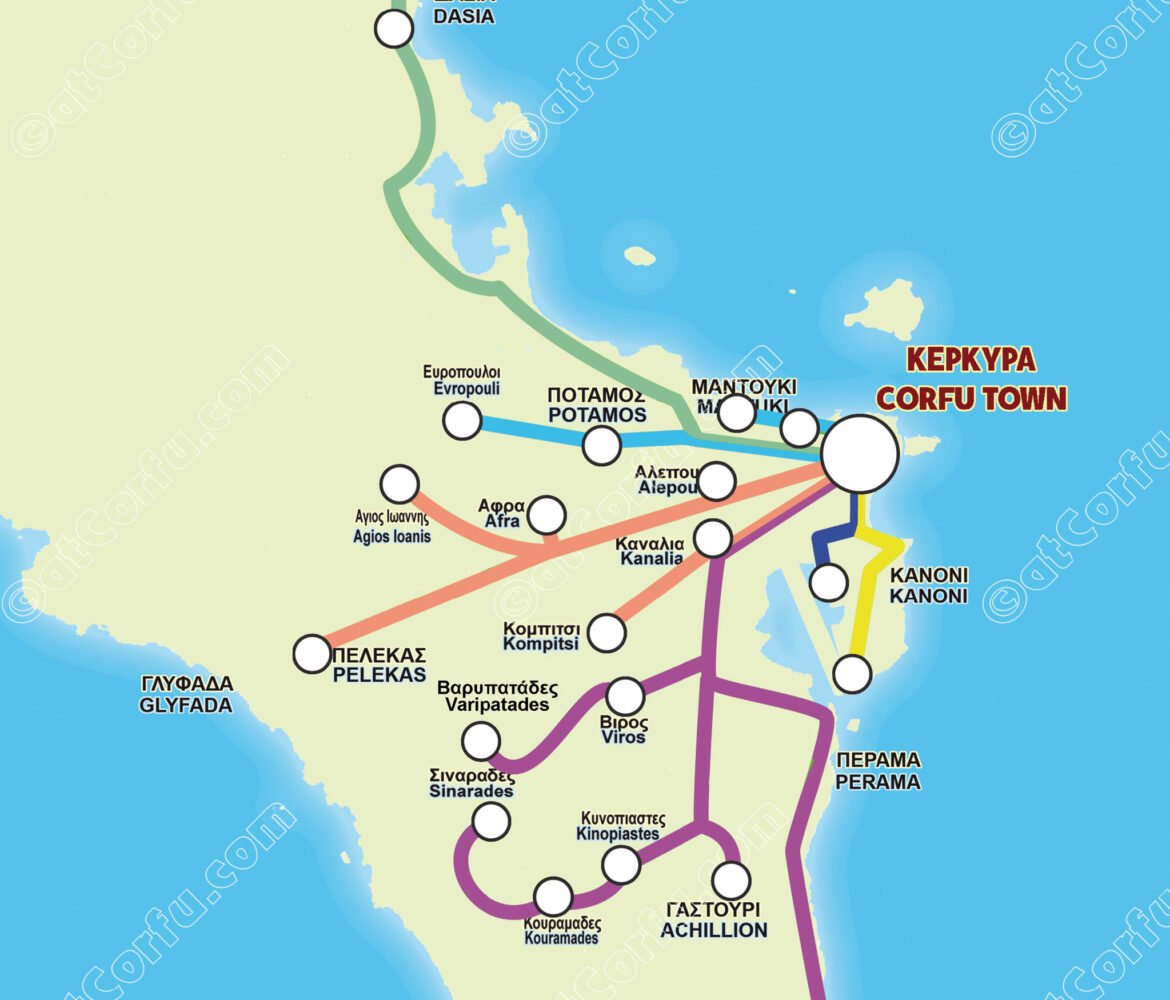
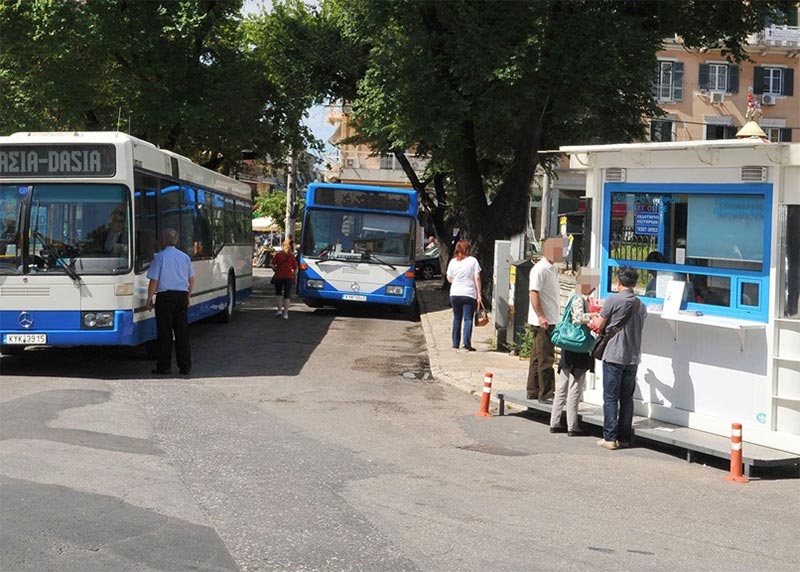
The Blue Buses of Corfu, operated by ASTRA Urban Transport, provide a reliable and affordable way to explore Corfu Town and its surrounding destinations.
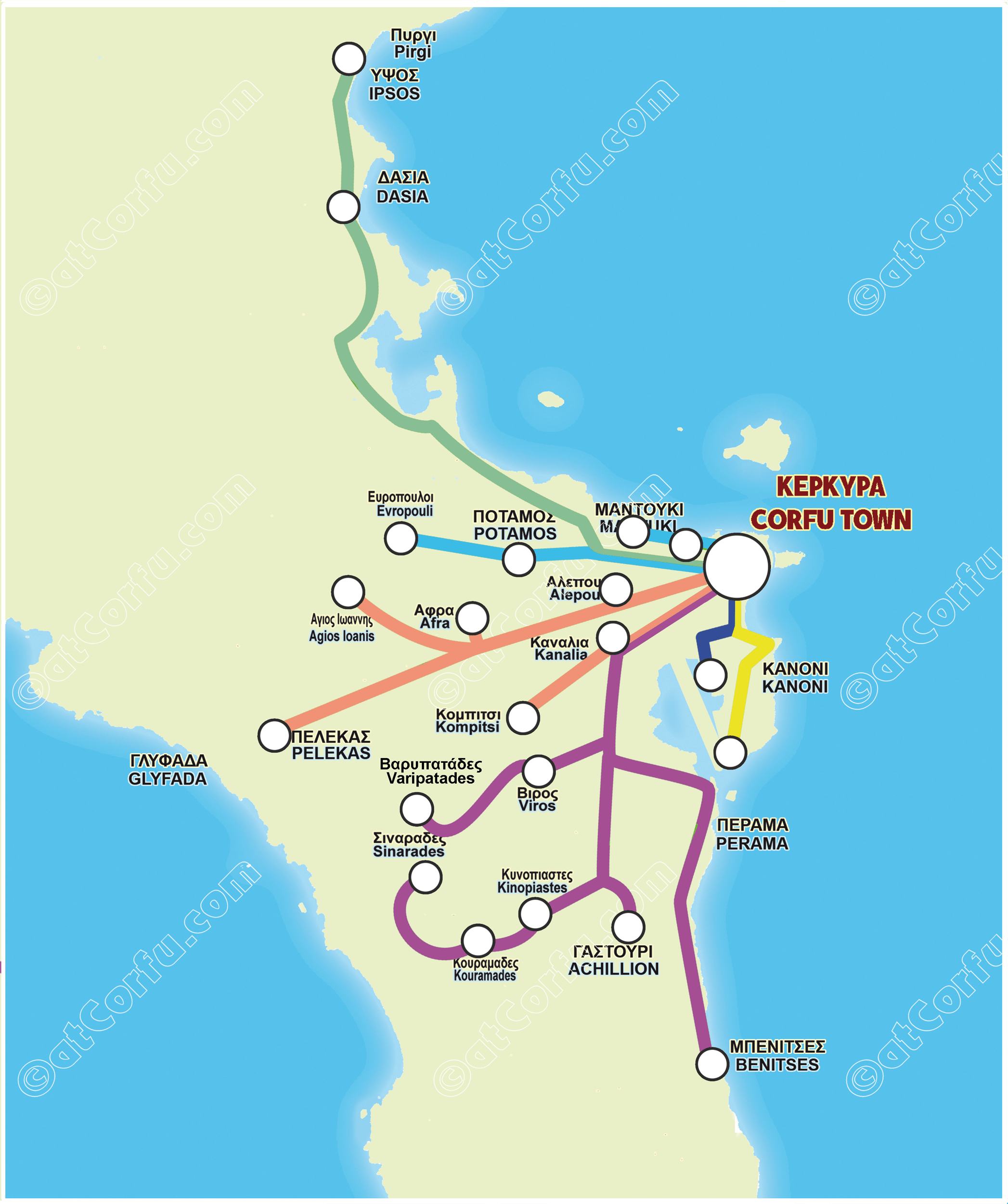
This complete guide includes route descriptions, departure points, and downloadable PDF timetables to help you navigate the local transport system while exploring the island using our Corfu Island Guide.
Blue buses make frequent stops throughout their routes, typically every kilometer or at key locations along the way.
In addition to serving town centers and major intersections, they usually stop near large hotels, popular beaches, archaeological sites, museums, ports, and other tourist attractions. This makes them one of the most convenient ways for visitors to explore the area without needing a car.
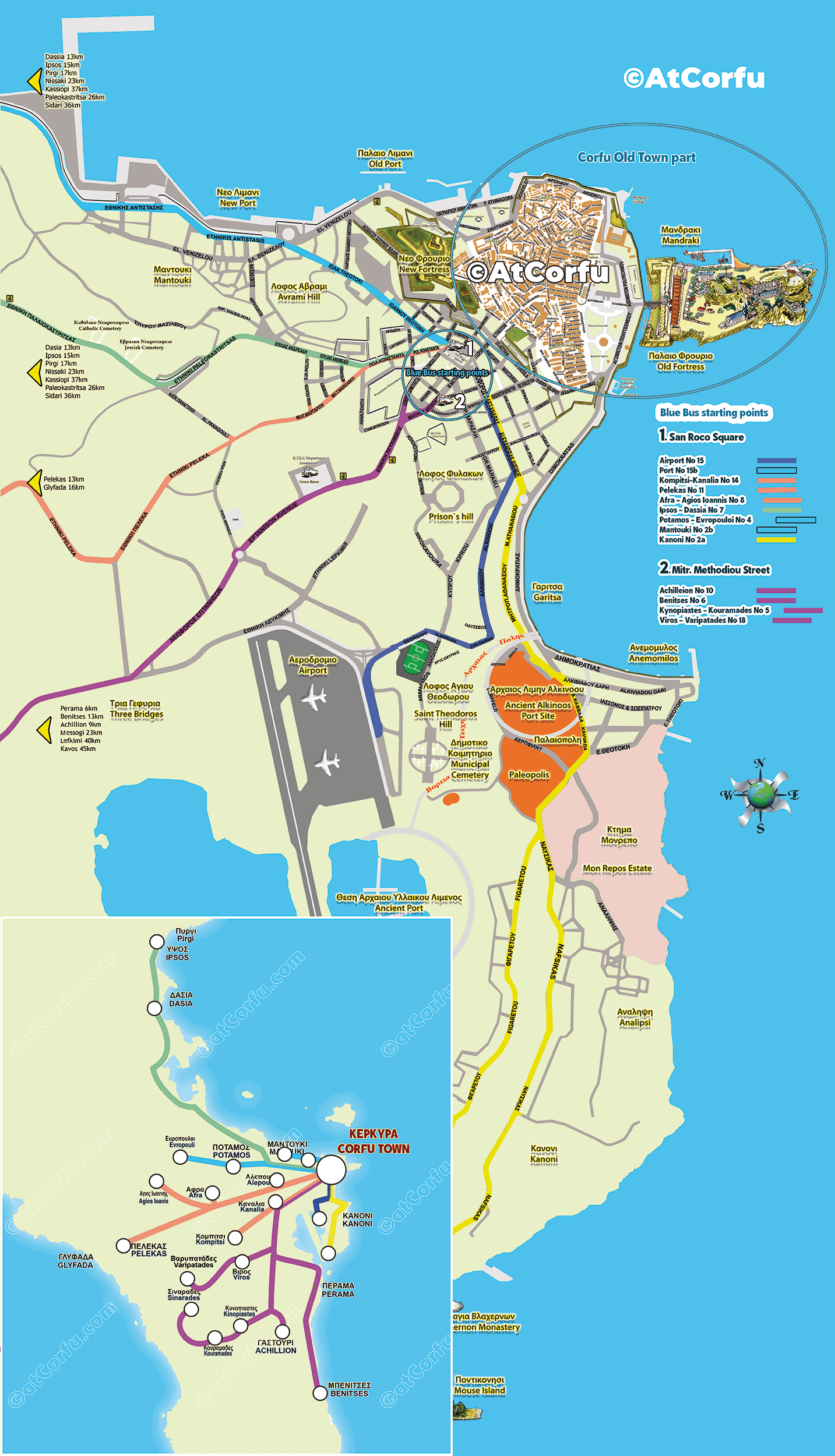
🗺️ Corfu Blue Bus Interactive Map
🚏 Corfu Blue Buses Depart Points
There are three main departure points in Corfu Town:
San Rocco Square (Plateia San Rocco): Main terminal for most routes.
Mitr. Methodiou Street: Used by lines 5, 6, and 10, approximately 200 meters from San Rocco.
Spianada Square: Used only by Line 2a (Kanoni), located inside the Old Town.
📥 Download Full Timetables (PDF)
Click on a route below to download the official PDF timetable:
Frequencies vary by time of day and season. See PDF for full details.
Line 2a
Departure: Liston
Route: Kanoni – Pontikonisi
First: 06:20 – Last: 23:00 See full PDF
Line 2b
Departure: San Rocco
Route: Kefalomandouko
First: 07:50 – Last: 21:10 See full PDF
Line 4
Departure: San Rocco
Route: Potamos – Evropouli
First: 06:40 – Last: 21:10 See full PDF
Line 5
Departure: Mitr. Methodiou
Route: Kouramades – Kinopiastes
First: 06:20 – Last: 22:00 See full PDF
Line 6
Departure: Mitr. Methodiou
Route: Benitses
First: 06:30 – Last: 22:30 See full PDF
Line 7
Departure: San Rocco
Route: Dassia – Ipsos
First: 06:20 – Last: 23:00 See full PDF
Line 8
Departure: San Rocco
Route: Agios Ioannis (Aqualand)
First: 06:20 – Last: 22:15 See full PDF
Line 10
Departure: Mitr. Methodiou
Route: Achilleion Palace
First: 06:40 – Last: 20:05 See full PDF
Line 11
Departure: San Rocco
Route: Pelekas
First: 07:00 – Last: 22:15 See full PDF
Line 14
Departure: San Rocco
Route: Kanalia – Kompitsi
First: 07:15 – Last: 14:00 See full PDF
Line 15a
Departure: San Rocco
Route: Port Shuttle
First: 08:15 – Last: 21:15 See full PDF
Line 15b
Departure: San Rocco
Route: Airport Shuttle
First: 07:05 – Last: 22:45 See full PDF
Line 18
Departure: Mitr. Methodiou
Route: Viros – Kalafationes – Varipatades
First: 06:30 – Last: 16:05 See full PDF
🚌 Corfu Blue Bus Timetable Overview (2026)
Here is a quick reference timetable for all Corfu Blue Bus routes. For complete details and exact schedules, please refer to the official PDFs linked below each line.
These are the prices if you buy the ticket from a kiosk. Tickets purchased from the bus driver cost €0.50 more.
Ticket Type
Price
Urban route (short)
€1.30
Suburban (longer) route
€1.80 – €2.50
Onboard purchase
+€0.50 surcharge
Day Pass (unlimited)
€5.00
Smart Tickets & Cards
Corfu Blue Buses now use a new “smart” ticketing system that replaces the old paper tickets.
You can buy or top up tickets and cards from vending machines at San Rocco Square, Metropolitan Methodiou, and Avra terminals, or from ticket kiosks.
Two ticket types:
Non-personalized: Paper or plastic, no name on it. Used for standard or multi-ride packages.
Personalized: Plastic card with your name. Needed for student or family discounts and monthly passes.
You can recharge tickets at machines, check remaining rides online or on the app, and pay either cash or card.
Day passes, 10-ride packages, and 30-day passes are available for Zone A and Zone B.
Lines 5, 6, and 10 leave from Mitr. Methodiou Street.
Line 2a (to Kanoni) starts at Spianada Square, inside the Old Town.
Line 15 (Airport/Port) departs from San Rocco, not the Old Town.
Schedules may differ on Sundays and holidays.
🧭 Final Thoughts
The Blue Bus network offers excellent coverage of central Corfu at a low cost. Whether you’re heading to the beach at Ipsos, the palace at Achilleion, or need to get to the airport, the system is simple and efficient, as long as you check your line number and starting point.
Bonus Tip:
Planning your Corfu travels? Download this free, full-size map in PDF of the Blue Bus route network, featuring all routes, major stops, and central pick-up points in Corfu Town. Perfect for quick reference on the go or offline use.
Corfu Town: Sophisticated, local, and cosmopolitan.
Sidari: Friendly, fun, and easygoing.
Gouvia: Chill, scenic, and romantic.
Corfu Nightlife: Where to Go Out on the Island
Corfu nightlife is spread across a few key areas, making it easy to find the right place to go out depending on your style — from all-night parties in Kavos and Ipsos to relaxed bars in Corfu Town and Sidari. Whether you’re looking to party until sunrise or enjoy a drink with a sea view, there’s something for every style.
Here’s a quick look at Corfu nightlife and what to expect across the island:
The best nightlife in Corfu depends on the area you choose — Kavos and Ipsos offer the biggest clubs, while Corfu Town is better for bars and more stylish nights out.
1. Kavos – The Party Capital
Located at the southern tip of the island, Kavos is Corfu’s most famous party resort. Especially popular with British tourists, it boasts a long strip full of bars, beach clubs, and nightclubs that stay open until dawn. Expect mainstream hits, house, techno, and themed party nights all summer long.
Highlights: The Yard Club, Maria’s Famous Karaoke Fun Pub
Vibe: High-energy, youthful, and wild
2. Ipsos – Lively and Social
Ipsos is one of the most popular nightlife areas in Corfu, offering a mix of beach bars, casual clubs, and late-night venues. It attracts a younger crowd but is less intense than Kavos, making it a good middle ground.
Highlights: Tartaya Tiki Bar
Vibe: Fun, social, and easygoing
3. Corfu Town – Stylish and Diverse
The capital city offers a more varied nightlife experience. In Corfu Town, especially around the Liston and the old town, you’ll find a mix of cocktail bars, elegant cafés, small clubs, and live music venues. The town also has a few major nightclubs just outside the center.
Up north, Sidari has a more relaxed but still vibrant nightlife. Its bars and clubs often play everything from EDM to rock and pop, making it great for groups and casual partygoers. Open-air venues and friendly atmospheres make Sidari a favorite for a more laid-back night out.
Highlights: Palia Skouna
Vibe: Friendly, fun, and easygoing
5. Gouvia – Relaxed Evenings
Just north of Corfu Town, Gouvia offers a quieter alternative. Its beachfront bars and music venues are perfect for those who want music and drinks without the crowds of Kavos or Sidari.
Vibe: Chill, scenic, and romantic
The best nightlife in Corfu depends on the area you choose, with Kavos and Ipsos offering the biggest clubs, while Corfu Town focuses more on bars and stylish venues.
More Nightlife Spots Around Corfu
Beyond the main areas, there are a few smaller spots worth mentioning:
Paleokastritsa – Known for La Grotta, a unique bar set in a sea cave
Glyfada – Home to Pazuzu, a stylish beach club with sunset parties
Acharavi – Growing nightlife scene with venues like Fabric Club
Moraitika & Dassia – Simple, relaxed bars for a quieter night out
Nightclubs in Corfu Town
Corfu Town has some of the island’s best-known clubs, combining atmosphere with a more stylish setting.
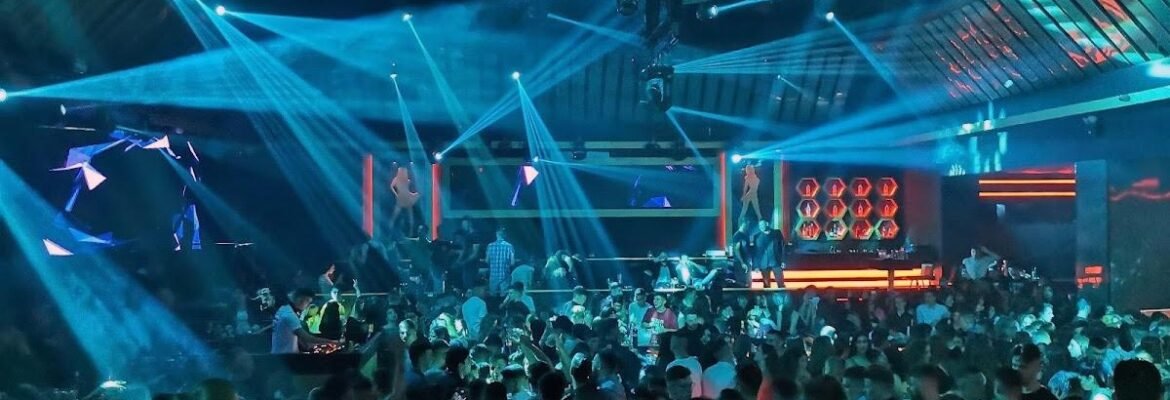
54 Dreamy Nights
54 Dreamy Nights Club
Located just north of the town on Ethnikis Antistaseos Street, this is Corfu’s largest and most popular club. With an impressive sound system, retractable roof, dazzling lights, and top DJs, it stays open until 8 a.m.—perfect for serious clubbers.
Cubaneros
A Cuban-themed venue in the heart of the old town offering salsa, reggaeton, R&B, and hip-hop in a warm and colorful setting.
Mansion
Located on the outskirts of Corfu Town, Mansion is a trendy spot with a mix of mainstream, house, and techno beats.
Tamam
This cozy club in the old town offers a more intimate experience, with Greek and international music, perfect for a relaxed but stylish night out.
Atlantis
A spacious club right in the center of Corfu Town. It’s great for dancing to a mix of modern hits, electronic, and house.
Bristol Café
Found on Kapodistriou Street, this is a classy café-bar in a Venetian building, offering cocktails, coffee, snacks, and often live music—jazz, blues, or traditional Greek.
A Romantic Alternative
Not a fan of loud clubs? Corfu also caters to those who prefer peaceful and romantic nights. Consider:
Traditional tavernas in villages and resorts for live bouzouki and Greek meze.
Outdoor dining in the Venetian alleyways of Corfu Town.
A quiet stroll through Esplanade Square followed by a drink at Liston, where you’ll find elegant bars and cafés with a relaxed, classy vibe.
Final Tips
Check schedules and events before heading out—many clubs operate seasonally.
Dress codes are casual but tidy. Most venues allow beachwear early in the evening but not later at night.
Stay safe and drink responsibly. Taxis and night buses are available in most major areas.
Conclusion: Is Corfu a Party Island?
Yes, but it’s much more than that.
Corfu is versatile—its nightlife can be as wild or as relaxed as you want it to be. From the club-heavy streets of Kavos and Ipsos to romantic bars in Corfu Town and scenic beach lounges in Paleokastritsa, the island offers something for every kind of night owl.
Contains information related to marketing campaigns of the user. These are shared with Google AdWords / Google Ads when the Google Ads and Google Analytics accounts are linked together.
90 days
__utma
ID used to identify users and sessions
2 years after last activity
__utmt
Used to monitor number of Google Analytics server requests
10 minutes
__utmb
Used to distinguish new sessions and visits. This cookie is set when the GA.js javascript library is loaded and there is no existing __utmb cookie. The cookie is updated every time data is sent to the Google Analytics server.
30 minutes after last activity
__utmc
Used only with old Urchin versions of Google Analytics and not with GA.js. Was used to distinguish between new sessions and visits at the end of a session.
End of session (browser)
__utmz
Contains information about the traffic source or campaign that directed user to the website. The cookie is set when the GA.js javascript is loaded and updated when data is sent to the Google Anaytics server
6 months after last activity
__utmv
Contains custom information set by the web developer via the _setCustomVar method in Google Analytics. This cookie is updated every time new data is sent to the Google Analytics server.
2 years after last activity
__utmx
Used to determine whether a user is included in an A / B or Multivariate test.
18 months
_ga
ID used to identify users
2 years
_gali
Used by Google Analytics to determine which links on a page are being clicked
30 seconds
_ga_
ID used to identify users
2 years
_gid
ID used to identify users for 24 hours after last activity
24 hours
_gat
Used to monitor number of Google Analytics server requests when using Google Tag Manager