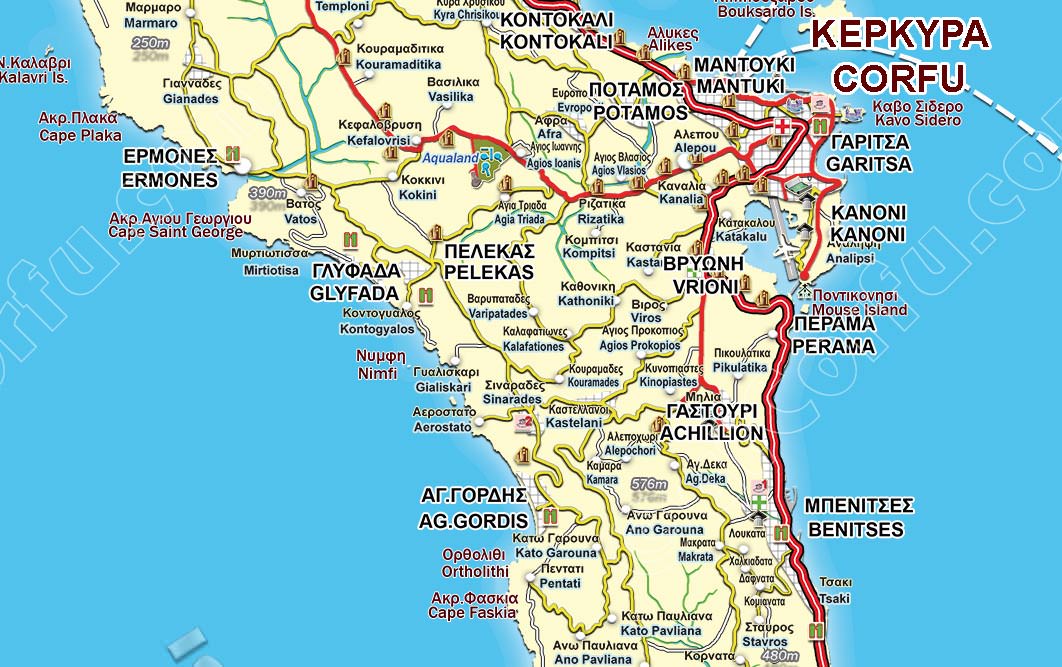
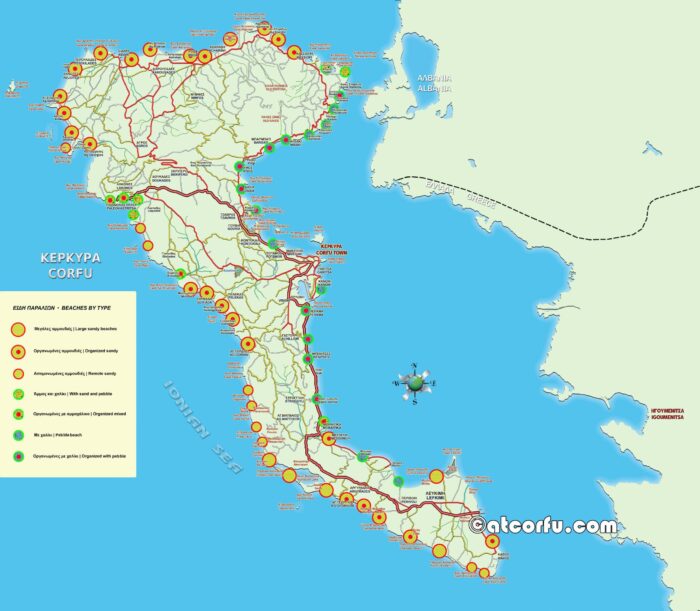
Corfu’s coastline changes dramatically from one region to the next — from dramatic cliffs and coves in the northwest to long, sandy shores in the south.
This guide helps you explore the best places by area, using custom regional maps and quick links to detailed guides.
Each section below includes a handmade map and links to local guides you can trust — all written from firsthand experience.
The northwest coast is wild and dramatic, with some of the island’s most photogenic scenery. Expect green hills, deep blue bays, and steep paths to hidden coves.
Easy to reach from Corfu Town, the central coastline offers sandy beaches with sunbeds, beach bars, and water sports. Not the quietest, but very accessible.
Wide sandy stretches, shallow waters, and quiet villages make the south perfect for laid-back beach days. The further south you go, the wilder and emptier it gets.
Prefer to search by experience instead of area? Use this visual guide to find beaches based on what matters most to you — family-friendly, sandy, remote, or west coast sunset views.
Every beach on this list is marked on the map for easy navigation. Whether you plan to rent a car or stay local, these maps make it easier to choose the right beach for your needs — and avoid long drives to the wrong coast.
Water sports facilities in Chontrakia Benitses Beach
Benitses is a seaside resort. But rather than a single uniform stretch, Benitses Beach is divided into several distinct sections. Starting from the north near the Laopetra rock, it continues past the marina and the main beach by the port, then extends south towards Loutrouvia and a series of smaller, quieter coves.
The beach has changed significantly over the years, becoming wider and more accessible, with plenty of space to relax along the coast.
Most parts are well organized, with sunbeds, easy access from the road, and lifeguards during the summer months.
The sea is particularly clear and calm, making it ideal for swimming, while the central areas also offer water sports and boat rentals.
Overall, Benitses Beach combines convenience with variety, offering both lively spots and quieter corners along the same stretch of coastline.
Laopetra Area (North End of Benitses Beach)
Benitses – Laopetra rock at the beach
Let’s kick off our beach tour with a visit to Laopetra Beach, right at the north entrance of the village. You’ll find it just a stone’s throw away from the yachting marina port.
Get poised to dive into tranquility itself. This beach is all about serenity, making it the calmest spot in town.
Picture pebbles and a sprinkle of sand right at the water’s edge, creating a soothing hideaway for those seeking a little shoreline bliss. You won’t spot any high-octane water sports here, but what you will find is a sparkling clean sea that invites you to take a leisurely dip.
And oh, the views! Prepare to be swept away by the sheer magnificence of the landscape. Behold the grandeur of the colossal Laopetra rock that takes center stage, commanding the scenery like an ancient guardian.
So, if you’re in the mood for quiet bliss, Laopetra Beach has your name written all over it. Grab your towel and your favorite book, and let the waves of tranquility wash over you in this spectacular coastal haven.
Main Beach by the Port
Benitses Beach in the port area
Right beyond the harbor, or as we like to put it, just a skip away from the port’s embrace, you’ll stumble upon the heart and soul of the village – its main beach.
This sandy haven boasts crystal-clear waters that practically twinkle with cleanliness. And for those craving a dash of adventure, you’re in for a treat.
Imagine gliding over the waves on skis or hopping onto a pedal for a leisurely cruise. And if you’ve got a bit of a skipper in you, there’s even the option to rent a boat and captain your mini adventure.
So, whether you’re diving in for a refreshing swim or gearing up for some playful water sports, this bustling beach right outside the port’s gates has got you covered. It’s like a sun-soaked playground where fun meets relaxation in perfect harmony.
Chontrakia / Loutrouvia Area
Benitses beach at Loutrouvia
Venture about 200 yards south to the Chontrakia region, and you’ll discover the expansive beauty of Benitses’ larger beach – affectionately known as Contrakia or Loutrouvia. Nestled between the inviting embrace of the Potamaki Hotel and the tranquil Koutsomaroula Bay at its southern tip, this beach is a showstopper.
Prepare for a dose of well-orchestrated relaxation, because Contrakia/Loutrouvia stands as the pinnacle of organization. Perched right along the main road, it’s the place to be. Think of it as a beach bazaar – shops galore, all at your fingertips. But that’s just the beginning of the adventure.
Here, the waves call out to the adventurous souls. From zipping across the water on skis to holding tight on banana rings, there’s a watery thrill for everyone. And for those who dream of soaring above the sea, paragliding will have you feeling like a modern Icarus.
So, if you’re seeking a beach experience that’s both organized and vibrant, Contrakia/Loutrouvia is your ticket. Get ready to enter a world of shops, water sports, and sun-soaked delight – all framed by the stunning beauty of the Potamaki Hotel and Koutsomaroula Bay.
Hidden Coves South of Benitses in Tsaki settlement
South Benitses beaches
Imagine a collection of small, secluded coves nestled to the south of Benitses, in the settlement named Tsaki, each a picturesque haven with waters that could take your breath away.
These gems have no names; they are named by the locals according to the name of a hotel, a house, or a sight near or next to them.
These coves are a true feast for the eyes, adorned with magnificent, sizable rocks and sandy shores that seem to have a calming effect on the soul.
But that’s not all; there’s not just one or two of these coastal treasures – there are dozens of them, each delivering a unique experience and stretching down to the Moraitika area.
And if you’re seeking serenity and perfect weather conditions, you’re in luck.
These hidden paradises are known for their tranquility, with minimal wind. They are not busy even during the peak of summer, when the waters become deliciously warm and nearly scorching, making them the perfect escape for relaxation.
What’s more, these gems are a bit of a local secret, embraced by lush vegetation, giving a sense of near-complete isolation, yet with effortless access as they lie just a stone’s throw from the main road.
The only hitch in this paradise is the increasing number of explorers finding their way here, gradually eroding the unique charm these coves possess.
So, if you’re ever in the area, hurry up before these well-kept secrets become crowded destinations.
The sea in Benitses is remarkably clean, thanks to a marine plant named Posidonia, which you can observe on the seabed.
Although its dark color may not appeal to swimmers, it effectively cleans the water by filtering toxic substances, heavy minerals, and carbon dioxide. Additionally, it provides oxygen and serves as a valuable shelter and food for small fish.
Posidonia is largely responsible for the delicious seafood available and contributes to the overall purity of the water.
While Posidonia meadows appear green, their leaves turn a dark brown color as they age.
These leaves eventually separate from the plant and, aided by tides, wash up on beaches. However, after winter storms, the beaches are meticulously cleaned, providing visitors with a beautifully pristine environment to enjoy.
It’s important to note that Posidonia is not seaweed, as some mistakenly believe, but rather a valuable marine plant that grows, blooms, and multiplies similarly to terrestrial plants. Its primary threats include trawlers, intensive fishing, and human ignorance.
A flourishing presence of Posidonia indicates a clean sea and a well-balanced environment, as it thrives only in the purest waters of the Mediterranean Sea.
The sandy beaches of the West Coast are close
If you plan to rent a car or have your own, it’s easy to explore the vast sandy beaches of the nearby west and southern coasts. From Benitses, beaches such as Chalikounas, Issos, Agios Georgios, Marathias, and many more are just a few miles away.
Panigiria are traditional Greek village festivals, combining religion, food, and music. In Corfu, these local events take place throughout the summer and offer an authentic cultural experience.
As in Corfu Town, so in the villages- the events of the Carnival are the same, plus a few villages have maintained some fascinating and entertaining traditions.
The Holy Marriage
Until 1960, this was called Karnavalitikos marriage and happened in most villages, but it is now preserved only in the villages of Chlomos, Marathia, Kritika, Giannades, and a few others.
It takes place on the Shrovetide Sunday, or Tyrinis. The men of the village dress the groom, shaving him and decorating him with cologne, but also with ashes from the fireplace.
In another area, the bride, who is also a man, preferably with a mustache, will be decorated by the women of the village.
The fact that a bride is a man comes from the patriarchal influences that forbade women from participating in community events.
The ceremony also involved a demon in the form of a satyr who does his best to spoil the wedding.
Throughout the ceremony, the villagers tease each other with endless obscenities.
The custom of the Vlachs
In the village of Argirades, Vlachs are the lords of the carnival.
There are only two of them, and they dance one leading the procession and the other at the rear. The dance they do is an ancient Greek ritual dance.
They hold in their hands the blossom of the first Spring flowers, and it seems that their mission is to force all visitors to smell the flowers.
The Dance of the Priests
In the village of Episkepsis, in the square of St. Basil on Shrovetide Sunday, the Dance of the Priests is performed.
The priest of the village starts the dance, and all the men follow each other in turn according to their age and their social position in the local society.
The chorus repeats the verse that the priest says without the accompaniment of music.
When the dance ends, the old women of the village follow on, and accompanied by the music, they dance a local dance called Corfiot.
This custom only happens here, and according to Mr. Klimis (a historian and journalist) is a remnant of an ancient Maenad tribe dating from 500 BC, as he writes in his book: The “History of Corfu”.
Festivals of Folkloric Groups
The different festivals that occur throughout Corfu over the year, but mostly in the summer, are endless.
Every village has at least 3-4 per year, so with more than 200 villages on the island, one can calculate that there are local festivals and celebrations almost daily.
We mention only the most important festivals and other events that attract the most people.
40 days after Easter: The feast of the Ascension, at the Analipsis area in Kanoni.
May 8 and August 15: Festivals on the Assumption in Kassiopi and the Kanoni area.
20th of May: Festival at Alikes of Potamos village.
May 21st: Konstantine and Helen feast in Koulines village.
May 21st: Achillian race with its finish in the square of Benitses.
June 9th: Celebrations in Alykes of Potamos, Petalia mountain village, and Potamos.
June 24th: Day of Saint John, the festival at Mantouki and also in many villages with the lampatines festival, where people jump over fires.
June 24th: Feast of the Holy Spirit in Kontokali, Argyrades, Stavros village, Kastellani Mesis, and Othoni island.
June 29th: Peter and Paul feast in Kompitsi, Stroggyli, Vitalades, and Gaios at Paxos.
July 2nd: Notre Blachernon, a festival in Garitsa.
July 8th: Feast of Agios Prokopios in the villages of Agios Prokopios and Kavos Lefkimi.
July 13th: Festival in the Sarocco Square for Saint Spyridon.
July 20th: Feast of the Prophet Elijah in Magoulades village.
July 26th: Agia Paraskevi at Porta Remounta festival and a celebration in Benitses.
July 15-17th: Agia Marina, a large festival in Benitses.
July 27th: Saint Panteleimon festival at the Psychiatric Hospital.
August 6th: Feast of the Transfiguration of the Saviour, in the Mouse island, Perivoli village, Strinnyla and Palaiochori, Agioi Deka and Agios Mattheos, and a six-day pilgrimage from August 1 to August 6 at the top of the Pantokrator.
August 11th: On the first Sunday of November, Palm Sunday, and Holy Saturday, on these dates, 4 processions are accompanied by bands from all over the island.
August 15th: Festival on the fifteenth of August in the Monastery of Platytera.
August 16th: Gala weekend in the village of Kato Garouna.
August 23: Feast of Our Lady Odigitrias in the villages of Gastouri, Pelekas, and Agioi Deka.
September 8th: Feast at the villages of Afra, Sinarades, Marathia, and San Marcos Potami Lefkimi.
September 14th: Feast of the Holy Cross at the monastery of St. John and in Sidari.
On the last Thursday of the carnival, Corfu has revived a very old tradition, an integral part of the Corfu carnival, which dates from the years of Venetian rule. It is called the Petegoletsia; petegolia is simply the gossip, which means exactly what it says.
It is a popular street theatre that takes place in public, between the balconies of the old city along the narrow alleyways.
In these ‘gossip plays,’ the women come onto their balconies and gossip to their neighbors, making sly comments about recent events and also about the laundry of the other people. These are all played in the original dialect of Corfu and in a libertine language and style that would make even Aristophanes blush.
It is the famous indiscretion of Corfu, which was misunderstood in other parts of Greece, but here it is completely different, the Corfiots routinely use this phraseology many times in everyday social life, it helps to halt misunderstandings at a low level, giving chance to let off steam and avoid the use of force.
The Petegoletsia are watched every year by thousands of people; they satirize politicians, even by exposing their personal lives and scandals in public, both at the national and local levels.
Local MPs, mayors, and other public figures have to listen and at least pretend not to mind the jibes.
The Ancient celebrations in early spring that took place in honor of Dionysus, god of wine and fun, hoping for a good harvest and successful husbandry, are the forerunners of today’s carnival in Greece.
Here in Corfu over the years, the celebrations gained a strong Venetian influence that makes today’s Corfu carnival completely different from those in other parts of Greece.
It also demonstrates the innate zaniness of the Corfiots and shows their creativity
Costumes were worn, and the floats were influenced by medieval pageantry and exuded an aristocratic Venetian “air”.
The satires of absolutely everything are scorching, especially the satires of the politicians, both of today and of the past.
Discretion and conservatism are unknown words, and revelry continues in both the city of Corfu and the villages, where they still maintain many unique customs that you can enjoy watching.
One of them is the famous custom of Venetian marriage, the sets and clothes of the era bring the atmosphere closer to that of the Middle Ages.
Floats parade through the streets during the parade on the first Sunday of the Prodigal Son and also on the last Sunday of Carnival, when the King of Carnival is burned, among other characters that exist only here are the “Ntotoroi” ( doctors), the “nodaroi” (notaries) useful in reading the will of Carnival, and the “Muzeta” that is our name for the carnival masks which give anonymity.
The masqueraders cover the whole of their faces with Muzeta; they are unrecognizable, and they go anywhere and tease people without showing any mercy to their victims.
On the third and last Sunday of the carnival, the parade ends with the final burning of King Carnival, with the symbolic burning of all evil, and the nodaroi (notaries) accompanying him reads his will, which is usually full of innuendos aimed at politicians.
This is followed by a celebration with dances and songs all night.
In Corfu town at the vibrant crossroads of Eugeniou Voulgareos and M. Theotoki streets, Corfu Town Hall stands as an architectural masterpiece with an intriguing history. This charming edifice exudes an air of timeless elegance, captivating both locals and visitors with its unique allure.
Picture a harmonious blend of Venetian and Greek elements, expertly woven into its design. The façade tells a tale of grandeur, showcasing intricate details that harken back to the building’s origins. It’s not just a mere structure; it’s a cultural gem that has witnessed centuries of transformation.
Let’s rewind to 1691, when the foundation of this building was laid, initially serving as the gathering spot for the Venetian nobles of Corfu – the loggia di Nobili, as they called it in Italian. But that’s just the beginning of its transformation tale.
The San Giacomo Theatre
In 1720, it underwent a magical transition into a theater, named San Giacomo, and held the honor of being Corfu’s first-ever theater and a groundbreaking one for the entire Greek territory.
Between 1733 and 1893, this very theater took center stage as the hub of Greek opera, attracting a symphony of Italian musicians and composers. These creative maestros became part of Corfu’s musical fabric and, in turn, enriched its cultural legacy.
The notes of Italian and Corfiot music traditions harmonized on this very stage, creating an intoxicating blend, thanks to virtuosos like the Corfu composer Nikolaos Halikiopoulos Mantzaros. The crescendo of their artistry reached a high note when Mantzaros musically composed Greece’s national anthem from the poetic words of Dionysios Solomos.
Operas were the heartbeats of this historic stage, often resonating with the delightful strains of opera buffa, a comic opera style that was both entertaining and budget-friendly. Even during challenging times, like sieges, the theater played a dual role as both a tool of propaganda and a morale booster for the community.
The spotlight also shines on the passionate actors and performers who graced the stage – mainly Italians from southern Italy, alongside a sprinkling of Greeks. This became the nurturing ground for Greece’s very first musicians and composers, a pivotal moment when music was still unheard of in the rest of the Greek territory.
Corfu’s relevance during that time cannot be overstated. As the capital of the Ionian state, it was a political and spiritual hub. The San Giacomo Theater was a shining star on Europe’s cultural map, setting the stage for theatrical triumphs.
If work was “applauded in Corfu,” it was granted a golden ticket to perform on European stages. This litmus test ensured that only the best made the cut for international recognition.
Antonio Vivaldi himself graced this stage, presenting his oratorio Juditha Triumphans in honor of the Ottoman siege repulsion in 1716. This triumph paved his way to Milan and beyond, marking his first major oratorio.
Corfu Old Municipal Theater
However, as time flowed on, the curtain eventually fell on the San Giacomo Theater in 1892, shifting its spotlight to the old Municipal Theater of Corfu. Tragically, this latter theater suffered immense damage due to the German bombing in 1841, ultimately making way for the New Municipal Theater – an architectural shift that might not have won hearts.
New Corfu Municipal Theater
Corfu Town Hall
In 1903, the grand transformation took place, and the building of San Giacomo was reborn as the City Hall of Corfu – a fitting new chapter for this cultural cornerstone.
Today, the building stands as the Corfu Town Hall, a living relic of the past that remains an integral part of the present. Its walls have seen transformation, adaptation, and reinvention, yet they retain the echoes of the lives and stories that unfolded within.
As you stand before the building, take a moment to immerse yourself in its history. Let your imagination wander through the ages, envisioning Venetian nobles, theatrical wonders, and the birth of a musical legacy. This building isn’t just a monument; it’s a living chapter in Corfu’s narrative, inviting you to be a part of its unfolding story.
So, when you gaze upon the Corfu Town Hall today, remember that it’s not just a building; it’s a living testament to Corfu’s artistic evolution, a stage that once echoed with the melodies of the past and a cornerstone of this enchanting island’s captivating history.
Contains information related to marketing campaigns of the user. These are shared with Google AdWords / Google Ads when the Google Ads and Google Analytics accounts are linked together.
90 days
__utma
ID used to identify users and sessions
2 years after last activity
__utmt
Used to monitor number of Google Analytics server requests
10 minutes
__utmb
Used to distinguish new sessions and visits. This cookie is set when the GA.js javascript library is loaded and there is no existing __utmb cookie. The cookie is updated every time data is sent to the Google Analytics server.
30 minutes after last activity
__utmc
Used only with old Urchin versions of Google Analytics and not with GA.js. Was used to distinguish between new sessions and visits at the end of a session.
End of session (browser)
__utmz
Contains information about the traffic source or campaign that directed user to the website. The cookie is set when the GA.js javascript is loaded and updated when data is sent to the Google Anaytics server
6 months after last activity
__utmv
Contains custom information set by the web developer via the _setCustomVar method in Google Analytics. This cookie is updated every time new data is sent to the Google Analytics server.
2 years after last activity
__utmx
Used to determine whether a user is included in an A / B or Multivariate test.
18 months
_ga
ID used to identify users
2 years
_gali
Used by Google Analytics to determine which links on a page are being clicked
30 seconds
_ga_
ID used to identify users
2 years
_gid
ID used to identify users for 24 hours after last activity
24 hours
_gat
Used to monitor number of Google Analytics server requests when using Google Tag Manager