



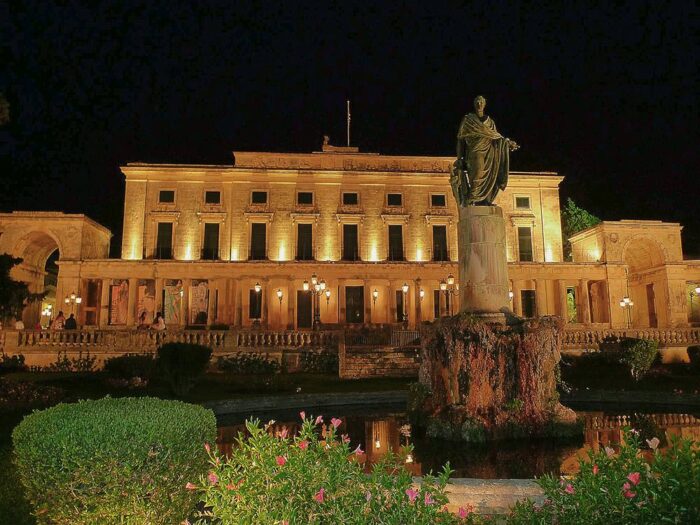
During the era of British rule, work began in 1819 on a grand residence for the Lord High Commissioner of the Ionian Islands. It grew into the Palace of Saint Michael and Saint George in Corfu town, a palace far larger than any ordinary house.


The building was designed by the English engineer Colonel Sir George Whitmore (1775-1862). Despite its enormous size, it is elegant and well proportioned, and it has been described as one of the best examples of Regency architecture outside Britain. It is also one of the largest palaces in Greece, after the palace of King Otto in Athens, which today houses the Greek parliament.
The architecture
A long line of Doric columns runs along the front, with two gates: the Gate of Saint Michael and the Gate of Saint George. The facade carries carved representations of the Ionian Islands. In the garden stands the statue of Commissioner Frederick Adams, made by the Corfiot sculptor Pavlos Prosalendis.
Inside the palace
Two rows of Ionic columns surround the main hall, which shows scenes from the Odyssey. The first floor is decorated with Corinthian columns and has three main halls: the ballroom, the throne room and the symposium room.
History of the palace
During British rule, the palace was the residence of the Lord High Commissioner, the seat of the Ionian Senate and the headquarters of the Order of Saint Michael and Saint George.
After the union of the Ionian Islands with Greece, it became a residence of the former Greek royal family. In 1994 it hosted a summit meeting of the European Union.
The palace today
Today the palace is a museum. It houses the Museum of Asian Art and the Municipal Gallery, and it looks over the north side of Spianada Square on Iroon Politechniou Street.
Visiting the palace
Today the palace houses the Museum of Asian Art, the only museum in Greece dedicated entirely to Asian art, with collections from China, Japan, India, the Himalayas and Central Asia.
Opening hours: Summer (April to October) 08:00-20:00; winter (November to March) 08:30-15:30, closed on Tuesdays. The last entry is 20 minutes before closing.
Tickets: around €10 in the standard season (check before you go, as prices and free-entry days change).
Phone: +30 26610 30443
Website: matk.gr
Hours and prices are set by the Ministry of Culture and can change, especially on public holidays, so check the museum’s website or call before you visit.


Comments