
10 Beautiful and Traditional Old Villages in Corfu

Discovering the island’s most charming villages

Corfu is not just a tourist spot, but it also has some very beautiful, old, traditional villages scattered around the island, most of which preserve their history and customs and have not been touched by uncontrolled tourist development.

Corfu is not particularly large; it is the 7th largest Greek island, but it is very densely populated to the point that there are over 200 villages and settlements.

Exploring Corfu’s best villages is the perfect way to discover the unique charm of this Greek island.

From the picturesque mountain retreat of Old Perithia to the cobblestone streets of Koinopiastes, each village offers its unique character and heritage.

Many traditional Corfu villages are still free of the tourist crowds and offer a glimpse into traditional Greek life, with traditional buildings and old mansions, traditional cuisine, and local culture.

The traditional Corfu villages of Agios Mathaios, Nymphes, and Pelekas are ideal for those looking to explore the culture and customs of the region. With stunning landscapes and charming streetscapes, each village offers a unique experience that must be experienced to truly appreciate.

In villages, casual slang and playful expressions dominate conversations, reflecting the everyday life of locals.

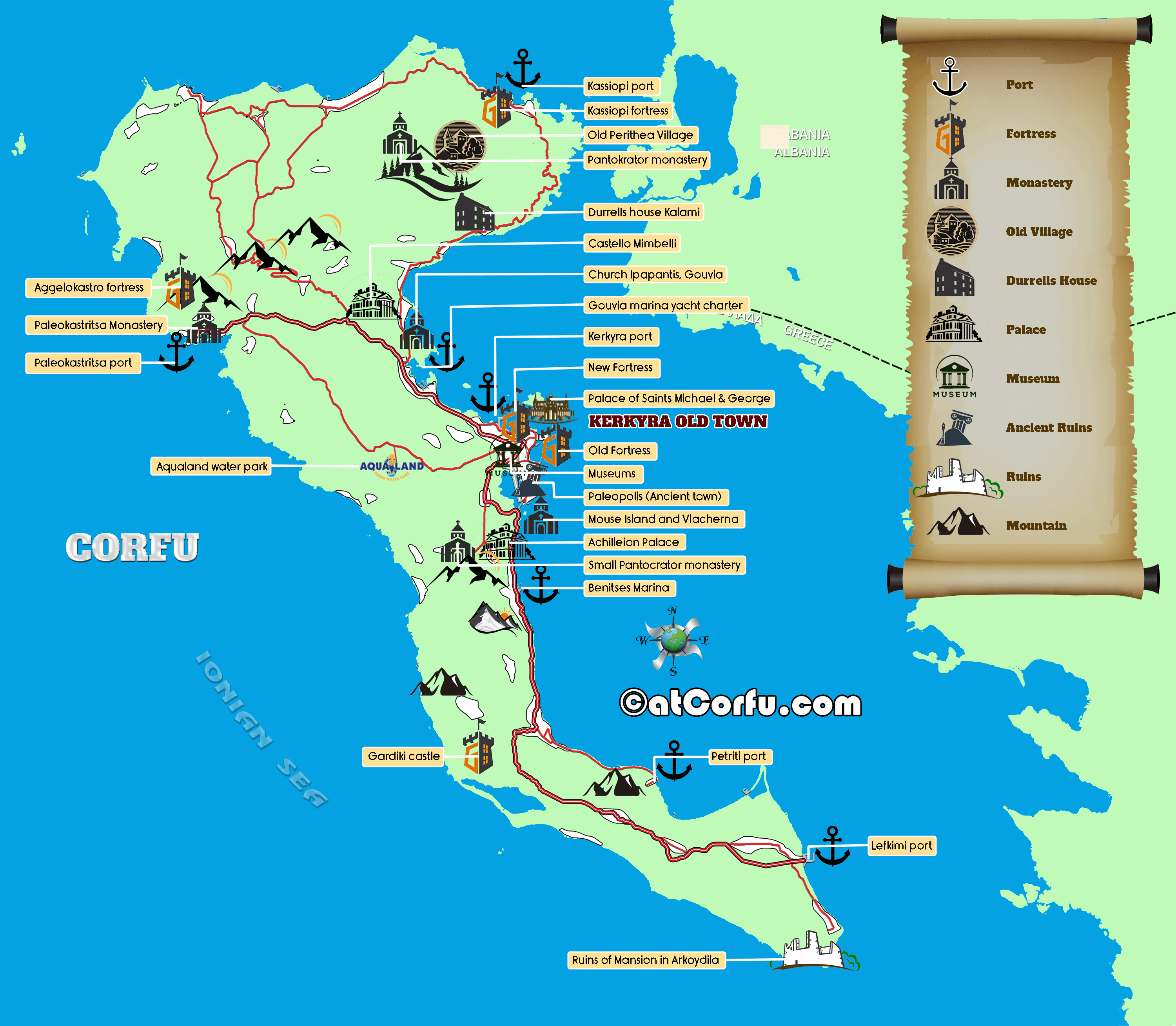
Most visitors to Corfu are aware of only the tourist parts of the island. They still know the most beautiful beaches with the big hotels and the places of archaeological and historical interest, such as the old Corfu town or Achilleion palace, but they ignore the real Corfu, which lives in the island’s old and traditional villages.

And there are many of them, mainly old mountain villages where time moves very slowly and which have been inhabited since ancient times.

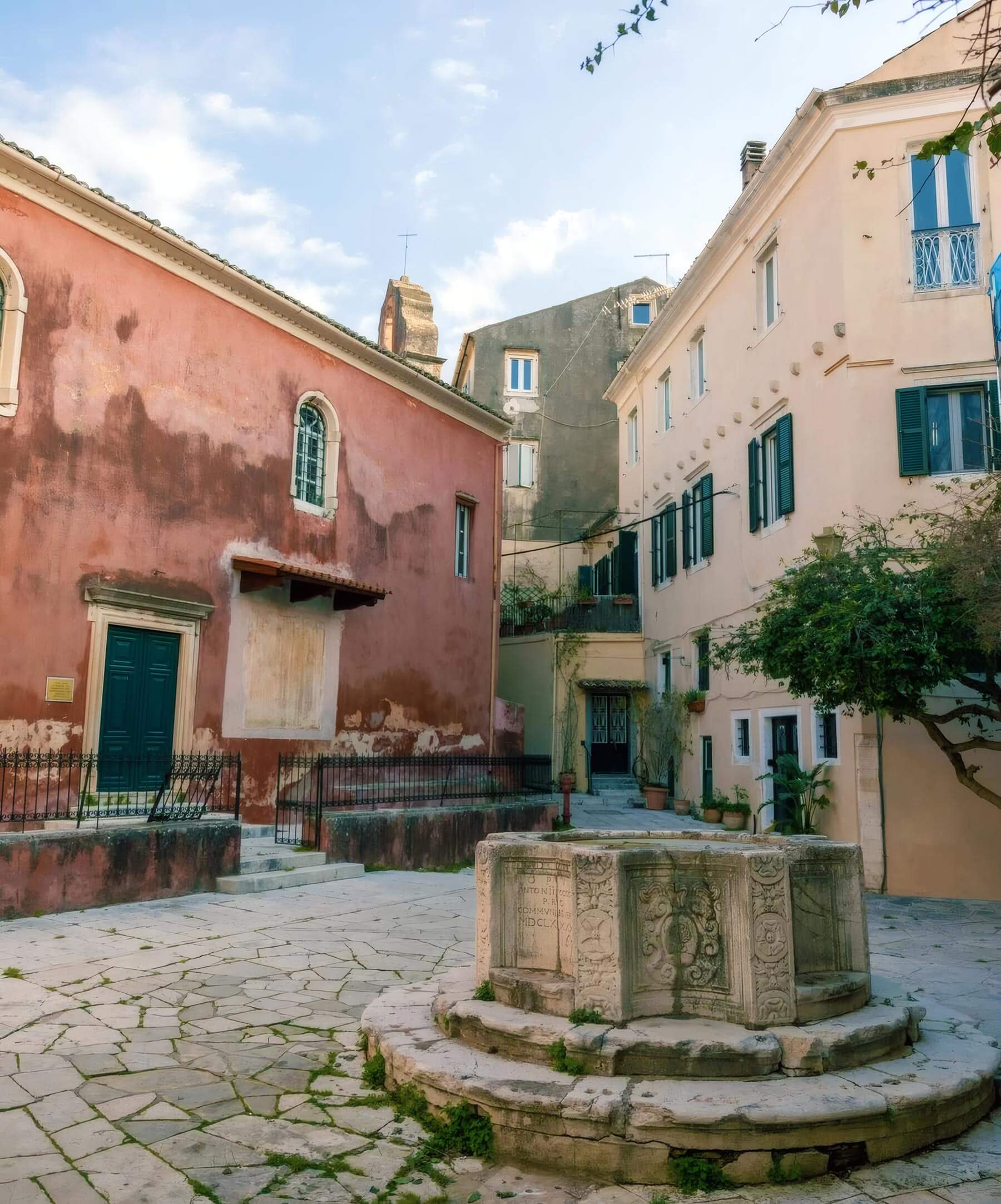
They present an important and rich architectural and urban planning interest since they are influenced by the Venetian presence on the island.

The most difficult for us was the selection of the most beautiful among the dozens of candidates for the title of the best Corfu villages.

But let’s take a closer look at the 11, in our opinion, most important and beautiful old villages of Corfu.

Nymphes

Waterfalls in Corfu Nymfes

A village built at an altitude of 200 meters, on a slope of the Pantokrator mountain that dominates the northern part of the island. The first time that the name appeared in official documents was in 1347; therefore, it is indeed a very old village.

The area is surrounded by lush vegetation with olive groves, oak trees, huge plane trees, and cypress trees. This makes it an ideal place for walking tourism.

However, the village owes its special character to its springs and waterfalls, which are unique on the island. These springs could sustain up to 21 watermills in the past, but today we find only the ruins of them close to the village. The vegetation is vigorous, and the waterfalls are simply beautiful.

The village took its name from these springs in which, according to mythology, water deities, Fairies, or Mermaids, who in ancient times were called Nymphs were lived here. Nymphes means the place of Mermaids.

The Settlement is built according to the standards of Corfu architecture with Venetian, Frankish, and British influences.

If you visit the village, the souvenir you will buy will be some Kumquat derivative, such as a sweet or a liqueur, since this traditional citrus fruit, originating from China, is cultivated here in large quantities due to the abundant waters.

Festivals and all kinds of local cultural events happen almost every day in the Corfiot villages, one of them is the Dance of the Priests, which takes place simultaneously in the nearby village of Episkepsis and here.

The priest of the village starts the dance, and all men follow each other in turn according to their age and their social position in the community. The chorus repeats the verse that the priest says without the accompaniment of music. See more here.

Lakones

Lakones village
Lakones village

Lakones is another beautiful, picturesque old village in the northwest of the island. Perched on the mountain, Lakones is the village that gives Paleokastritsa half of its beauty.

Yes, don’t be surprised, from here the admittedly beautiful Paleokastritsa looks even better.

From Lakones, one can enjoy the picturesque scenery of the varied coastline, which is, according to many, the most beautiful part of the island.

From the village, you can see both the beaches inside the settlement of Paleokastritsa and also the beaches further south, which are the most isolated and beautiful, such as Rovinia.

There is no intense tourist development here; despite this thought, there are several restaurants and rooms for rent for those who enjoy the quiet of the old village better than the intense tourist traffic of the beach.

And always, let’s not forget the amazing view.

Pelekas

Pelekas lies 13 km west of the town of Kerkyra, on the west Corfu coast, up on a hill.

It is indeed one of the oldest and prettiest Corfu villages.

Pelekas has very interesting architecture. The old houses seem to be perched on the slopes with the main road running between them, climbing towards the top.

But this isn’t all. From here, one can enjoy spectacular views and magical sunsets, as this mountain village has a clear view of the west Ionian Sea. If the weather is clear is possible that southern Italy can be seen.

There are beautiful souvenir shops and cafés in the village, also traditional restaurants offering delicious Corfiot dishes aren’t missing.

The famous spot from where the whole of middle Corfu offers a spectacular view is the Kaiser’s Throne, at the top of the hill, which used to be the favorite spot for the German emperor Kaiser Wilhelm II. There is a cafe near the hill of the Throne from where the views are unique.

The village has its beach called Kontogialos, a very busy sandy beach at a close distance from other famous beaches of the island, such as Glyfada and Myrtiotissa.

Benitses

Benitses is one of the oldest traditional villages in Corfu.

According to official documents, it has existed since 1200CE with the name Penitise, but the ruins of the existing Roman villa with baths indicate that the place was inhabited since antiquity.

It is the perfect combination of mountain and sea as it lies in the middle of a valley at the center of Corfu’s east coast, very close to the city of Corfu.

Today, the traditional part keeps all its old-style glory with old renovated houses and all its natural beauty despite the intense tourist development which started back during the 60s.

This beauty coexists with excellent tourist facilities such as hotels of all categories, rooms, and studios.

Benitses village, without a doubt, is an idyllic place, worldwide famous in the past, with a current presence in tourism and great prospects for the future that every tourist to Corfu must visit.

Petriti

Petriti port
Petriti port

Petriti is a very traditional Greek fishing village in the eastern Gulf of southern Corfu.

The fishing boats return with their catch, so if you’re lucky enough to be there when the boat comes in, you’ll probably eat the freshest fish you’ve ever eaten in your life!

Many fish taverns exist along the coast here, and in recent years, they have also adapted to the tastes of foreign visitors.

Across the bay are the saltpans of Lefkimi, and closer is a small island that a resident has declared to be his republic!

Petriti is accessible by two roads. One is the coastal road from Messonghi, which follows the relatively quiet coast right next to the sea, and also passes by Boukari, a small fishing location.

The second starts from the main road to the south of the island. When you reach Argyrades, you turn left, and in a little while, you will reach Petriti.

Today, Petriti is a relatively large village, since in recent years it has expanded inland far from the sea. It remains, of course, a quiet village, which will remind the older visitors of the old Greece, before the arrival of fast food and loud music.

The sea remains shallow for several meters from the shore and is therefore safe even for small children.

Old Perithia

Perithia is built at an altitude of 450 meters on a plateau of eastern Pantokrator, near Kassiopi.

It is perhaps one of the oldest, if not the oldest, villages of Corfu, as the area has been known since 300 BCE.

The village is said to have been built by devastated people who lived close to the beach when they were hit by a tsunami.

But also, the fear of pirates during the Middle Ages forced many inhabitants to choose mountainous, inaccessible, and invisible places from the sea to build their villages.

The same happened to many other old mountain villages on the island, too.

During the Middle Ages and up to 1400AD, the population increased mainly due to this protection from pirates since the village is not visible from the sea at all.

There were very rich mansions and large schools here, as evidenced by the ruins, and in general, the village flourished.

But despite the isolation, the village was affected very badly by the malaria epidemic that ravaged Corfu in the 15th century, forcing almost all the inhabitants to abandon it. This was the start of the end of Old Perithia

Later, the advantages of isolation during the Middle Ages became disadvantages when piracy disappeared and the great tourist flow to Corfu began.

Life in the mountainous environment of the village became difficult, and so the remained inhabitants moved down to the nearest tourist areas, such as Kassiopi and Acharavi, to find work.

Inevitably, little by little, the village was abandoned and began to fall into disrepair.

But in 1980, the whole of old Perithia was declared a preserved cultural monument, and this changed the village’s fate; it was the beginning of its rebirth.

A little later in 2009, Mark from London and Saskin from the Netherlands fell in love with the village and decided to invest in it.

They bought a dilapidated mansion and renovated it, keeping its architecture intact. This house became a small hotel.

Their example was followed by many descendants of the old residents who started repairing the old houses, slowly bringing life back to the ghost village, because that’s what Perithia was called before 2009.

Today, around 130 houses have been renovated, using the stone of the area, following the local Corfu style and preserving the Venetian elements.

There are still old mansions and the church of Agios Iakovos at the entrance of the village, which is considered one of the most remarkable monuments. But also several taverns that attract people from other places and give life and income to the now permanent residents.

Please note that cars and swimming pools are prohibited in the settlement.

The village today is one of the most beautiful retreats of Corfu, and many artists and writers live there.

Stavros

Corfu view from Stavros mountain

Stavros is a small traditional mountainous village at an altitude of 400 meters, almost in the center of the island. It is an old and very picturesque village without tourist development.

Life here is typical of a small Greek village, and it is worth a visit.

Nevertheless, there are some rooms for rent here and there and some cafes for a drink that offer a fantastic view of almost 70% of the island, and especially many villages and landscapes located in the southern part of Corfu.

Stavros is located on the mountain that hangs above Benitses, the distance between the two does not exceed 1000 meters, and there are many paths, and including a normal road that connects them.

These are ideal paths for hiking lovers, while houses or small churches pop out of the lush vegetation with a great interest for visitors.

Agios Mattheos

Agios Mattheos, or Ai Mathias, as the locals call it, is a large village in the southwest of the island near the beach of Halikounas.

It is built at an altitude of about 150 meters, behind Mount Gamelion (Wedding), a conical mountain with a peak of 465 meters, which completely hides the village from the sea.

Agios Mattheos is officially classified as a traditional village of Corfu.

Unfortunately, the population is constantly decreasing. In 1960, there were more than 2000 residents living here, which slowly decreased. In 2011, there were only 1000, and the majority of them were elderly.

Unfortunately, today and after the 2021 census, there are even fewer.

The settlements of Chalikounas and Skala, both amazing beaches, also belong to the village.

There is no tourism here, and the inhabitants are employed almost exclusively in agricultural and livestock activities.

The village, for many decades, has had its football team called OFAM, which comes from the acronym of the words Omilos Filathlon Agios Matthaios(Group of Funs of Agios Mattheos)

And there is also a normal field with grass, one of the few on the island that exists in villages.

The life of the inhabitants flows calmly through their agricultural pursuits, while during free hours and holidays, the many coffee shops of the village, which are mainly located in the square crossed by the main road, are full.

Residents gathered there, playing cards, discussing or arguing, or simply lazing around. It is a typical Greek rural village.

Tradition says that the mythical king of the Phaeacians, Alkinoos, got married at the top of Mount Gamelion.

There are also several attractions in the area, with the main ones being the Venetian alleys and the colorful houses of the settlement.

  1. The Pantokrator monastery on Mount Gamelion.
  2. The forest with pines on the way to the monastery.
  3. The Grava cave, also on Mount Gamelion, is a cave of great importance since the findings there reveal Paleolithic and Neolithic settlements in the area, which communicates with the sea through the so-called “Hole of Pelau” (The hole of the open sea)
  4. Finally, someone should see the Gardiki fortress, an octagonal castle with eight towers and three gates, dating from the time of the Despotate of Epirus, built by Angelos Komnenos at the same time as two other castles of Corfu, Angelokastro, and Cassiopi’s castle(13th century).

Chlomos

Chlomos lies on the East Southeast side of the island, about 20 km from the town, and is one of the oldest villages of Corfu and one of the most picturesque on the whole island. Some call it the “Balcony of Corfu” because from there, at an altitude of 270 meters, you can enjoy a wonderful view, both of the southern part of the island and the eastern coastline of Corfu.

Chlomos was built around the 13th century on the slopes of Chlomos mountain and has special architecture. Its houses are built around the central square and not along any central road. Most are of Venetian architecture and are painted in red and orange colors, giving the village a distinct traditional image.

If you wander through its cobbled streets, you will discover many old mansions, including that of the Despot of Morea(Peloponnisos), Thomas Palaiologos, brother of the last Byzantine Emperor Constantine Palaiologos. This mansion dates back to the 15th century.

Going up towards Chlomos, you will have the opportunity to admire from above the Korission lake, which extends over an area of 6,000 acres and is one of the most important wetlands on the island, as well as the wonderful Cedar Forest of Issos.

According to tradition, the name Chlomos(which means pale) came from the appearance of the inhabitants, who were pale because the area had been hit by malaria at the beginning of the 19th century.

Lefkimi

Lefkimi river
Lefkimi river

Lefkimmi is built around the river that flows out near the Lefkimi port and is one of the oldest villages of Corfu.

It is located in the southernmost part of the island, about 40 km from the airport of Corfu.

Its name was used in the 11th century by the Andegavs to name the entire area of southern Corfu.

Until about 1980, it was the most neglected town of Corfu with dirt roads, old houses, and a sense of misery since it was almost the poorest area of the island.

But these are a thing of the past because, after 1980, vertical development began with the construction of the ring road that bypasses the city and ends at the port.

The large port of Lefkimmi is today the second largest port of Corfu. With a daily ferry service to the port of Igoumenitsa on the opposite mainland coast, the cost of the ferry is less than that of the port of Corfu, and this may be of interest to those who want to travel cheaply.

So today Lefkimi is a modern city, the second in Corfu after the capital, while the old streets have grown in size and quality, and the houses have been renovated.

There are narrow streets full of mansions and country houses, as well as rooms for rent, although the town has no tourist activities.

Lefkimi has many interesting Italian-style churches located in the upper town.

Very close by are also the salt pans that, until a few years ago, produced salt; today they are closed, and the old buildings have become a wildlife refuge, where flamingos, egrets, and many migratory birds can be seen.

The sea in the salt flats is impressively very shallow, warm, and sandy, even for kilometers away from the shore, so it becomes ideal for children.

Historical detail: Lefkimmi was the scene of a daring rescue operation in World War 2 when a Lancaster bomber crashed. Some locals rescued the crew, hid them, and then drove them to Kontokali, where they were picked up by a British submarine.

In brief

In this short list, we certainly can’t cover all the beautiful traditional villages of Corfu; maybe we did an injustice to some that are missing from our list.

We certainly missed many large, small, picturesque, or traditional villages of the northern and middle parts of Corfu. For instance, some of them are Avliotes, Karousades, Agros, Doukades, Upper and Lower Korakiana, Sokraki, Spartilas, Gastouri, Koinopiastes, and many more. None of them is touristy, and their inhabitants survive by agriculture and stock raising.

So, the choice was very difficult; after all, Corfu has more than 200 villages, most of them unknown to tourists. Our objective is to encourage you to leave the beaches and crowded tourist places for a while and try to get to know the real Corfu.

In the atmosphere of Corfu’s unique villages, the turbulent history and the traditions and influences are still very much alive.

Angsana Corfu Hotel: A Luxury Resort in Benitses

Nestled on a lush hill overlooking the clear Ionian Sea, Angsana Corfu Resort & Spa is Banyan Group’s first European property and a premier 5-star hotel in Corfu, Greece. This remarkable destination blends Greek hospitality with Asian influences in its elegant rooms, suites, and luxurious villas with private pools. Enjoy the stunning infinity pool, seaside dining, private beach, and world-class wellness facilities, all set against the backdrop of breathtaking scenery.

Angsana Corfu Hotel in Benitses is the new luxury 5-star hotel in place of the closed 2008 San Stefano hotel which belonged to the Manesis family and since 2008 is owned by the Kerschikov group.

Belongs to the Angsana Hotels and Resorts chain belonging to the Banyan Tree Group, which cooperates with the Kerschikov group and is constructed by KLC III Hellas.

The Hotel

Angsana Hotel sits on a hill on the north side of Benitses, 150 meters above sea level, providing uninterrupted views of the south of the island, a panoramic view of Corfu town, and the northeast part of the island. To the north of this hill is the famous Achilleion Palace.

The Angsana Corfu promises a slice of paradise with its breathtaking views of the Ionian Sea, lush gardens, and a pristine private beach. It’s not just a hotel; it’s an experience.

Imagine waking up in your plush room, greeted by the gentle sea breeze. You’ve got a world of relaxation at your fingertips – from lounging by the pool to indulging in rejuvenating spa treatments.

Oh, and the dining! Get ready to embark on a culinary journey, savoring gourmet delights infused with local flavors. From traditional Greek dishes to international cuisine, your taste buds are in for a treat.

But the real magic happens when the sun sets. Picture yourself enjoying a cocktail at the bar, watching the sky turn shades of pink and gold over the sea. It’s pure bliss.

So, if you’re craving a getaway that’s all about luxury, natural beauty, and unforgettable moments, the Angsana Corfu is calling your name. It’s a place where dreams come true, memories are made, and relaxation is the ultimate priority. Get ready to be pampered and captivated – your Corfu adventure awaits!

The Swimming Pool

The hotel offers a stunning 1000 sqm infinity pool, awarded the esteemed Prix Villegiature 2022 for Best Hotel Pool in the World, and is a highlight among luxury hotels in Corfu, Greece.

This picturesque and Instagrammable location merges seamlessly with the sea, giving the impression of swimming into the horizon.

For ultimate privacy, Angsana Corfu Resort & Spa offers 37 exclusive private pool villas, where guests can indulge in romantic dinners under the stars, enjoy revitalizing in-villa massages, or enhance their stay with unique villa experiences.

A Family-friendly hotel

At Angsana Corfu Resort & Spa, families have a wealth of choices.

Children can delight in our Kids’ Club, take swim lessons, or join in various daily activities.

San Stefano Estate: Venetian Manor in Benitses

The house of San Stefano was built on the hill just north of Benitses, in 1782, by a member of the great Venetian Giustiniani family, on the site of an older house destroyed by an earthquake- so the new manor was built on a rock!

The house was the center of a large estate and took its name from the private chapel of San Stefano, which is built on the same rock as the manor.

San Stefano and the farm passed by marriage into the Flamburiari family, and more recently was given as a dowry when Lily Flamburiari (the current owners’ grandmother) married Petros Manessis.

It has a unique place in the History of Corfu as the visitors’ books show.

Amongst them was Elizabeth of Austria and Kaiser Wilhelm 2nd, a photo on the landing is a gift from Queen Alexandra.

More recently Vivien Leigh, Roger Furse, Gerald Durrell, and notables in many fields have enjoyed a drink on the balcony whilst watching the sunset.

British High Commissioner Sir Frederick Adam stayed in the house while supervising the construction of the waterworks which finally supplied Corfu Town with mains water (around 1850).

The furniture shows the family links with Venice, Greece, England, and India (where Lily Flamburiari was born in 1896).

The present generation has a cosmopolitan inheritance on both sides, as Petros Manessis mother Sofia was the daughter of a notable Victorian philosopher-diplomat Sir Peter Vraila-Armeni, who gave Elizabeth of Austria his villa at Gastouri which enabled her to build the Achilleon Palace.

He was a highly respected Greek ambassador in St Petersburg and at the Court of St James – indeed when he died Queen Victoria was so upset that she instructed one of her warships to bring his body home to Greece.

The house now has been renovated so that you can enjoy it too!

It is available to rent as a whole, suitable for a large family or group of friends.
It is also the perfect venue for celebrations – weddings, anniversary parties, etc., and groups of people sharing an interest.

It is set in five acres of land – citrus trees, olive groves, and gardens so there is total privacy, and they can be enjoyed by everyone staying at the house.

The views are spectacular, looking across the Corfu Channel to mainland Greece.

In front of the house is the private chapel of St Stephen, and to the side are the old farm buildings, with an interesting history of their own, as over the centuries they have been rented to monks, nuns (the aunt of Tsar Nicholas 2nd brought her nuns there and donated a fine icon to the church).

During the first world war, they housed the British staff of a field hospital.

Don’t miss the chance to explore the old historical pictures of the house on this page.

Our aim is for you to love our house, and our beautiful island.
We will do our best to help you do this, and delight in helping you to discover the secrets which make Corfu so special.

For prices you can call the owner, Mrs Jan Manesis, Phone 0030 26610 72216 – Mobile 0030 6985030290 – Address PO Box 59 Vrioni, Corfu 49084, Greece

Greek Symposium

Why Do Greeks Use To Eat Late At Night?

Posted in: Travelling in Greece 0

Many people who come to Greece for vacation wonder why they see that all the restaurants are full late at night.

Under which circumstances are Greeks used to having this habit?

The answers come from Greek history and the weather conditions in Greek territory.

Greek Symposium
Greek Symposium

Deepnon in the ancient Greece period

– Ancient Greeks used to have three meals; breakfast (akratismos) a small snack which usually was a slice of barley bread dipped in wine, lunch late in the afternoon which included a bigger variety than breakfast and the main lunch the richest of all late at night called ‘Deepnon’.

Usually, Greeks had this ‘Deepnon’ with the company of some friends hearing music and speaking for political and philosophical issues. They took part in the famous “Symposia”.

Small note: “Deepnon” (Greek: Δείπνον) in ancient Greek or ‘Deepno” (Greek: Δείπνο) in modern can be translated as “Dinner” in English, although it wasn’t dinner at all.

Deepnon in the Byzantine era

– Byzantium included many different ethnicities, and the dominating culture was the Greek one.

Byzantines continued the Greek tradition of eating the “Deepnon’ late at night, in big companies families, and with friends.

The dining room was the biggest room of all in the house and for the first time in history, Byzantines used to have fine tablecloth and flatware many of which were silver-made.

After the first crusade westerners came, and they were very surprised as they had never seen those luxury objects before.

It seems that the Byzantines enjoyed their meals at night as the ancient Greeks did before, but from the 10th century, they stopped sitting in small sofas called anaklintra (recliners) and started sitting in chairs.

Ottoman imperial and modern Greek State

– During the ottoman imperial and when the first Greek state formed, the society was mostly agricultural.

Families used to work all day long from morning to sunset, even women and children.

After a long-day working logically, needed many hours to prepare their food. The late-night lunch was unavoidable.

Another reason why Greeks eat late at night is the hot weather, especially during the summer which lasts for about six months.

Latest years

After the 70s Greeks started to work all day long in touristic jobs and the families continued to eat late at night.

Nowadays Greeks use to entertain themselves by visiting a cinema or a theater and finishing with a nice ‘Deepno” in a good restaurant. Furthermore, in many Greek live music halls, food is served before the start of the performance.

Coasts and Villages of Corfu: A Unique Video

Posted in: Corfu Videos 0

So watch this video by Petros Kapsokavadis that shows a different perspective of our island, it was made for the Oasis Hotel in Perama, Corfu.

Here is the channel of Petros Kapsokavadis on Youtube

This video shows that Corfu is beautiful always, during winter is well, and perhaps in winter, it’s even better.

It does not follow the beaten path, that is, it does not only show the well-known tourist beaches but also the interior of the island with its traditional unique villages and unique green landscapes.

It also reveals in a unique way the heart of the island, where the hidden Corfu exists and where the traditions of this place still live.

Of course, it does not include everything that would be worth seeing, because there are so many that could not fit.

Corfu really is a continent in miniature in itself, it cannot be described in words but only in pictures. See them.

Mon Repos Palace in Paleopolis of Corfu

About Mon Repos Palace

Mon Repos Palace is a historic neoclassical building in the eastern part of Paleopolis, which is what Corfu’s ancient city is called.

The palace is situated on a hill overlooking the sea and was built as a summer residence for the British Commissioner of the Ionian Islands, Frederick Adam, in 1828, at the beginning of the peninsula of Kanoni opposite the ruins of Paleopolis. Though impressive, it falls short of the grandeur of the Achilleion Palace.

This structure was a gift from Sir Frederick Adam to his Corfiot wife, Nina Palatianos, reflecting his dedication to the Ionian Islands’ development, seen in various infrastructure projects he undertook.

Mon Repos Palace
Mon Repos Palace

Later and throughout British rule, the palace was used as a summer residence for the commissioner in charge.

The Mon Repos estate covers an area of about 250 acres and includes a large garden with rare trees and plants, as well as a small lake. The palace itself is a neoclassical building with 12 rooms, which has been renovated and restored over the years.

Its well-laid-out gardens feature a variety of trees and plants, including palm trees, cypress trees, and eucalyptus trees, and are surrounded by the old Greek monuments of ancient Corfu and have spectacular sea views of the eastern coast of Corfu island, as well as a large pond with a small island in the center.

Source: https://en.wikipedia.org/wiki/Mon_Repos,_Corfu

Queen Elizabeth of Austria in Mon Repos

Queen Elizabeth of Austria, also known as the Sad Empress Sisi, stayed at Mon Repos Palace before commissioning the construction of the Achilleion Palace on the island of Corfu. It was during her stay at Mon Repos that she fell in love with the island and decided to build her palace there.

Empress Elizabeth, known as Sisi, was a frequent visitor to Corfu and often stayed at Mon Repos Palace. She was particularly fond of the gardens, which she found to be beautiful and peaceful. It was during her visits to Mon Repos that she became interested in Greek mythology and began to incorporate themes from Greek mythology into her own life and work.

Mon Repos and the former Greek royal family

According to the union treaty of the Ionian Islands with Greece, the building was to be given for use by the Greek royal family. Note: only to use it, not to own it.

And indeed, after the union with Greece in 1864, Mon Repos was used as their summer residence until the abolition of the Greek monarchy in 1973.

In 1974, after a referendum on the Greek Republic, the monarchy was definitively abolished, with 70% of the voters voting against the monarchy, and the alleged royal property was assigned to the Greek state.
Source: https://en.wikipedia.org/wiki/1974_Greek_republic_referendum

The former royal family appealed to European courts, considering this area and two others north of Athens as its property, but the European courts decided conclusively that the property now belongs to the Greek state and that the only thing the former royal family was entitled to was a small monetary compensation.

So the matter was closed once and for all. The Greek government considered the palace public property and turned it into a museum.

The palace is now open to the public as a museum.

The Gardens of Mon Repos

The gardens were designed by a team of British architects and landscape designers, including Sir Thomas Mawson, Edith Wharton, and Geoffrey Jellicoe, and were commissioned by the Greek royal family in 1819. The garden is located on a hill overlooking the Ionian Sea and covers an area of approximately 258 acres.

The gardens are divided into several sections, each with its unique features. One of the most notable features is the Pinewood Garden, which features a dense forest of pine trees that provides a cool respite from the hot summer sun. Another notable section is the Garden of the Nine Muses, which features nine statues of the muses, each with a different instrument or attribute.

Other sections of the garden include the Palm Garden, the Rose Garden, and the English Garden. The gardens also contain several buildings, including the Mon Repos Palace, which was built in the neoclassical style and served as a summer residence for the Greek royal family.

Today, the Gardens of Mon Repos Palace are open to the public and are a popular destination for tourists visiting Corfu. Visitors can stroll through the gardens, explore the various sections, and learn about the history of the palace and the royal family that once resided there.

The wide area of Paleopolis, Corfu

Ancient Corfu Paleopolis

Paleopolis is the ancient city of Corfu, and it is considered one of the most important archaeological sites on the island. The site covers a wide area and includes several important historical and cultural landmarks.

The city was founded in the 8th century BC by the Corinthians and was an important center of trade and commerce in the ancient world. Today, the archaeological site of Paleopolis covers an area of approximately 20,000 square meters and includes several important landmarks, such as the Temple of Hera, the Temple of Artemis, and the Sanctuary of Kardaki. Mon Repos Palace is inside the wide area of Paleopolis in the Eastern part.

More about Paleopolis

Is Mon Repos the birthplace of the Duke of Edinburgh, Phillip?

Prince Philip, the Duke of Edinburgh, was born in Mon Repos Palace in Corfu on June 10, 1921. He was born into the Greek and Danish royal families as Prince Philip of Greece and Denmark and was the fifth child and only son of Prince Andrew of Greece and Denmark and Princess Alice of Battenberg.

At the time of his birth, Greece was a constitutional monarchy, and Prince Philip’s grandfather, King George I of Greece, was the reigning monarch. However, the family was forced to flee Greece when Prince Philip was just a baby due to political turmoil in the country.

After leaving Greece, the family settled in Paris, and Prince Philip was later sent to school in England. He eventually joined the British Royal Navy and served in World War II before marrying Queen Elizabeth II in 1947 and becoming the Duke of Edinburgh.

Despite being born in Greece, Prince Philip spent very little time there and was primarily raised and educated in England. However, he maintained a strong connection to his Danish heritage throughout his life, but never visited Greece. He even denied his Greek identity.

Bolovini Eleni, a historian writes about the strange life of Pince Philip and why he denied his Greek identity.

(Greek: Η πραγματικά παράξενη ζωή του πρίγκιπα Φιλίππου, πατέρα του Καρόλου -Γιατί απαρνήθηκε την ελληνική ταυτότητά του)
Source: : iefimerida.gr – https://www.iefimerida.gr/news/415189/i-pragmatika-paraxeni-zoi-toy-prigkipa-filippoy-patera-toy-karoloy-giati-aparnithike-tin

Mon Repos Corfu as a Museum

Mon Repos in Paleopolis

Today, Mon Repos Palace belongs to the Greek state, and it is used by the Municipality of Corfu, mainly for authoritative or festive meetings.

Mon Repos has been transformed into a museum and a historic place with a large park full of archaeological treasures that can be visited by all.

Inside the palace, there are exhibits showcasing the history of the palace and the island of Corfu, as well as displays of art and artifacts. The palace also hosts cultural events and exhibitions throughout the year.

It is an ideal place for pleasant walks under the shade of very large and old trees.

One of the museum’s most interesting exhibitions is the collection of old Corfu photographs, most interesting and informative.

This museum is open to the public on weekdays from 8 am to 7 pm for a small fee of 4€, while there is usually no charge on weekends.

Also, you can buy a combined ticket that includes visits to Mon Repos, the Asian Museum of Art in Corfu town, Achilleion Palace, and some other places simultaneously.

There are buses connecting Paleopolis with Corfu town every 40 minutes, but the distance is small and can be covered on foot in just 15 minutes.

The telephone number for further details is +30 26610 41369.

Wrapping Up

Today, Mon Repos Palace is open to the public and is a popular tourist destination on the island of Corfu. Visitors can explore the palace and its beautiful gardens, as well as learn about the history of the palace and the Greek royal family that once resided there.

1 11 12 13 14 15 16 17 53