
Gossip with a Twist: Corfu’s Petegoletsa Tradition

Posted in: Corfu Culture and Events 0

Petegoletsa

Petegoletsa - Street theater
Petegoletsa – Street theater

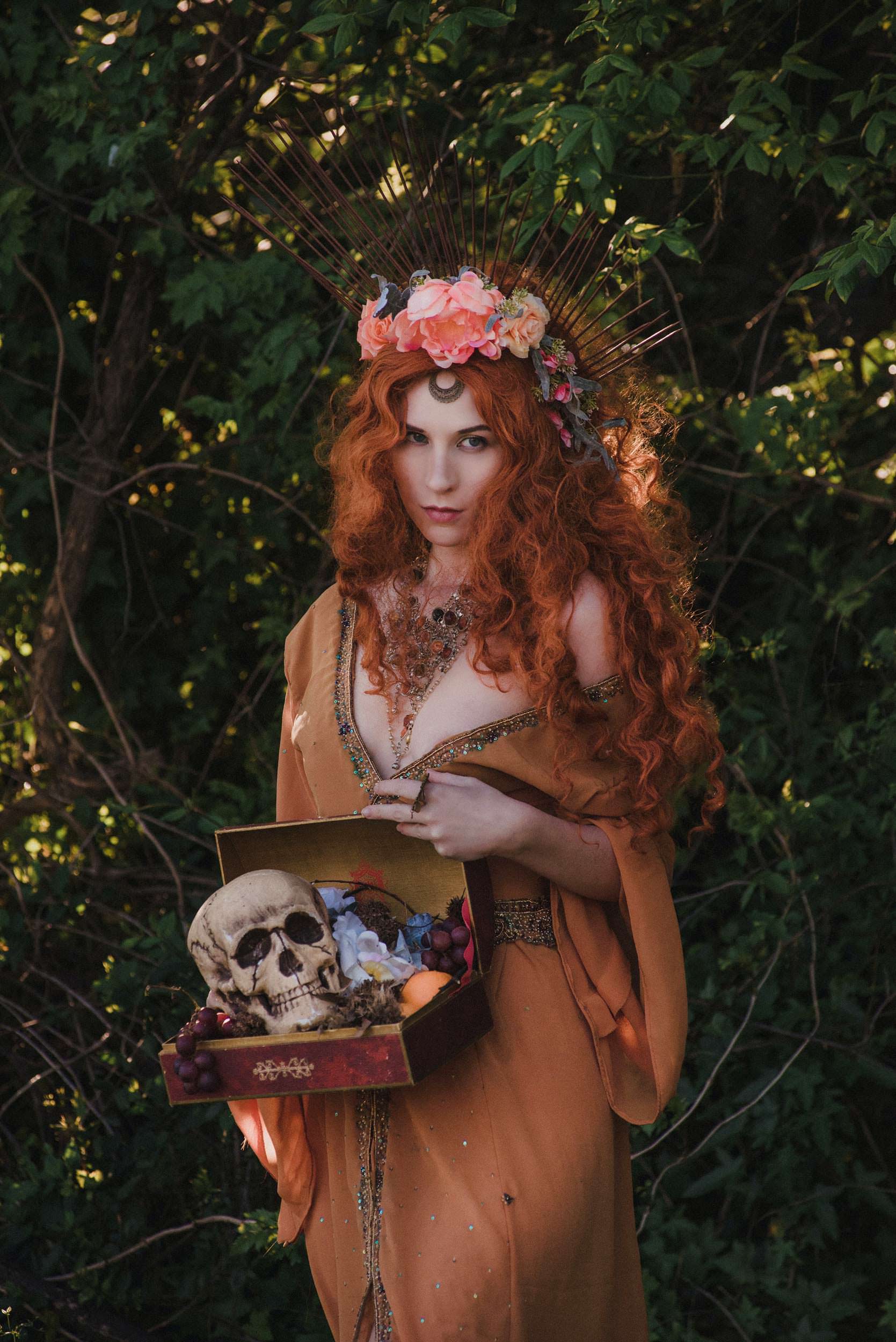
On the last Thursday of the carnival, Corfu has revived a very old tradition, an integral part of the Corfu carnival, which dates from the years of Venetian rule. It is called the Petegoletsia; petegolia is simply the gossip, which means exactly what it says.
It is a popular street theatre that takes place in public, between the balconies of the old city along the narrow alleyways.

In these ‘gossip plays,’ the women come onto their balconies and gossip to their neighbors, making sly comments about recent events and also about the laundry of the other people. These are all played in the original dialect of Corfu and in a libertine language and style that would make even Aristophanes blush.

It is the famous indiscretion of Corfu, which was misunderstood in other parts of Greece, but here it is completely different, the Corfiots routinely use this phraseology many times in everyday social life, it helps to halt misunderstandings at a low level, giving chance to let off steam and avoid the use of force.

The Petegoletsia are watched every year by thousands of people; they satirize politicians, even by exposing their personal lives and scandals in public, both at the national and local levels.
Local MPs, mayors, and other public figures have to listen and at least pretend not to mind the jibes.

Corfu Carnival: Echoes of a Venetian Past

Posted in: Corfu Culture and Events 0

The Corfu Carnival

Corfu Carnival
Corfu Carnival

The Ancient celebrations in early spring that took place in honor of Dionysus, god of wine and fun, hoping for a good harvest and successful husbandry, are the forerunners of today’s carnival in Greece.

Here in Corfu over the years, the celebrations gained a strong Venetian influence that makes today’s Corfu carnival completely different from those in other parts of Greece.

It also demonstrates the innate zaniness of the Corfiots and shows their creativity

Costumes were worn, and the floats were influenced by medieval pageantry and exuded an aristocratic Venetian “air”.

The satires of absolutely everything are scorching, especially the satires of the politicians, both of today and of the past.

Discretion and conservatism are unknown words, and revelry continues in both the city of Corfu and the villages, where they still maintain many unique customs that you can enjoy watching.

One of them is the famous custom of Venetian marriage, the sets and clothes of the era bring the atmosphere closer to that of the Middle Ages.

Floats parade through the streets during the parade on the first Sunday of the Prodigal Son and also on the last Sunday of Carnival, when the King of Carnival is burned, among other characters that exist only here are the “Ntotoroi” ( doctors), the “nodaroi” (notaries) useful in reading the will of Carnival, and the “Muzeta” that is our name for the carnival masks which give anonymity.

The masqueraders cover the whole of their faces with Muzeta; they are unrecognizable, and they go anywhere and tease people without showing any mercy to their victims.

On the third and last Sunday of the carnival, the parade ends with the final burning of King Carnival, with the symbolic burning of all evil, and the nodaroi (notaries) accompanying him reads his will, which is usually full of innuendos aimed at politicians.

This is followed by a celebration with dances and songs all night.

Benitses 2400 CE-4

What might Benitses in Corfu have been like?

Posted in: All Info to Benitses 0

Benitses in Corfu is a village with deep historical roots, and after Corfu’s Old Town, it stands as the island’s oldest tourist resort. Situated on the east coast, it’s just a short distance from the city center, making it an easily accessible destination.

But could it be different, could it be better?

As Greek locals who live here day in and day out, we see its imperfections more clearly. Infrastructure problems have plagued the village for decades, left unresolved despite the passing of time.

Benitses also lacks natural beaches, which is a real drawback for a coastal village. The beaches someone can see today are artificial, made by the locals who run hotels and shops here, nothing has been done by the state.

The sewer system, old and poorly maintained, sometimes leaves the air heavy with unpleasant odors. Sadly, this isn’t surprising in a country where infrastructure issues are common and neglected. Corruption and inefficiency seem to dominate, leaving many public services in disrepair.

Frequent water and electricity shortages, the long-lived garbage problem that is present all over the island, dammed rivers that create floods, broken roads full of potholes and dangerous turns….these are only a few of the problems in your dreamy tourist “paradise”.

We dream of a better Benitses, a place where these problems are addressed, but deep down, we know it’s a dream that may never come true, not in our lifetimes.

Corfu, with all its beauty and heritage, deserves better. Some of us even question whether it should belong to Greece, a country that too often fails to care for its own. It’s hard not to feel that Corfu, the queen of the Ionian Islands, deserves a brighter future, one free from the shadows of corruption and neglect.

This state has never done anything for Corfu, but they are very good at collecting taxes, that’s the only thing that they can do well!

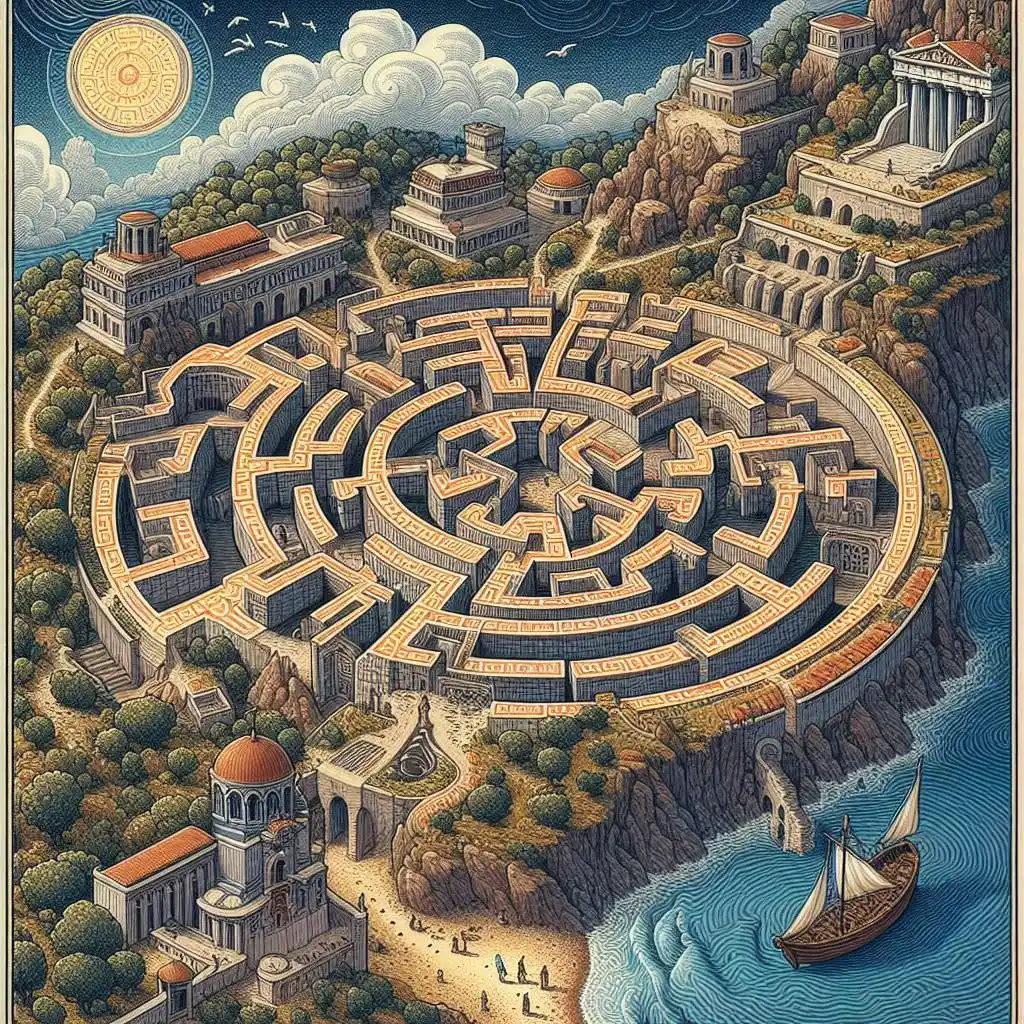
Today, we’re being brutally honest. And yet, we leave frustration on the site, and we created some idealized images using AI to visualize what Benitses could be one day in the future, in a different world.

Fantastic photos of Benitses (2400 CE)

Don’t be surprised, it’s not reality but just a fantasy. After all, what is real in today’s world? From the news media to social media, ideas, and even religions, much of what we’re told feels like a constructed reality, a series of illusions built on fake facts and empty promises.

So, enjoy your life while you can because it’s short. Don’t put your faith in politicians, journalists, or self-proclaimed experts. In the end, we’re all navigating a world where truth is elusive. As for us? We’ll keep dreaming of a better Benitses.

Go to Benitses Guide

Corfu Town Hall: The San Giacomo Theatre

Posted in: Corfu Town 0
Corfu town hall San Giacomo

Nestled at the vibrant crossroads of Eugeniou Voulgareos and M. Theotoki streets, Corfu Town Hall stands as an architectural masterpiece with an intriguing history. This charming edifice exudes an air of timeless elegance, captivating both locals and visitors with its unique allure.

Picture a harmonious blend of Venetian and Greek elements, expertly woven into its design. The façade tells a tale of grandeur, showcasing intricate details that harken back to the building’s origins. It’s not just a mere structure; it’s a cultural gem that has witnessed centuries of transformation.

Let’s rewind to 1691 when the foundation of this building was laid, initially serving as the gathering spot for the Venetian nobles of Corfu – the loggia di Nobili, as they called it in Italian. But that’s just the beginning of its transformation tale.

The San Giacomo Theatre

In 1720, it underwent a magical transition into a theater, named San Giacomo, and held the honor of being Corfu’s first-ever theater and a groundbreaking one for the entire Greek territory.

Between 1733 and 1893, this very theater took center stage as the hub of Greek opera, attracting a symphony of Italian musicians and composers. These creative maestros became part of Corfu’s musical fabric and, in turn, enriched its cultural legacy.

The notes of Italian and Corfiot music traditions harmonized on this very stage, creating an intoxicating blend, thanks to virtuosos like the Corfu composer Nikolaos Halikiopoulos Mantzaros. The crescendo of their artistry reached a high note when Mantzaros musically composed Greece’s national anthem from the poetic words of Dionysios Solomos.

Operas were the heartbeats of this historic stage, often resonating with the delightful strains of opera buffa, a comic opera style that was both entertaining and budget-friendly. Even during challenging times, like sieges, the theater played a dual role as both a tool of propaganda and a morale booster for the community.

The spotlight also shines on the passionate actors and performers who graced the stage – mainly Italians from southern Italy, alongside a sprinkling of Greeks. This became the nurturing ground for Greece’s very first musicians and composers, a pivotal moment when music was still unheard of in the rest of the Greek territory.

Corfu’s relevance during that time cannot be overstated. As the capital of the Ionian state, it was a political and spiritual hub. The San Giacomo Theater was a shining star on Europe’s cultural map, setting the stage for theatrical triumphs.

If work was “applauded in Corfu,” it was granted a golden ticket to perform on European stages. This litmus test ensured that only the best made the cut for international recognition.

Antonio Vivaldi himself graced this stage, presenting his oratorio Juditha Triumphans in honor of the Ottoman siege repulsion in 1716. This triumph paved his way to Milan and beyond, marking his first major oratorio.

Corfu Old Municipal theater
Corfu Old Municipal Theater

However, as time flowed on, the curtain eventually fell on the San Giacomo Theater in 1892, shifting its spotlight to the old Municipal Theater of Corfu. Tragically, this latter theater suffered immense damage due to the German bombing in 1841, ultimately making way for the New Municipal Theater – an architectural shift that might not have won hearts.

New Corfu Municipal Theater

Corfu Town Hall

In 1903, the grand transformation took place, and the building of San Giacomo was reborn as the City Hall of Corfu – a fitting new chapter for this cultural cornerstone.

Today, the building stands as the Corfu Town Hall, a living relic of the past that remains an integral part of the present. Its walls have seen transformation, adaptation, and reinvention, yet they retain the echoes of the lives and stories that unfolded within.

As you stand before the building, take a moment to immerse yourself in its history. Let your imagination wander through the ages, envisioning Venetian nobles, theatrical wonders, and the birth of a musical legacy. This building isn’t just a monument; it’s a living chapter in Corfu’s narrative, inviting you to be a part of its unfolding story.

So, when you gaze upon the Corfu Town Hall today, remember that it’s not just a building; it’s a living testament to Corfu’s artistic evolution, a stage that once echoed with the melodies of the past and a cornerstone of this enchanting island’s captivating history.

Liston in Corfu

Esplanade (Spianada) Square and Liston in Corfu

Posted in: Corfu Town 0

Spianada (Esplanade) square and Liston

The Esplanade is the central square of Corfu and a meeting place for residents and visitors, surrounded by the streets of Iroon Politecniou at the east and north, Eleftherias and Kapodistriou to the West and Akadimias Street in the South, and crossed in the middle by Dousmanis street.

Built-in the style of the Royal Gardens of Europe it is the largest square in the Balkans and one of the largest in Europe.

In the square’s bandstand, there are often concerts and other events, especially during the summer.

Cricket matches are also frequently played there.

Cricket is purely British sport which has been enthusiastically adopted by the Corfiots since the period of English domination of the island.

There are 12 cricket clubs and two other pitches on the island.

Corfu Cricket team is the only cricket team in Greece and so is the Greek National Cricket team also.

To one side of the square is the popular pedestrian area of The Liston with its French architectural buildings (modeled on the Rue de Rivoli in Paris) and numerous cafes.

The construction of The Liston began in 1807 by Napoleon, the sole purpose of the building’s construction was to house the French army.

It was completed in 1814. The buildings were designed by French architect Lesseps and implemented with the assistance of the Greek engineer Ioannis Parmezan.

Corfu Liston is a complex of buildings facing the Esplanade, with arched ground-floor galleries which the locals call “Volta”

The name was given by the word “list” which arrives from the Greek word “lista” that was used for the list of the Nobles (Libro d ‘Oro) as at the old days only the nobility were able to walk in this part in the city.

Today, the arcades of Liston are the busiest part of Corfu, it is filled with cafes, restaurants, and craft shops in general, and one that is busy all year round.

The walk-in front of the Liston’s arches is something that every Corfiot does and taking coffee in one of The Liston’s cafes is a daily habit for many Corfiots…

The Palace of St. Michael and St. George

Posted in: Corfu Town 0

During the era of British rule, High Commissioner Sir Frederick Adams in 1819 decided to build a house for himself and his family.

But he was a little exaggerated, and instead of a house, he created a unique palace in a Georgian style, the Palace of Saint Michael and Saint George in Corfu

The building was designed by the English engineer Colonel Sir George Whitmore (1775-1862), and despite its enormous size, it is elegant and beautiful. It has been described as the best example of Regency architecture outside Britain.

It is the largest palace in Greece, second only to the palace of King Otto in Athens,  which today houses the Greek parliament.

The large line of Doric columns has two gates, the Gate of St. Michael and the Gate of St. George.

In the garden is the statue of Commissioner Frederick Adams made by Corfiot sculptor Pavlos Prosalendis.

Outside, it has carved representations of the Ionian Islands and two rows of Ionic columns surrounding the main hall, showing scenes from the Odyssey.

The first floor is decorated with Corinthian columns.

There are three main halls: the ballroom, the throne room, and the symposium room.

The palace previously housed the Ionian Senate and is the home of the Order of Saint Michael and Saint George.

For half of the century, it was also the summer residence of the former Greek royal family. Today, it has been refurbished as a museum displaying classical antiquities.

A meeting of the summit of the European Union was held here in 1994.

The building looks over the north side of Spianada square on Iroon Politechniou street and also houses the Asian Art Museum and the Municipal Gallery.

1 5 6 7 8 9 10 11 52