
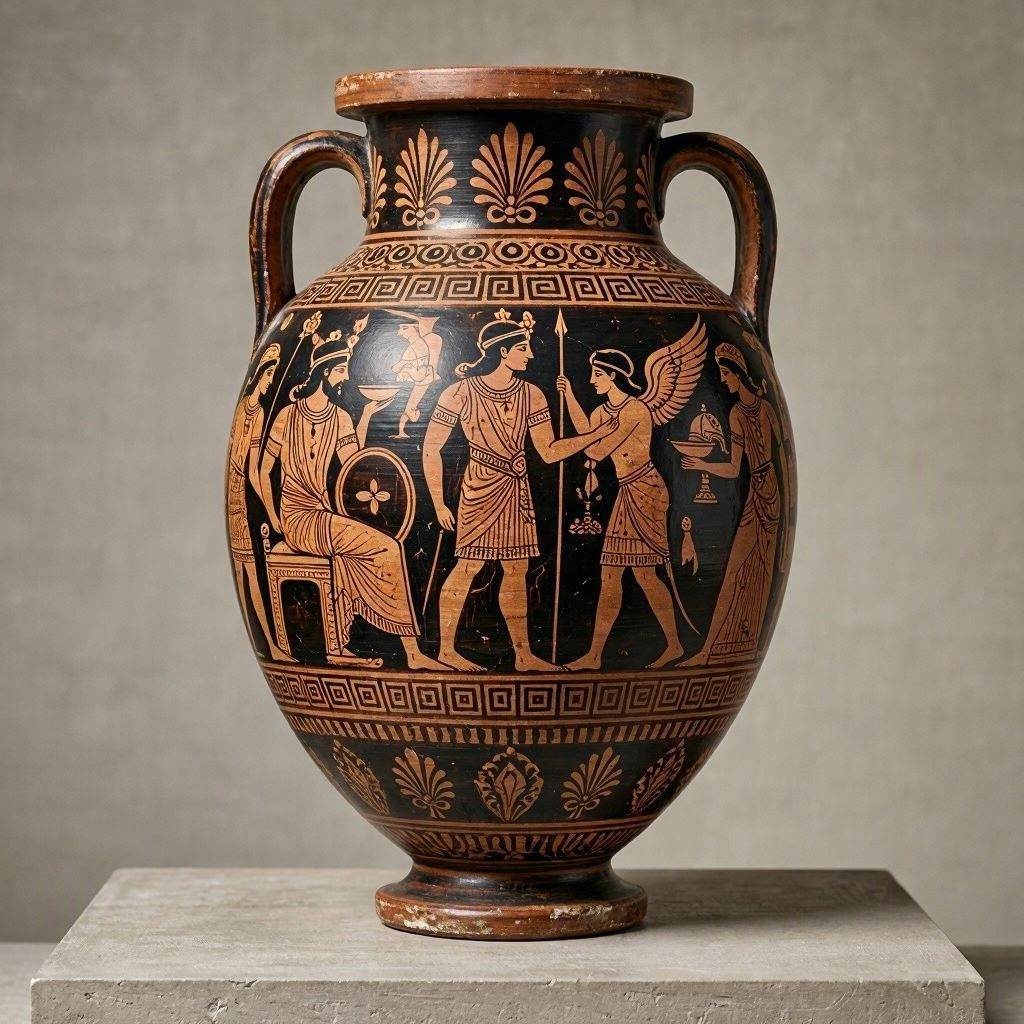
No single poet sat down and invented the gods. No ancient book exists from which every myth descended. What we call Greek mythology is the surviving edge of traditions that were already old when Homer and Hesiod gave them the shapes we still recognize today.
Its roots likely reach back past the first Greek literary texts — into the early Bronze Age, and possibly further, to inheritances from peoples who lived centuries before the Greeks of the classical era. Some of it may belong to a much older Indo-European past; other parts grew locally in the Aegean, or arrived through contact with neighboring civilizations.
This mythology wasn’t born. It evolved.
Where did Greek mythology come from? From several sources at once. Its roots lie in the Bronze Age Aegean, in older Indo-European beliefs, and in contact with Anatolia and the Near East. The stories were told by word of mouth for centuries and changed as they went, until Homer and Hesiod gave them their first great literary form around the 8th century BCE.
Greek Mythology at a Glance: A Timeline
- Before about 1450 BCE: Minoan Crete and the early Aegean. The Minoan script, Linear A, is undeciphered, so its religion is largely unreadable.
- Roughly 1450 to 1200 BCE: The Mycenaean palaces. Their Linear B tablets, the earliest readable Greek, already name gods such as Zeus and Poseidon.
- Roughly 1200 to 800 BCE: The palaces fall, and the stories survive by word of mouth during what is often called the Greek Dark Ages.
- 8th to 7th century BCE: Homer and Hesiod give the myths their first great literary form.
- After 700 BCE: Lyric poets, tragedians, vase painters and later mythographers keep reshaping the stories.
Before Homer, There Was Already a Tradition
Read the Iliad and the Odyssey today, and it’s tempting to treat them as the starting point of Greek mythology.
They aren’t. They’re among the earliest surviving large-scale literary versions of stories that had already been circulating for generations — gods, heroes, monsters, kings, battles, journeys, betrayals, passed by word of mouth long before anyone wrote them down. Each generation of storytellers kept some elements, dropped others, merged traditions, and reshaped familiar characters for new audiences. An oral tradition survives precisely because it’s flexible enough to keep changing.
By the time the Homeric poems reached the form we know, the material behind them could already have been extremely old — meaning Homer wasn’t an originator so much as one of the great shapers of something inherited. Even the identity of “Homer” stays open to debate: a historical poet, a poetic tradition, or material accumulated across generations. What matters for the history of mythology is simpler — the world in the poems clearly didn’t begin with them.
The Mycenaean Gods Were Already There
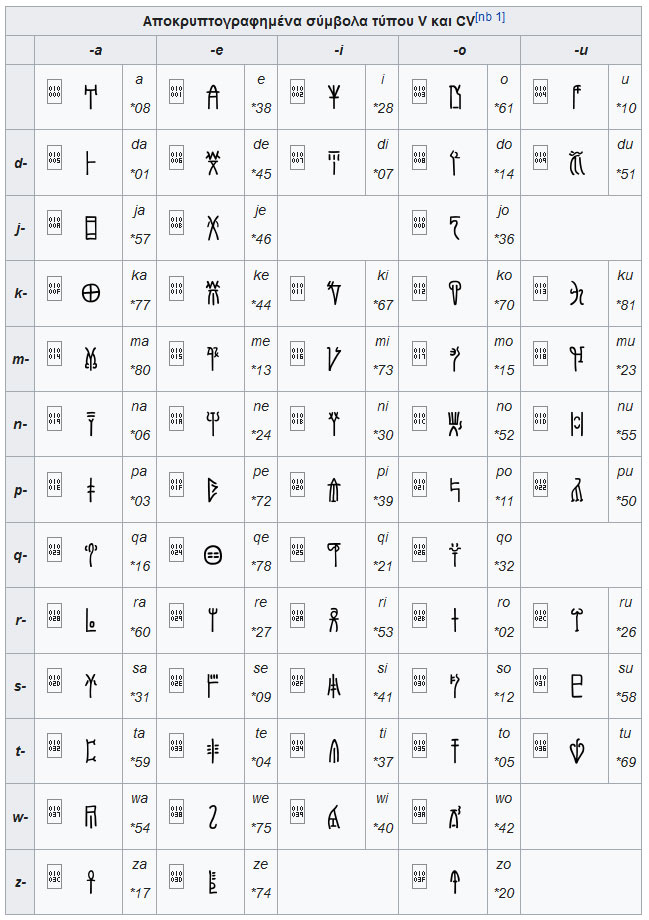
One of the strongest clues comes from the Mycenaean world.
The Linear B tablets, written in the second millennium BCE, predate Homer by centuries. They’re administrative records, not mythology — but scattered among them are religious references, including names that carry straight through into later Greek religion. Zeus appears in Mycenaean form; so does Poseidon, and so do the names of Hera, Hermes, Artemis and Dionysus.
That matters. It means these gods were already part of Aegean religious life long before the poems that made them famous.
Even so, Linear B isn’t the true beginning either — just the earliest written evidence we can currently read. The underlying traditions were almost certainly older than the clay they were pressed into.
What About Linear A?
The mystery deepens in Minoan Crete.
Linear A, used before and alongside Linear B, remains undeciphered. We can’t read its religious vocabulary or name its gods with any confidence. It’s entirely plausible that some traditions later folded into Greek mythology had Aegean ancestors stretching back into Minoan Crete — but plausibility isn’t proof. We simply can’t read the script well enough to say.
This is where the history of mythology gets genuinely fascinating: the further back you go, the more evidence vanishes, and the more everything has to be pieced together from fragments.
A Common Indo-European Heritage
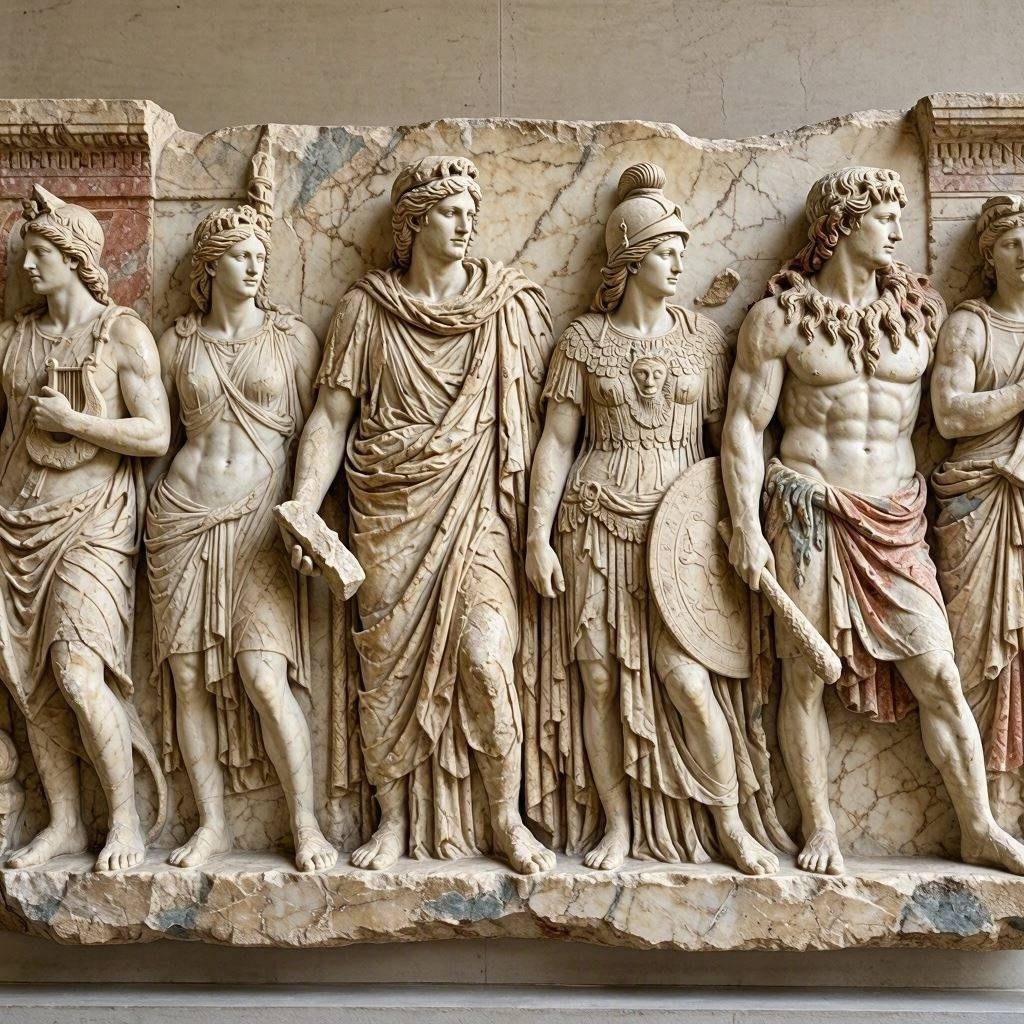
The Greek-speaking world was never sealed off from the rest of Eurasia.
Greek belongs to the Indo-European language family, alongside Sanskrit, the Iranian languages, Latin, and the Germanic, Celtic, and Slavic branches — all descended from a much older common ancestor. That doesn’t mean Greek mythology was imported wholesale from India or Persia. It means something subtler: certain religious concepts, names, and narrative patterns may have been inherited from a shared Indo-European past, then developed independently by each people who carried them forward.
Zeus is the clearest example. Linguistically, the name connects to the reconstructed Indo-European Dyēus, echoed in Vedic Dyaus and the first element of Latin Jupiter. These aren’t copies of one another — they’re distant, separate growths from the same root.
The same logic may apply more broadly. Greeks, Indo-Iranian peoples, and various Anatolian cultures didn’t share a single mythology; they inherited fragments of something older and built very different worlds out of them.
The Greeks Were Also Part of an Older Eastern Mediterranean World
Indo-European inheritance is only half the picture.
For thousands of years, the Aegean stayed connected to Anatolia, the Levant, Egypt, and Mesopotamia through trade, war, migration, and the exchange of ideas that travel with people. So Greek mythology carries elements that Indo-European descent alone can’t explain — creation stories, divine successions, monstrous beings, floods, and battles between gods and cosmic forces all echo across the ancient Near East in different forms.
Put the pieces together, and a single-origin story stops making sense. Some material likely came from deep Indo-European roots. Some grew locally in the Aegean. Some arrived through contact with Anatolia or the Near East. And some emerged independently in multiple places at once, simply because different societies kept confronting the same questions — about gods, death, kingship, and how the world began — and arrived at strikingly similar answers.
Not a single source, then, but a layered one.
Myths Changed Because People Changed
There’s another reason chasing the “original” Greek myth can mislead you: these were never museum pieces. They were living stories.
A storyteller could reshape a detail because it landed better with a particular audience. A local tradition could merge with a rival one. A god could pick up a new role; a hero could get adopted by a new city; a monster could migrate from one tale into another.
Over centuries, the same figure could accumulate wildly different, even contradictory, stories — which is exactly why Greek mythology is full of contradictions. Different versions disagree about genealogies, locations, relationships, even the identity of characters, and that’s not a sign the ancient Greeks were careless about their own mythology.
It’s evidence that for most of its history, there simply was no single canonical version. The idea of one fixed body of “Greek myths” only emerges later, after generations of oral tradition, poetry, art, and eventually scholarship got stitched together into something that looks unified from a distance.
Then Came the Great Poets
Eventually, a vast oral inheritance found its way into poetry.
Homer and Hesiod matter because they preserve some of the earliest large-scale literary structures we have for Greek myth — but neither stood at the beginning. They stood near the end of a very long process of transformation. In the Iliad and Odyssey, Zeus, Hera, Athena, Apollo, Poseidon, and Aphrodite already arrive with established identities and relationships fully intact. Hesiod’s Theogony goes a step further, organizing the generations of gods into something like a genealogy.
What these poets did wasn’t invention — it was distillation. They took an enormous inherited tradition and gave it memorable, durable literary form. And because that poetry survived while so much of the oral material around it didn’t, their versions became disproportionately influential in shaping what later generations would think of as “Greek mythology.”
What the Myths Remember, and What They Don’t
All of this also explains why it’s risky to treat Greek mythology as distorted historical record.
Some myths likely preserve real memories — of places, rulers, conflicts, or ancient customs. Troy was a real city. Crete was real. Mycenae was real. You can visit Knossos and Mycenae today.
The Aegean world behind many of these stories genuinely existed. But that doesn’t make the stories themselves history. The Minotaur doesn’t need to have been an actual half-man, half-bull for the myth to carry echoes of Bronze Age Crete; the labyrinth might preserve the memory of a sprawling palace complex, or it might simply have become a powerful symbol in its own right, independent of any specific building. Daedalus and Icarus likely combine older narrative motifs with places and technologies that felt familiar to a Greek audience.
Why Was the Story of Daedalus and Icarus Told?

A useful test case is Daedalus. A real tyrant would hardly have spared the craftsman who betrayed his secrets, yet the myth keeps him alive because it needs him for a second lesson: the wings, the warning, and Icarus flying too high. That gap between what a king would do and what the story allows suggests a tale built to teach. Human ingenuity can achieve extraordinary things, but ambition that outruns its limits ends in disaster.
The myth may echo Bronze Age Crete, yet it survives because it is unforgettable. The full story is in Daedalus and Icarus: The Fall of Ambition, and the Minotaur’s side of it is in Theseus and the Minotaur.
A Mythology Without a Beginning
Greek mythology never had a single starting point. It behaves less like a book with a first page and more like a river — fed by ancient streams and later ones alike, changing course, picking up new water, carrying old stories into new territory long after their original tellers were gone.
Homer didn’t create Greek mythology. Centuries did.
And that might be the most compelling thing about it: what we call Greek mythology isn’t the work of one people, one poet, or one age. It’s what’s left over from an enormous, ongoing act of human storytelling — still being read, still being reshaped, thousands of years on.