
Corfu New fortress

Corfu New Fortress: A Venetian Fortification Masterpiece

Posted in: Corfu Town 0
The New Fortress in Corfu is another example of the exceptional capacity of Venetians in fortification and an architectural marvel of art.

The New Fortress

New fortress Corfu
New fortress of Corfu

The New Fortress in Corfu is another example of the exceptional capacity of Venetians in fortification, and an architectural marvel of art built by the Venetians and with the physical labor of the inhabitants from 1576 until 1645.

Today it stands as one of the most important monuments of Corfu, as you can find out in this historical sites map.

Venetians, due to the permanent threat of the Turks, felt that it was necessary to complete the fortifications of the city, which meanwhile had been expanded far beyond the existing fortress.

The construction of the new fortress

Corfu New fortress
Corfu New Fortress

The fortress, known as the New Fortress or Fortezza Nuova in Italian, was built between 1576 and 1645 on the rocky hill of San Marcos overlooking the old town of Corfu. The fortress extended south with walls and ramparts reaching the sea at Garitsa Bay. Corfu is now all within the walls; it was then that Corfu took the name Kastropolis.

The New Fortress was designed and built by the Venetian military engineer Ferrante Vitelli. Vitelli was a renowned architect and engineer who worked extensively on fortifications throughout the Venetian Republic, including the construction of the walls of Nicosia in Cyprus and the fortifications of the Dalmatian coast.

The fortress was designed to be a modern and formidable defensive structure, capable of withstanding attacks by both land and sea. It featured a complex system of walls, bastions, and moats, as well as barracks, powder magazines, and other facilities for soldiers and officers.

Vitelli’s design for the New Fortress was highly innovative and influential, and it served as a model for many other fortifications built during the 16th and 17th centuries. Today, the New Fortress is one of the most impressive and well-preserved examples of Renaissance military architecture in Greece, and it is a popular tourist attraction and historical landmark in Corfu.

The construction of the fortress was a response to the increasing threat of Ottoman attacks on the island. It was designed to strengthen the island’s defenses and provide a secure stronghold for the Venetian garrison.

Corfu new fortress
Corfu new fortress

The fortress was built in a pentagonal shape and included a series of walls, bastions, and gates, as well as a moat and a drawbridge. The main entrance was located on the eastern side of the fortress, and it was protected by a massive gate known as the Porta of Spilia.

Despite its formidable defenses, the New Fortress was eventually captured by the French in 1797 and later by the British in 1815. NOTE: In fact, we shouldn’t consider these as captures since the collapse of the Venetian Republic had preceded it after its defeats by the French, and the two fortresses of Corfu were essentially left without a garrison, waiting for the French army.

Today, it remains one of the most impressive examples of Venetian military architecture in the Mediterranean and is a popular tourist attraction in Corfu.

To become a fortress, except for the exhaustive work of the residents, 2,000 houses in particular, where now stands the vast Esplanade square, had to be demolished.

It has been said that materials taken from the ruins of the ancient city of Corfu in Paleopolis were also used, and this was a disaster, to say the least.

The reason for the house’s demolition was not only to find building materials but primarily defensive; the Venetians wanted to create a large buffer zone between the Old Fortress and the city, something that would help better their defense plans. At the same time, this place could be used as the perfect field for military exercises.

That is why today, Corfu has perhaps the largest square in Europe, the famous Esplanade.

Inside the New Fortress of Corfu

Inside the New fortress of Corfu
Inside the New Fortress of Corfu

The New Fortress of Corfu, or Fortezza Nuova, is an impressive complex of buildings and fortifications, which is well worth a visit for those interested in history, architecture, or military strategy.

Once inside the fortress, visitors can explore several different areas, including:

  1. The Parade Ground – This large, open space was originally used for military drills and exercises. Today, it is a popular spot for picnics and relaxation, with stunning views over the city and the sea.
  2. The Barracks – Located in the northern part of the fortress, the barracks were used to house soldiers and officers. They have been restored and now house the Museum of Ceramic Art.
  3. The Powder Magazine – This building was used to store gunpowder and other explosives. Visitors can still see the iron bars on the windows that were used to prevent theft or sabotage.
  4. The Bastions – The fortress has several bastions, which were designed to protect the walls and provide additional firing positions for the defenders. Visitors can climb up to the top of the Bastions for panoramic views over the city and the sea.
  5. The Naval Station of Corfu is also hosted in a new building inside the fort.
  6. The lion of Saint Markos is at the entrance of the new castle, which was the emblem of Venice.

English left marks on the New Fortress

During their domination of the island, the British left their mark on the new fortress as well, by building a barracks next to the main gate and another one on the second level. And the temple of Panagia Spilaiotissa was added by them around 1850.

Overall, the New Fortress of Corfu is a fascinating and historically significant site that offers visitors a glimpse into the island’s rich and complex past.

Exhibitions and events in Corfu’s New Fortress

Corfu new fortress
Corfu new fortress

While it is primarily a fortress and tourist attraction, Corfu’s new fortress also hosts a number of exhibitions and events throughout the year.

  1. The Museum of Ceramic Art – This museum is located in the barracks of the New Fortress and showcases a collection of ceramics from the 19th and 20th centuries. The pieces on display range from traditional Greek pottery to contemporary works by local and international artists.
  2. Concerts and Performances – The New Fortress occasionally hosts concerts and other cultural events, particularly during the summer months. These events may take place in the fortress courtyard or one of the smaller buildings within the complex.
  3. Art Exhibitions – The New Fortress has several exhibition spaces that are occasionally used to showcase contemporary art, photography, and other cultural exhibits. These exhibits may feature works by local or international artists, and they can be a great way to learn more about Corfu’s artistic community.
  4. Historical Reenactments – From time to time, the New Fortress may host historical reenactments or demonstrations of traditional crafts and skills. These events can be a fun and educational way to experience the fortress’s history and learn more about life in Corfu centuries ago.

Overall, the New Fortress of Corfu is a dynamic and multi-faceted attraction that offers visitors a range of cultural and educational experiences throughout the year.

Tickets to enter the fortress

Corfu new fortress
Corfu new fortress

Tickets to enter the New Fortress of Corfu can be purchased at the entrance gate of the fortress. There is a ticket booth on the staircase of Solomos Street where visitors can buy their tickets before entering the site. The ticket price may vary depending on the season and any special events or exhibitions that may be taking place at the time of your visit.

Alternatively, visitors can also purchase tickets online in advance through the official website of the Ministry of Culture and Sports of Greece or other authorized ticket vendors. This can be a convenient option to save time and avoid queuing at the ticket booth.

It is important to note that visitors may need to show proof of vaccination or a negative COVID-19 test result to enter the fortress, as part of the health and safety measures in place due to the ongoing pandemic. It is recommended to check the current regulations and requirements before planning a visit to the New Fortress of Corfu

In Brief

Today, the New Fortress is one of the most popular tourist attractions in Corfu, and visitors can explore its many halls, tunnels, and galleries to learn more about its history and architecture. The fortress is also home to several museums and exhibitions, including the Museum of Ceramic Art, which showcases a collection of ceramics from the 19th and 20th centuries.

In addition to its historical and cultural significance, the New Fortress is also a popular spot for outdoor activities such as hiking, picnicking, and taking in the breathtaking views of Corfu and the surrounding area. Whether you’re a history buff or just looking for a unique and memorable experience in Corfu, the New Fortress is a must-see attraction that should not be missed.

Corfu Old Fortress And The Old British Hospital

Posted in: Corfu Town 0

Corfu Old Fortress Location

The Corfu Old Fortress is situated on a small rocky peninsula, a natural stronghold on the eastern border of the medieval citadel of Corfu.

Originally, it was a natural promontory that protected the inhabitants from the 5th century AD onwards, when the city of Corfu was relocated here following the destruction of the ancient city by the Visigoths. It was on this site that the people constructed the first medieval city, known as the Citadel.

Undoubtedly, the Corfu Old Fortress is the most significant monument and a must-visit attraction in Corfu Town.

The compact medieval city within the fortress has been separated from the mainland since the Venetian era by a narrow moat. However, today, visitors can easily access it via the bridge constructed by the Venetians.

The Byzantines had already utilized this promontory as a natural fortification for the early medieval town from the 5th century CE. Between 1300 and 1700, the Venetians further fortified it to safeguard the island from potential invaders.

Its strategic position along the coastline, along with its elevated vantage points, facilitated the early detection of approaching boats on the horizon, providing ample time to alert the island’s inhabitants to potential threats. During your visit, you will have the opportunity to view some of the original weapons used for defense and enjoy breathtaking views of the sea.

You will be amazed at how conveniently located the Old Fortress is to the city, making it easily accessible regardless of your mode of transportation. You can even walk there if you have the entire day to spare!

Fortifications

The Corfu Old Fortress features two peaks, or ‘koryfes’ (also spelled ‘korfes’): one in the East, where the Sea Tower was originally constructed by the Byzantines around the 7th century AD, and the Western peak, known as the Land Tower.

During the 8th century AD, the Byzantines fully transformed it into a fortress, encompassing the entire small medieval town along with military barracks.

The rocky stronghold received continuous reinforcement, either by the Angevins or later by the Venetians, to defend against the numerous invasions during the Middle Ages. Gradually, the town expanded around it.

In response to the threat posed by the Ottomans, the Venetians bolstered their fortifications, extended the bastions, and excavated a moat known as the ‘kontra fossa,’ effectively isolating the fortress from the mainland and turning it into an island.

During the final period of Venetian rule, the area in front of the Fortress underwent a significant transformation as nearly 3,000 houses were demolished. This was done for defensive purposes and is how Corfu acquired its spacious Esplanade square that we see today.

This strategic development allowed the Venetians to establish an impenetrable triple line of defense, both on land and from the sea.

Buildings inside the Old Fortress

Inside the old fortress, in 1840, the Doric church of St. George was constructed by the British as a garrison church.

During the Venetian era, numerous buildings were erected as it functioned as a small town. However, most of these structures did not survive and have since been demolished. The ones that remain are primarily those built by the British.

Of particular note are the central gate, the bastions of Savornian, Martinengo, and Mandraki, the Land Tower in the West, and the Sea Tower in the East. Other significant structures include the English hospital, the English barracks, the clock tower, and the lighthouse.

Within the fortress, a prison built by the Venetians in 1786, later expanded by the British, is still in place. Additionally, you can find the military chapel and two English barracks from 1850.

The lower part of the British military hospital now houses the Music Department of the Ionian University.

Furthermore, the fortress serves as the repository of historical records spanning over six centuries of history, a Byzantine collection featuring sculptures and images from the Byzantine era, and a public library.

At the entrance of the old fortress on the upper Esplanade, you’ll encounter the statue of Prussian Marshal Johann Matthias von der Schulenburg, crafted by the Venetians in his honor for successfully repelling the Turkish invasion of 1716.

Today, the Corfu Old Fortress stands as a masterpiece of architectural and fortification art, offering visitors the finest panoramic views of the city, its harbor, and the sea extending to the mountains of Epirus.

The British Hospital

One of the significant structures that still stands within the Corfu Old Fortress is the British hospital.

In fact, there were two buildings: the larger one situated at the upper level, positioned between the Sea Tower and the Land Tower, and the smaller one at a lower level. Here, we will focus on the larger building.

The British colonists constructed this building in 1814 to serve as Corfu town’s second hospital since the larger hospital was situated in the Liston area.

The Corfu Old Fortress Hospital had the capacity to treat up to 120 patients. Throughout its history, it functioned primarily as a hospital. Initially, it served during the British colonial rule of the island, then throughout the 19th century, and later during both World War I and World War II.

However, there was a dark period for the building and the city during the occupation by Axis forces. First, the Italians, and later the Germans, used it as their headquarters. Executions and tortures within its walls transformed this life-saving facility into a place of death and anguish.

A hole in its floor, known as the “kokkaliera” or “bone hole,” was used by occupiers to dispose of the bodies of executed individuals or those who died after torture.

Following the German occupation, the Greek army took control of the building, sealed the bone hole, and used it for bureaucratic army services.

Regrettably, the building is now abandoned. It has given rise to various legends and is often considered one of the most haunted buildings in Greece. Many claim to have experienced paranormal activity within its walls, including sightings of executions, dark figures at the windows, screams, voices pleading for help, and even gunfire.

There is also a document in a local newspaper from 1982 that discusses similar rumors. It is our belief that these legends have emerged from the fear generated by the eerie atmosphere inside an abandoned building, characterized by its vast empty rooms, broken doors, and windows through which the wind’s howling sounds akin to screams. The building’s almost collapsed roof adds to the overall sense of unease it evokes.

Corfu Old Fortress Opening Hours

8:00 AM to 8:00 PM

But first, let’s clarify a few things.

The Corfu Old Fortress today resembles a small island, adorned with historic buildings, churches, old prisons, barracks, museums, and public services. It houses various offices, including the Ephorate of Antiquities of Corfu, departments of the Ionian University, military services, and even a café bar, among others.

Consequently, it’s challenging to provide precise opening hours since they vary, and certain government buildings may not be accessible to visitors.

However, the Old Fortress area remains open to the public as its main entrance never closes, allowing anyone to enter and explore the historical monuments.

Most museums within the fortress are open to the public from 8:00 AM to 8:00 PM.

It’s important to note that the Music Department of the Ionian University is not open to the public; it is exclusively accessible to students.

The Bell Tower of Annunziata in Corfu

Posted in: Corfu Town 0

Annunziata, a monument of pan-European significance

Annunziata was a church devoted to the Annunciation of the Virgin Mary as well as to Santa Luccia, at the intersection of Evgeniou Voulgareos and Vrahlioti streets in Corfu, it was the Catholic Church of Lontsiada as the Corfiots knew it.

Built at the end of the 14th century by the Napoletán captain Petró Capece and dedicated to the Annunciation of the Virgin Mary since March 25th is the date of the founding of the Venetian Republic.

At the inauguration ceremony where all the nobles of Corfu attended, Petró Capece handed over the church to the Order of the Augustinians, giving Nicolo Russino, a representative of the battalion, a commemorative stick, a symbol of the transfer.

Today the church does not exist, first destroyed by the German bombings on September 14th, 1943 and later, instead of being repaired, it was demolished without a serious reason in 1953 during the mandate of the mayor Stamatios Dessylas.

It is not the only monument in Corfu that has been demolished without reason, the same has happened with the old municipal theater, so did with Porta Reale, the main gate of the old city

Today, only the characteristic bell tower of Annunziata remains stand, which is a monument of pan-European significance, this is due to its relationship with one of the most important events of world history.

One of the greatest naval battles of all time was the naval battle of Nafpaktos in 1571 among the fleets of the Holy Alliance, ie the united fleets of Venice, Spain, Naples, Sicily, Genoa, and Malta against the Ottoman’s (undefeated until then) Turkish fleet.

In the naval battle that took place in the bay of Patras opposite Nafpaktos, the Turkish fleet was completely destroyed, since its 251 ships were sunk or captured, and of the 50,000 Turkish soldiers and sailors over 20.000 were killed.

In Turkish ships also served about 1500 Greeks from the Turkish-occupied Greece who after the battle were released.

Many of the Latin nobles who lost their lives during the naval battle of Nafpaktos were buried in this church, so this is the reason for the historical significance of the monument.
After the demolition of the church, the bones of those Heroes were transferred to the Catholic cemetery.

Among the dead Christians were the Corfiots Halikiopoulos, Kontokalis, Kokkinis, and Petros Bouas.

PETROS BOUAS became the Martyr of Freedom, he had the misfortune to be captured, the Turks dangled him alive and presented his skin as loot to the Sultan.

Today efforts are being made to maintain and emerge the monument, but sometimes plans change, sometimes they are abandoned after they encounter various obstacles such as political feats, impotence, disclaimer …

Who is going to Save Annunziata?

17 Of The Best Museums in Corfu

Posted in: Corfu Town 0

Due to the rich historical and cultural heritage, the museums in Corfu are numerous and offer a wide variety of exhibits from Neolithic times to the present. There are also cultural museums dedicated to the rich intellectual life of the Ionian Islands, a bright example is the Corfu Reading Society.

There are also scattered museums throughout the island, not just in the city, in fact, two of the most important, such as the Achilleion palace and the shell museum, are near and within Benitses village.

Also, there are two folklore museums in the villages of Sinarades and Acharavi, an olive museum in Kynopiastes, the museum in honor of Kapodistrias at Evropouloi, and the museum of traditional Corfiot and Greek costumes in Pelekas.

The most important Museums and Art exhibitions in Corfu

1) Corfu Archaeological Museum

Archaeological museum of Corfu
Archaeological Museum of Corfu

Corfu Archaeological Museum is located in Garitsa near the seaside boulevard in the street of Armeni Braila 1.

Built in the 60s under the standards followed then for buildings intended to be Museums and started its operation in September of 1967.

It is the largest of Corfu’s museums, a two-floor building with a courtyard garden and a balcony on the south and east side of the first floor.

The vast bulk of the exhibits are located on the first floor, which comprises four rooms and a hallway.

The largest western hall, along with other artifacts from ancient temples of Paleopolis, is the pediment of the Temple of Artemis in 580 b.c, with gigantic dimensions, 17 meters wide and 3 meters high, and its central theme is the mythical monstrous Gorgon.

Major exhibits are the archaic funerary lion of Menekratis (late 7th-century bc) found in the circular cenotaph of Menekratis, the left side of an archaic pediment (the pediment of Dionysus 500 BC) with dimensions of 2.73 meters long and about 1 meter in height that was found in Figareto and depicts of a Dionysiac banquet scene, the bronze statuette of a young “komastos” (570 BC) who runs and on his left hand holds a “rhyton”, the head of a kouros of 6th-century b.c which was found in excavations of Paleopolis in Mon Repos, a clay statuette of Artemis (490 BC) found in Kanoni, the kouros of Corfu (530 BC) from Parian marble headstone and the Arniada (630-600 BC) found in the ancient cemetery near Garitsa.

In the museum, there are finds of Palaeolithic and Early Bronze Age as well as recent articles of the Hellenistic and Roman period.

If someone wants to visit both the Museum, the Old Fortress, the Temple of Antivouniotissa, and the Asian Art Museum can purchase a ticket for all for 8 €, ie, minus 4 €

The Museum is located at Armeni Braila 1 street,t and the phone is: 26610 30680

2) Museum of Asian Art

George and Michael palace in Corfu
George and Michael’s palace in Corfu

A museum dedicated to Asian art is housed in the Palace of St. Michael and St. George.

Hosts the rich collection of Corfiot diplomat Grigorios Manos, consisting of 10,000 objects, the collection of the former ambassador Nikos Chatzivasileiou, with approximately 200 objects, and some smaller collections of diplomats Nikos Sinioglou and Pavlos Almanachos.

Among the exhibits are:

  • Bronze vases of China from the time of Chinese entry into historical times,
  • The pottery of the Cheo era,
  • Figurines since the Han dynasty,
  • Pottery tomb figurines from the time of the Tang Dynasty,
  • A bronze statue of Buddha from the Sung dynasty,
  • Small statues, vases, and jars from the golden era of the Ming Dynasty,
  • Several miniatures from semi-precious stones, arms, and armor of samurai divisions,
  • Drama masks of theater No,
  • Indian wooden objects with love scenes, etc.

3) Byzantine Museum of Corfu

Byzantine museum is housed in the church of Panagia Antivouniotissa in Kampielo at Mouragia and includes sculptures of Christian architecture, parts of mosaic floors, frescoes, and Byzantine icons from the 16th to the 18th century from various churches on the island.

4) Museum of Banknotes

Corfu museums - Hero`s square in Corfu
Corfu museums – Hero’s Square in Corfu

Museum of Banknotes is a unique museum that has been operating since 1981 and is housed in the Neoclassical building of the Ionian Bank in the Square of heroes known as the Plakada of Saint Spiridon, there was the first-ever Greek bank in 1839 when Corfu and the other Ionian Islands were still part of the Ionian state.

Along with the exhibits, it shows the history and method of production.

This is the only museum of its kind operating in Greece and one of the few in the world. It contains a remarkable collection of rare coins, die print photos, and artwork.

Remarkably, it shows all stages of production notes, starting from the initial design and production of paper as well as the way of destruction at old kilns.

Among the exhibits: the notes issued by the Ionian Bank from 1839 until 1920.

Also, the first notes that were released in liberated Greece in 1831 during the government of Ioannis Kapodistrias and the first notes released by the National Bank of Greece in 1840.

It is worth seeing the collected notes from the post-war period from various countries, as well as the Chinese note dating back to 1300, which is one of the oldest surviving in the world.

The phone of the Museum is: 26610 41552

5) Mon Repos, the Museum

Corfu - palace of Mon Repos
Corfu – the palace of Mon Repos

A Palace built by the British Commissioner Sir Frederick Adam in 1830, when the island was under British rule, was built within the boundaries of the ancient city of Corfu before the excavations which unearthed the ruins of the ancient city.

Once was the summer villa of the former Greek royal family and birthplace for Prince Philip, the Duke of Edinburgh.

Today it houses the museum of Paleopolis, which was the ancient Corfu.

Exhibits are archaeological findings from the first antiquities found during the British rule and findings from the excavations between 1936-1955, which revealed parts of the ancient Agora and the early Christian basilica.

Also, Byzantine artifacts, furniture, and dresses from the period of British rule, paintings, and other memorabilia from the history of Corfu.

The ruins of Paleopolis, the Roman baths, the dockyards of the port of Alkinoos, and a large section of the cobbled Market that came to light recently, are nearby.

In the halls of Mon Repos, today events are organized by the Municipality of Corfu as well as in special formal settings.

6) Solomos Museum

Dionisios Solomos
Dionisios Solomos

The home of our National poet Dionisios Solomos in the third end of Arseniou street at Mouragia has been turned into a museum, it is the place where the Poet lived for 30 years and inspired his poems.

It presents furniture, personal items, photographs, and historical material from his life.

7) The music museum of Nikolaos Mantzaros

A unique museum of its kind in Greece, in honor of Nicholaos Halikiopoulos Mantzaros.

The museum displays the history of the Corfu Philharmonic Society, founded in 1840, whose first director was the composer Nicholaos Mantzaros.
The exhibits are, of course, old musical instruments, photographs, sheet music, rare first recordings, and many others related to the composer’s work.

For the uninitiated, Nicholaos Halikiopoulos Mantzaros (1795-1872) was the composer of the Greek national anthem and the composer of the Olympic anthem.

The museum is located in the heart of the old town of Corfu, on the first floor of the building of the Philharmonic Society at Street of Nikiforos Theotokis 10.

8) Museum of Ioannis Kapodistrias

Ioannis Kapodistrias

A museum in honor of the first governor of Greece and a large child of Corfu, Ioannis Kapodistrias, was missing from Corfu.

This large gap was filled in 1981 with the establishment of the Centre of Kapodistrian Studies – Museum of Kapodistrias.

The museum is located near the village of Evropouli, 3 km from Corfu town, in a place called Koukouritsa, housed in an estate owned by the Kapodistrias family and donated by a descendant of Kapodistrias and former mayor of Corfu from 1956 to 1959, Mary Desylla-Kapodistrias.

The exhibits are the governor’s personal belongings, furnishings of that period, and other personal things.

The address is the Centre of Kapodistrian Studies, PO Box 49100 Eyropouloi – Corfu.

Phones are: +30 26610 39528 and +30 26610 32440

9) Municipal library

It contains some of the greatest works of painters from the Eptanese of the 19th century, as well as engravings and sculptures.

The municipal library, originally housed in a building of Dalietos’ legacies, is today housed in the Palace of Saints Michael and George.

10) Corfu Reading Society

The building of reading Society in Corfu
The building of the Reading Society in Corfu

Founded in 1836 at the time of English domination, and now housed in a building of the 19th century opposite and behind the Palace of St. Michael and St. George at Kapodistriou Street number 120 in Mouragia.

Corfu reading society is the oldest spiritual institution in modern Greece and prominent members of it were the most famous Personalities of culture, art and politics of Ionian isles, personalities as the Bishop of the Union Athanasios Politis, Angelos Kogevinas, Viaros, and Augustinos Capodistrias, the National poet Dionysios Solomos, the poets Andreas Kalvos and G. Markoras, politician George Theotokis, Iakovos Polylas, Spyros Samaras the composer of the Olympic anthem, Nicholas Tomazaios, Nicholas Mantzaros composer of our national anthem, Lorenzo Mavilis Secretary of the Company until his heroic death in Driskos, Angelos Giallinas, Dinos Theotokis, the Bishop of Corfu and later Ecumenical Patriarch Athenagoras and many others.

It has more than 10,000 volumes of Ionian literature as well as a rich general library.

Very often, presentations of paint collections and prints happen, also old maps, photographs, magazines, and newspapers are also presented.
It is rich in active art exhibitions, maintains cooperation at a scientific level with Greek and foreign universities.

In its rooms, conferences, lectures, seminars, and musical events.

It is open to visitors every day except Sundays from 9:00 in the morning until 2.00 pm.
Telephone number is: 26610 44165

11) Serbian Museum

19 Moustoxydou Street, with exhibits of the Serbian army, such as photographs, uniforms, arms and ammunition, Serbian regimental flags, religious artifacts, surgical tools, and other decorations.

The remnants of the Serbian Army of about 150,000 soldiers, together with their government, were in exile for three years in Corfu, where they found refuge and shelter, following the collapse of the Serbian Front as a result of the Austro-Hungarian attack of 6 October 1915.

12) Serbian War memorial on Vido Island

Mausoleum in honor of the 150,000 Serbian soldiers who came with their government to Corfu in 1915 after the collapse of the front, here are the graves of those who died.

Museums in the villages of Corfu

1) Museum in Achilleion

Achilleion
Achilleion

The Achillion Palace was built in 1890 by Queen Elizabeth of Austria-Hungary, now a museum and historical site.

The exhibits are particularly beautiful sculptures of mythical Achilles and ancient philosophers, heroes, and mythical ancient gods, ordered by the queen from different sculptors of the 20th century, and the unique, crafted paintings of the best artists of the time.

Along with the features are the 12-meter-high statue of Achilles in the gardens of Achilleion, the famous statue of the dying Achilles, which is an artwork by German sculptor Ernst Gustav Herter.

The depiction of Achilles injured trying to remove the arrow from his heel, and the panel painting by Austrian artist Franz Matsch, the famous triumph of Achilles, depicts the hero dragging the dead body of Hector outside the walls of Troy with his chariot.

The Achilleion museum is located on top of the hill, the highest point of the village of Gastouri, and attracts hundreds of tourists daily.

For more information about the exhibits, opening hours, and ticket prices, read here.

2) Corfu Shell Museum

Corfu Shell Museum in Benitses doesn’t exist anymore.

Shell Museum in Benitses

Update 23-5-2020

We are sorry to announce that the owner and collector, Mr. Sagias, passed away a couple of years ago, in 2018, and his relatives couldn’t keep the museum open, so the Sea Museum is permanently closed and all its exhibitions have been sold.

Find more info on this page

3) Folklore Museum in Acharavi

This folklore museum is housed in two rooms of a building situated just opposite the ancient Roman baths in the seaside village of Acharavi in the center of northern Corfu.

In the museum, there is an interesting collection of folklore items mainly from the region of northern Corfu, objects mainly household as furniture, a loom, a traditional mill for kitchen utensils and agricultural tools of past centuries, a watermill, church supplies, and other items showing the historical evolution of Corfu since then.

certainly exhibited are old photographs, books, and manuscripts, with the oldest of them since 1862.

Important exhibits also include coins from the period of the Ionian State (1799-1864)

4) Museum of Folk costumes in Pelekas

In the mountain village of Pelekas, there is an important private collection of traditional costumes mainly from the 19th century.

The costumes come from both Corfu and the rest of Greece; the collection is private and is housed in the home of the owner.

It offers visitors a great opportunity to admire the art and the details in the construction of local costumes in almost all parts of Greece, both on the mainland and in the island country.

In the museum also there is also a small section dedicated to the musical heritage of Corfu

5) The Olive Museum in Kinopiastes

Located in the traditional village of Kynopiastes, a village middle of Corfu, close enough to the city.

It is relatively new and, as shown by its name, is intended to keep the memories about the old oil mills abounded throughout Corfu, presenting a well-maintained traditional oil mill, such as other traditional objects of rural life in the villages of Corfu of the past centuries

AVLI Restaurant in Benitses, Corfu: A Dining Experience to Remember

Avli Restaurant Benitses

“AVLI” Authentic Greek Cuisine with a Special Touch

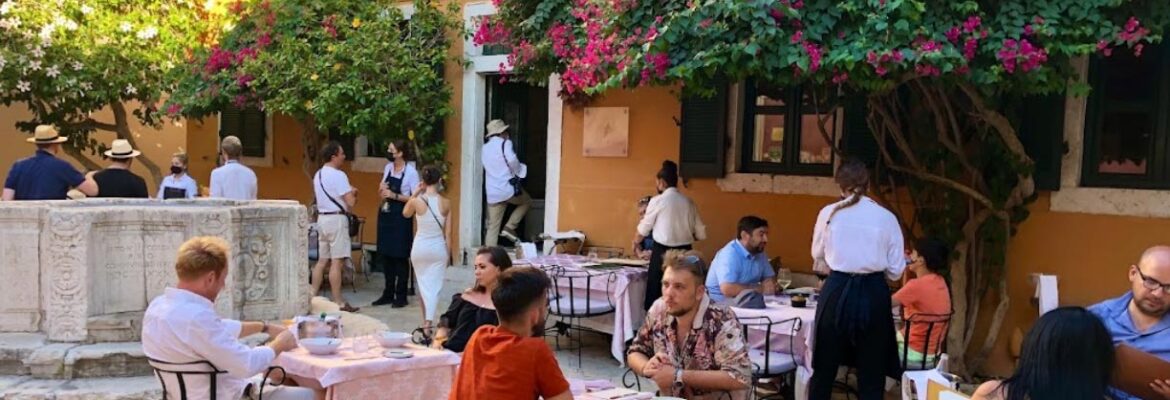
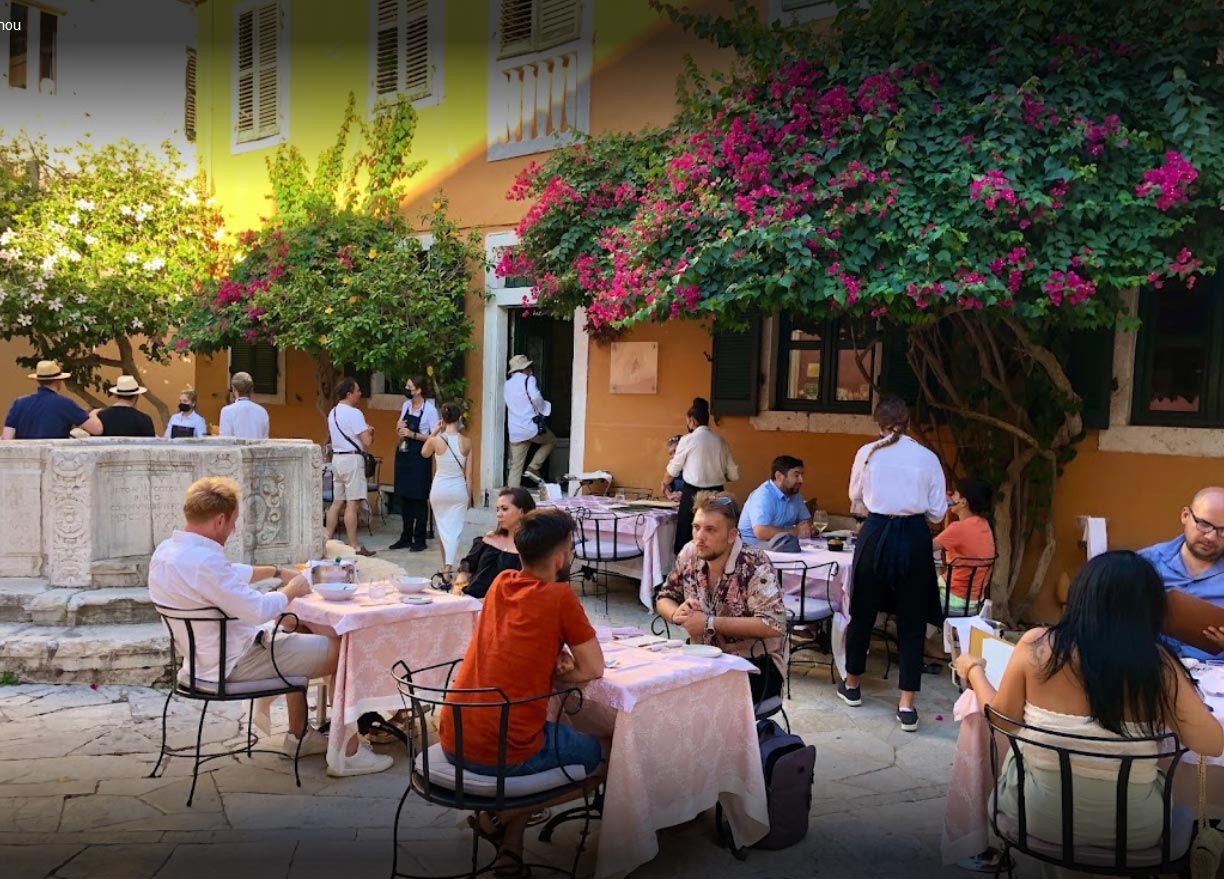
Located at the quieter end of the bustling waterfront in Benitses, Corfu, AVLI restaurant is quickly gaining a reputation as one of the area’s standout dining spots. Its name, “AVLI,” meaning “garden” or “courtyard” in Greek, perfectly reflects the restaurant’s beautifully designed outdoor space—a stylish, tranquil setting ideal for relaxed summer evenings by the sea.

Although relatively new to the Benitses dining scene, AVLI has already established itself as a real diamond among Corfu’s restaurants. What makes this place special isn’t just the food—it’s the entire experience.

Elegant Atmosphere with Careful Attention to Detail

Avli Restaurant Benitses - From the road
Avli Restaurant Benitses – From the road

AVLI stands out for its elegant aesthetics. The space is thoughtfully arranged, with modern touches blended harmoniously with the natural surroundings.

Unlike the busier, more tourist-packed tavernas nearby, AVLI offers a sense of calm and refinement, making it perfect for couples, families, or anyone seeking a memorable dining experience away from the crowds.

The Menu

Avli Restaurant Benitses - The Menu
Avli Restaurant Benitses – The Menu

The menu is creative, thoughtful, and rooted in authentic Greek cuisine. What elevates the dishes is the careful attention to the quality of ingredients—everything we tried was beautifully prepared, using fresh, local products that brought out the best of Mediterranean flavors.

Dishes aren’t just tasty; they’re presented with care, reflecting a balance between traditional flavors and modern culinary creativity. Every plate felt intentional, from appetizers to desserts.

Impeccable Service with a Personal Touch

Avli Restaurant Benitses

One of the most memorable aspects of dining at AVLI is the warm, impeccable service. The staff was attentive, professional, and genuinely friendly. On returning for a second visit, we were not only recognized but treated with generous extras on the house—a small but telling gesture that shows how much they value their guests.

It’s these little touches that turn a good meal into an unforgettable experience.

Final Thoughts

With its combination of refined flavors, elegant ambiance, and heartfelt hospitality, AVLI truly feels like a hidden gem in Benitses. Whether you’re planning a casual evening out or looking for the perfect spot to celebrate a special occasion, AVLI delivers.

Recommended for:
✔ Romantic dinners & special occasions
✔ Lovers of creative, high-quality Greek cuisine
✔ Visitors looking for a peaceful yet stylish place to dine in Benitses

Best Corfu Restaurants
1 6 7 8 9 10 11 12 52