



Think you know what malaka means? You don’t.
Most foreigners are told that “malaka” is a rude Greek insult meaning wanker, jerk, or idiot. But ask any Greek, and you’ll hear very different stories – ones that include laughter, friendship, and even affection.
In truth, this single word is used everywhere in Greece. It’s not just another one of the swear words – it’s culture.
In Greece, “Malaka” also works as a mask, so they don’t have to call you what you actually are – wanker, jerk, idiot, moron, asshole, useless, clown, walking disaster, pain in the ass – they use this word instead – and somehow, the same word also means friend, buddy, mate, legend.
But let’s be honest – you’ll mostly hear it from younger people. As people get older, it fades out. In many ways, it’s less a lifelong habit and more a piece of youth culture.
So, who’s a “Malaka”?
Chances are… We are.
Put simply: no one hasn’t been called a wanker, asshole, or jerk at some point.
Does that make us all fools? Probably — we all do something a little stupid now and then.
So don’t worry if someone calls you that; even the gods of Greek mythology, in their stories, weren’t immune to foolish mistakes. See? It’s not that complicated!
Accept it. Stereotypes exist for a reason.
What does malaka mean in Greece?
“Malaka” is probably the first Greek slang tourists hear. You’ll catch locals tossing it around casually, and it can sound either friendly or aggressive — context is everything.
“Malaka” means “masturbator.” But the modern usage is far more nuanced. Depending on tone, it can express insult, affection, or frustration:
A versatile word with strange rules: When referring to someone you hate, “Malaka” means “jerk“, “asshole”, “motherfucker”, “wanker“, “idiot”, or “stupid”—yet when spoken to a friend, the entire meaning flips into a warm greeting like “dude” or “mate” depending on one crucial social rule. See? It’s a bit complicated!

A word not only for idiots.
Let’s put it straightforward: the fact is that “Malaka” does not refer only to idiots.
It’s a word with a lot of ambivalence, but let’s be honest: unless we say it to our best friend directly, in almost all other cases, it’s an insulting word. And remember! No one will forgive us if we call him a malaka behind his back — not even friends.
🚫 When not to use Malaka
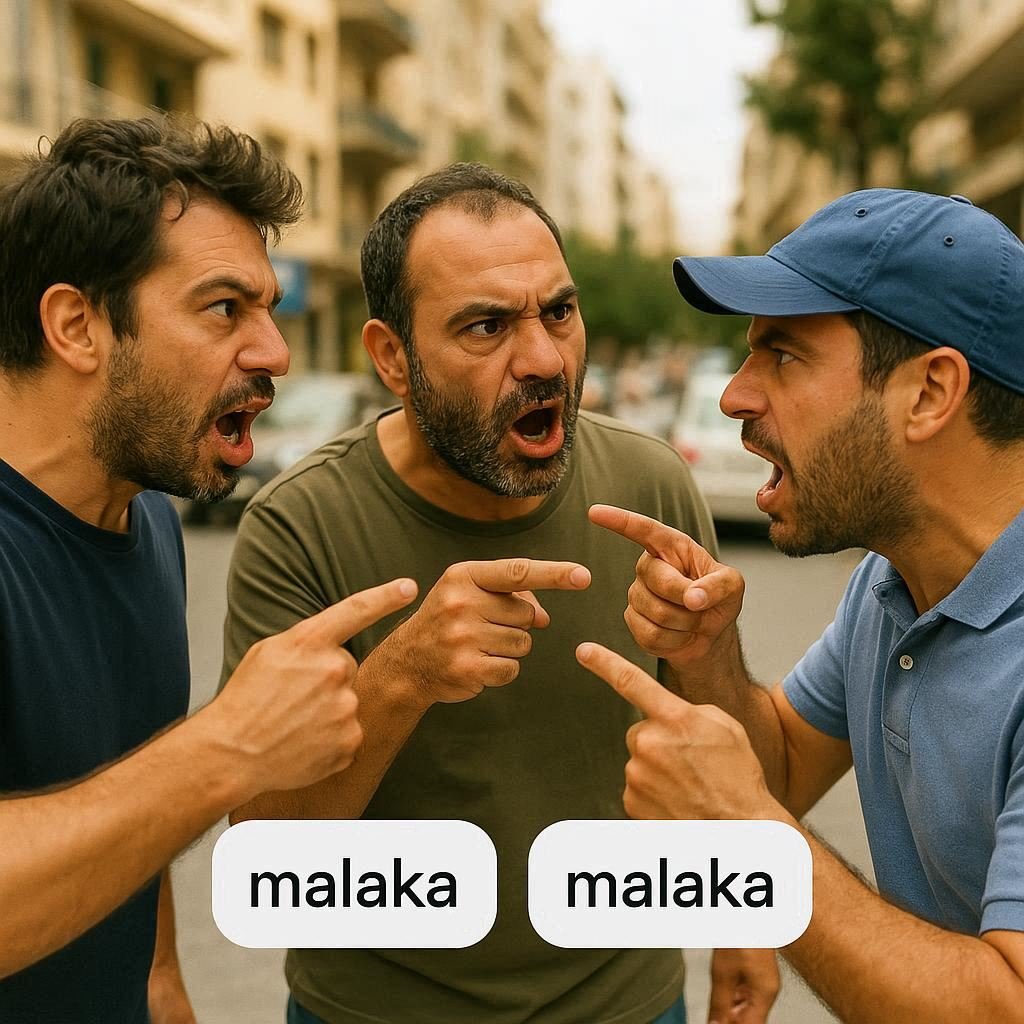
Although malaka can be friendly between close friends, there are many situations where you should avoid using it:
- Do not use it with women. Even if you hear Greek men using it among themselves, calling a woman malaka is usually offensive.
- Do not use it when meeting someone for the first time. It is not the appropriate way to break the ice.
- Do not use it with strangers. Almost all people will take it as an insult rather than a joke.
- Do not use it with older people. It is considered disrespectful when addressing parents, grandparents, or other elders.
- Avoid it during arguments. Even among friends or siblings, malaka can quickly turn a disagreement into a serious confrontation.
- Never use it in road rage. After a traffic incident, calling another driver malaka is one of the fastest ways to escalate the situation.
- Don’t assume you understand the context. Greeks can use malaka in dozens of different ways depending on tone, relationship, and situation. Until you understand these nuances, it’s safer not to use the word at all.
Rule of thumb: If you’re not a native Greek speaker and you’re unsure whether malaka is appropriate, don’t use it. It’s much easier to recognize the word than to master when it is socially acceptable.
✅ When you can call someone Malaka
Although malaka literally means “offensive,” Greeks often use it as a friendly expression in informal situations.
You can use malaka only when all of the following are true:
- With close friends. Among good friends, malaka often means something like “mate,” “buddy,” or “pal.”
- With siblings or close relatives. Brothers and sisters may use it jokingly, provided they are not arguing.
- In a relaxed, informal conversation. Expressions such as “ela re malaka” (“come on, mate”) or “eise enas malakas” (“you’re such an idiot, mate”) are common among friends.
- When everyone understands it’s a joke. Tone of voice, facial expression, and your relationship matter more than the word itself.
- When you know the other person well. The closer the friendship, the more acceptable the word becomes.
Rule of Thumb:
Use malaka only with people you know very well and who are comfortable using the word themselves. If you’re unsure whether it’s appropriate, don’t say it. What sounds friendly between close Greek friends can sound highly offensive in almost any other situation.
Why Do Greeks Say Malaka So Often?
Over the years, malaka has become a kind of social Swiss Army knife. In a country where frustration with politics, bureaucracy, the media, and everyday life is common, the word is used to express anger, irony, affection, sarcasm, or simple amusement.
Greeks may call someone malaka for many different reasons, including:
- Politicians – for being dishonest, corrupt, or putting personal interests above the public.
- Journalists – when they are seen as biased or serving political or business interests.
- Media owners – for promoting propaganda, manipulating public opinion, or spreading misinformation.
- The public itself – for accepting or tolerating situations without reacting.
- Bad drivers – for dangerous driving, ignoring traffic rules, or blaming everyone else.
- Close friends – affectionately, in the sense of “you idiot” or “you fool,” with no real insult intended.
This is the paradox of malaka: a vulgar word that has become a reflection of Greek society. Depending on the speaker, the relationship, and the situation, it can express anger, sarcasm, friendship, admiration, or simple surprise.
The safest rule for visitors is simple: listen first, understand the context, and don’t assume that every use of malaka means the same thing.

Greek slang compounds based on “malaka.”
Greeks add other words to the root “malaka” to form many informal slang variations:
- intensifiers (e.g., “very / extreme” forms)
- descriptive prefixes
- context-based exaggeration
These forms are typically:
- highly informal
- offensive depending on tone
- used for emphasis rather than literal meaning
Examples include:
- μαλακία (malakia) — masturbation; also used as “nonsense” or “bullshit” in everyday speech
- μαλακίζομαι (malakizomai) — to waste time, act stupid, or literally masturbate (slang)
- μαλακισμένος (malakismenos) — idiot / stupid person (strong slang insult), it’s literally the same as the root.
- αρχιμαλάκας (archimalakas) — “Chief malaka” (intensified form), the most malaka of all.
- χοντρομαλάκας (chontromalakas) — “Fat-malaka” / very strong insult (intensifier)
- ψιλομαλάκας (psilomalakas) — “tiny-malaka”, mild/“light” insult form (context-dependent)
- μαλακιστήρι (malakistiri) — derogatory form implying stupidity or immaturity, used for children.
- σκατομαλάκας (skatomalakas) — “shit-malaka”, very strong insult (explicitly offensive as it prefixes the word σκατά, meaning shit)
- μαλακοκαύλης (malakokavlis) — “malako-acorn,” a highly offensive compound slang insult with sexual connotations
And many more!
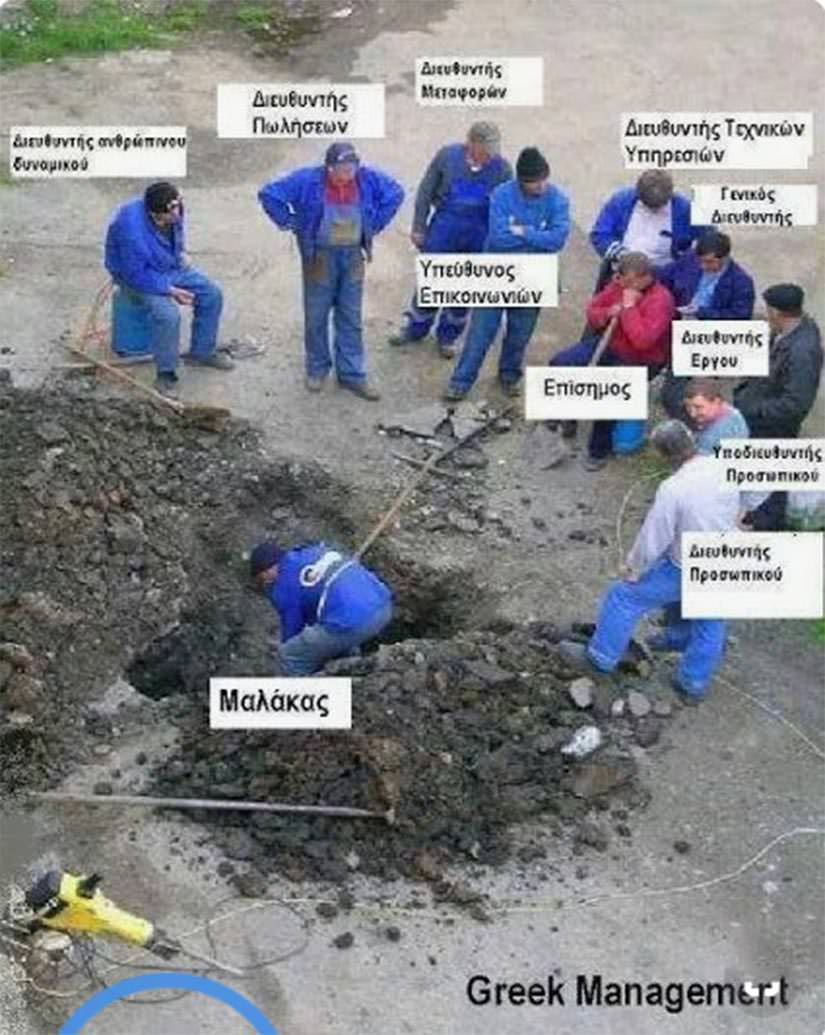
Why Do Friends Say “Malaka” to Each Other?
Among close friends, it’s not only tolerated — it’s expected. You’ll hear phrases like:
- “Ela re malaka” – Come on, man
- “Eisai enas malakas” – You’re such a goof (with affection)
Think of it as a Greek badge of trust — but only in familiar company.
Origins of the Word Malaka
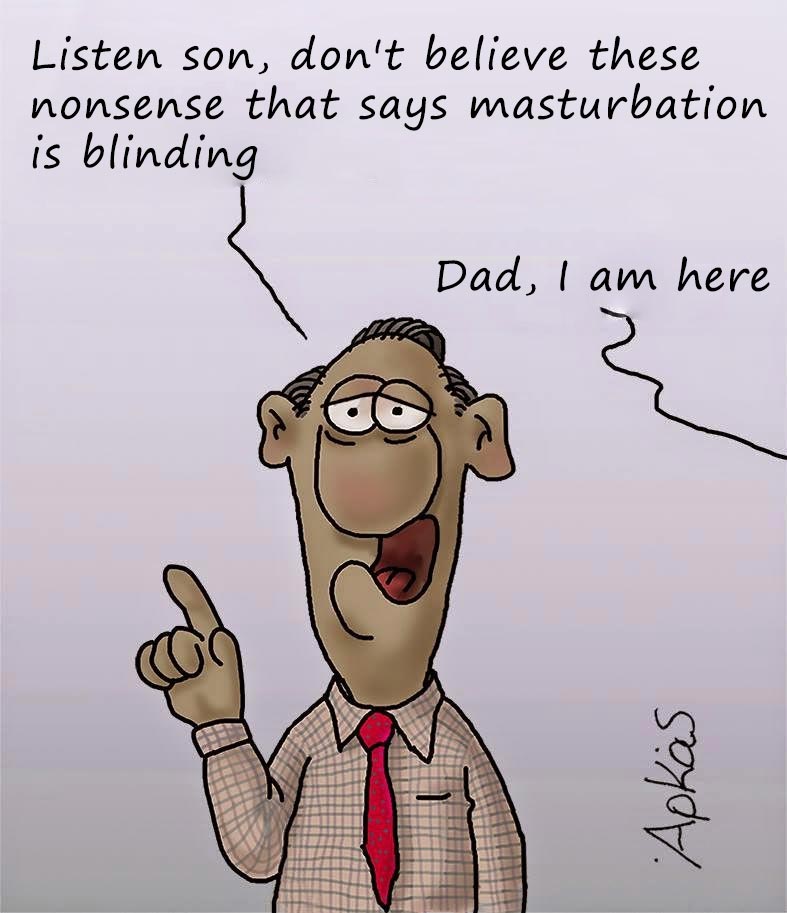
Historically, “malaka” comes from “malakia,” meaning softness or weakness. In medieval times, masturbation was linked to mental decline — so the term gradually evolved into a general insult for fools and weaklings.
But Greek culture is flexible. The same word can now carry irony, affection, or contempt — depending on the speaker and the moment — reflecting how the Greek language works in everyday communication.
So… Is “Malaka” a Bad Word?
Yes, it is. It’s vulgar in literal meaning, but softened by social context. Greeks use it like seasoning — sparingly or generously, but always with intent.
So, unless you’re sure of the mood and your relationship with the person, keep it in your linguistic back pocket. Use it wrong, and you might get silence. Or worse — a slap.
Visiting Greece? You’ll Hear It—a Lot.
Especially in casual settings, such as cafés, beaches, and traffic jams. It’s cultural shorthand. Don’t try to master it — just observe and enjoy.
But wait, Malaka is just the tip of the iceberg; there are thousands more swear words in Greek that you will definitely enjoy!
Tourist Tip – Can Foreigners Use It Safely?
If you’re an English-speaking adventurer hoping to bond with the locals, chances are you’ve already heard malaka tossed around like confetti. The good news? Tourists usually get a free pass — think of it like an amusement park wristband. But fair warning: there’s always a tiny risk of stepping into friendly fire.
Heading to Corfu? Don’t be surprised if Malaka pops up in cafés, on beaches, or from a smiling driver stuck in traffic. Around here, it’s often more playful than rude. Use it with care, and you might just pass for a local (or at least make someone laugh).
Bottom line: Malaka is like a secret handshake — it can open doors or accidentally start a duel. Unless you’ve cracked the code, it’s probably smarter to keep it in your back pocket. And hey, when in doubt, focus on pronouncing moussaka properly — fewer risks, more rewards.
Final Thoughts
“Malaka” is more than slang — it’s a window into the Greek psyche. It’s about emotion, timing, and relationships. It’s a mask word for almost everything.
And yes, here in Corfu, we might just say it more than anywhere else. But don’t worry — if we call you one, it might mean we like you.
Want more? See real-world examples from Greece, England, and France here:
Malaka… in Europe!So, buckle up, fellow adventurers, because the world of “Malaka” in Malaka’s country is just a click away.
And remember, when in doubt, embrace the spirit, the slang, and the unforgettable journey that comes with it. It’s all part of the glorious Greek experience, Malaka-style!
Excuse our lack of good sources, but who needs sources when an original Greek Malaka writes this post? Right?







Comments