
12 Olympian Greek gods

The 12 Olympian Gods and Goddesses in Greek Mythology

Posted in: Greek gods, Greek Mythology 0

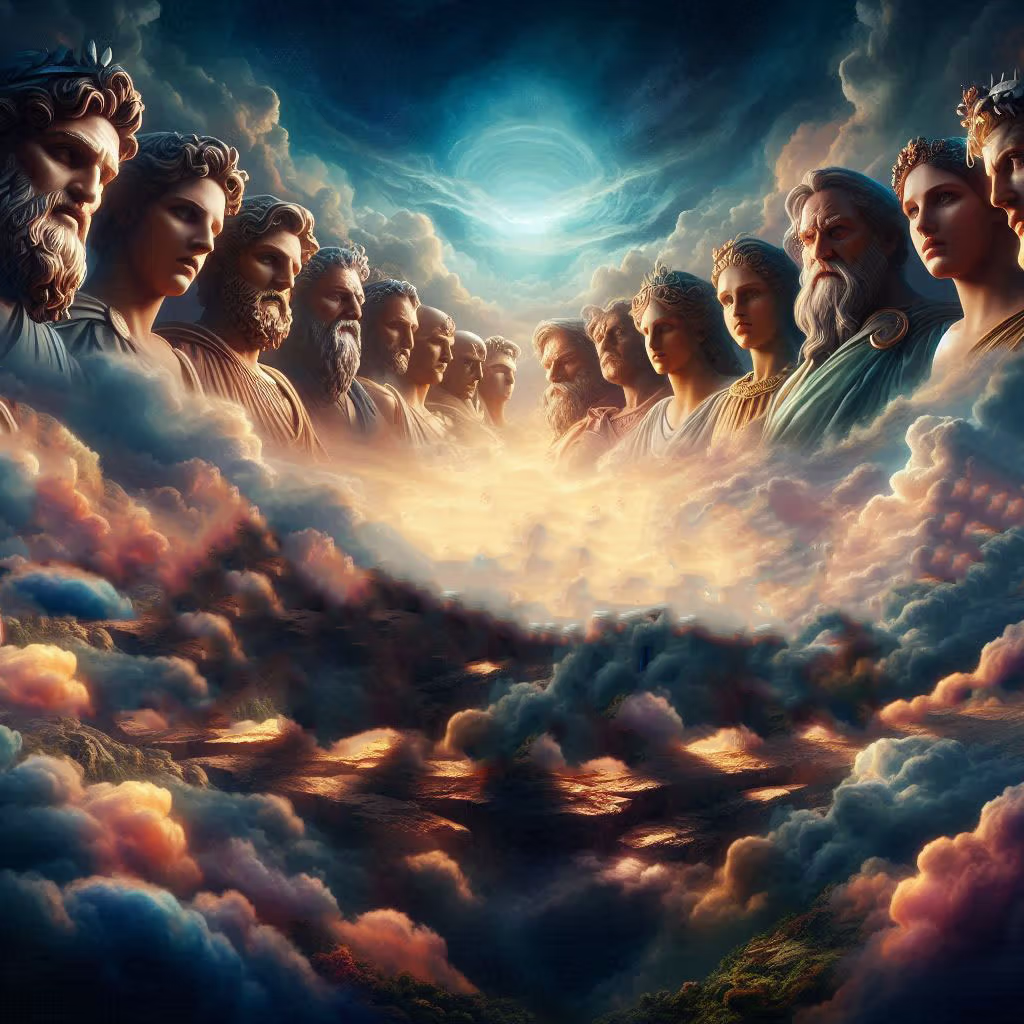
The 12 Olympian gods and goddesses — Zeus, Hera, Poseidon, Demeter, Athena, Apollo, Artemis, Ares, Aphrodite, Hephaestus, Hermes, and Dionysus — plus the non-Olympians Hades and Hestia, were the principal deities of Greek mythology.

Introduction: The Living Legacy of the Greek Gods

The Twelve Olympians weren’t just ancient myths — they were the beating heart of Greek culture, shaping how people understood the world, nature, and themselves. From the lofty throne of Dias atop Mount Olympus to the shadowy depths ruled by Hades, these gods embodied everything from raw power and wisdom to beauty and chaos.

As you may have noticed, in reality, the main gods numbered 14, including Hades and Hestia, but the Olympians are considered only those who lived on Mount Olympus. Hades was living in his realm, the underworld, and Hestia was replaced in Olympus by Dionysus.

Their stories are more than dusty old legends; they reflect human nature in all its glory and flaws — jealousy, love, bravery, and betrayal. The gods weren’t distant beings but active forces influencing daily life, inspiring art, politics, and personal faith across centuries.

Today, their legacy lives on, not only in history books but in the language, symbolism, and collective imagination worldwide. Understanding these deities gives us insight into ancient civilizations and timeless human themes.

The Most Important Gods of The Greek Pantheon

The Greek Gods family tree

Greek Gods and their ancestors [infographic]
Greek Gods and their Ancestors [Infographic]

The Twelve Olympian Gods were the descendants of Titans and are the most significant deities in Greek mythology, ruling the world from their divine abode on Mount Olympus.

They represent a range of aspects of life, nature, and human experience, and their stories form the foundation of ancient Greek religion and culture.

These gods were worshiped widely across Greece and beyond, with each deity having a unique role in both mythological tales and daily life.

While they lived in a mythical realm, their interactions with mortals, heroes, and each other created a rich tapestry of stories that explained the world and taught moral lessons.

Mount Olympus, located in Thessaly, was believed to be their home, an otherworldly place high above the mortal realm.

Despite their divine nature, these gods had human-like personalities, with their strengths, flaws, and emotions.

They were not distant, unreachable deities; rather, they were directly involved in the affairs of the world and often exhibited behaviors and emotions similar to those of humans, such as jealousy, love, and anger. This dual nature made them both powerful and relatable, allowing ancient Greeks to see them as both guardians and sources of conflict.

The 12 Olympians

Now, let’s explore each of the 12 Olympian gods in detail:

Dias (Zeus)
Zeus
Zeus

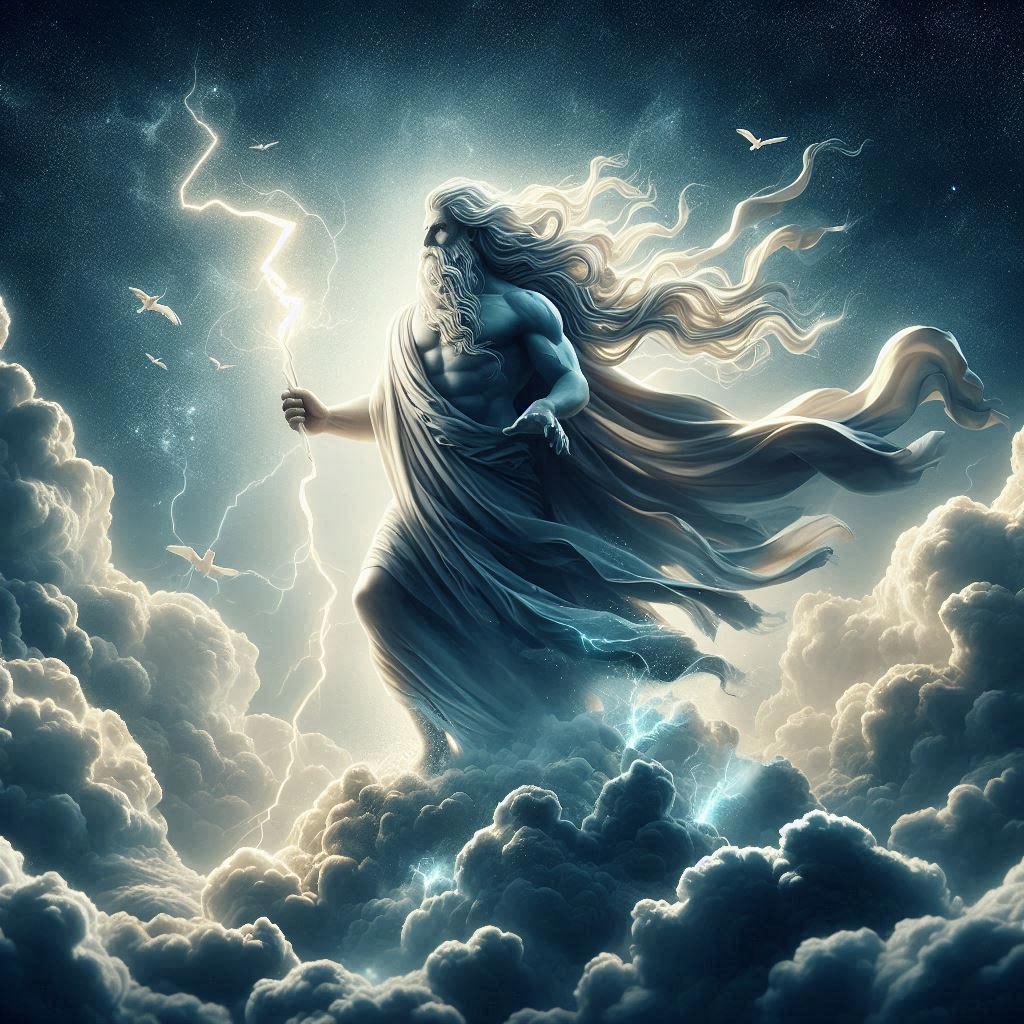
Dias, the king of the gods and ruler of Mount Olympus, presided over the sky and thunder, wielding his powerful thunderbolt to enforce his will.

As the supreme deity, he maintained order among both gods and mortals, ensuring balance and justice in the cosmos.

His role as a protector made him a patron of kings and leaders, often intervening in mortal affairs to set things right or to punish those who overstepped their bounds.

His status as the ultimate authority among the gods came from his victory over the Titans, particularly after he led his siblings in a successful rebellion against their father, Kronos.

Zeus’s domain extended beyond just governance; he was also deeply associated with hospitality and oaths, as well as being the guardian of guests and strangers.

Despite his role as a figure of justice, Zeus’s numerous romantic entanglements were a source of contention, often causing strife among both gods and humans.

His relationships resulted in the birth of many demigods and heroes, including Perseus and Heracles, whose stories intertwine with the broader tapestry of Greek mythology. These affairs often put him at odds with his wife, Hera, leading to many legendary conflicts.

Hera
Hera
Hera

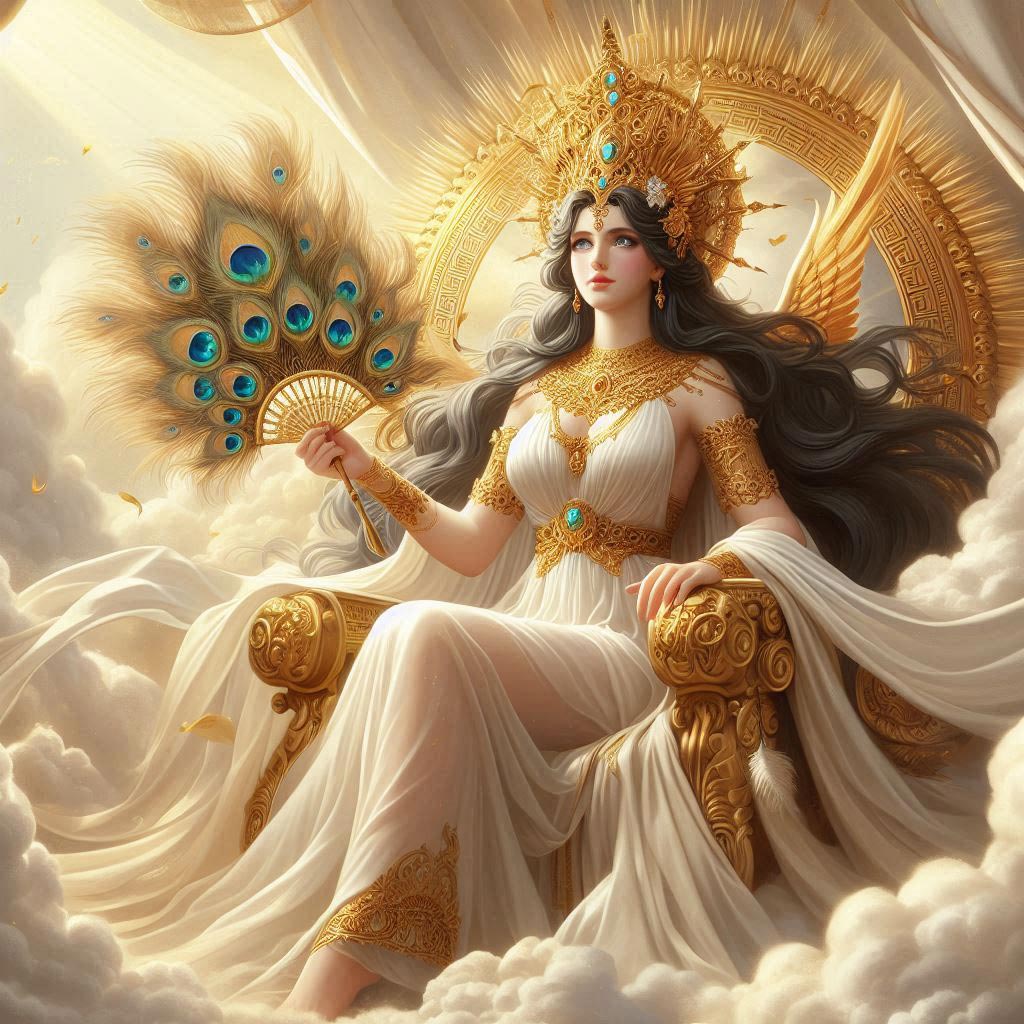
Hera, the sister and wife of Dias, reigned as the queen of the gods. She was the goddess of marriage, family, and childbirth, serving as a guardian of the sanctity of married life and a symbol of maternal care. Unlike other deities, whose domains included the unpredictable aspects of nature, Hera’s power was more focused on the orderly and traditional aspects of life. She held immense influence over the domestic sphere and was a protector of women during childbirth.

However, her marriage to Dias was fraught with turmoil due to his infidelities, which brought out her fiercely jealous nature. Hera’s wrath towards Zeus’s lovers and their offspring became the theme of many myths. For instance, she was relentless in her persecution of Heracles, even sending serpents to kill him as a baby and causing him numerous trials throughout his life.

Despite her stern and vengeful aspects, Hera was revered by the Greeks as a powerful deity who watched over families and upheld social order. In various cities, such as Argos and Samos, her temples were centers of worship, reflecting her status as a major deity within the pantheon.

Poseidon
Poseidon
Poseidon

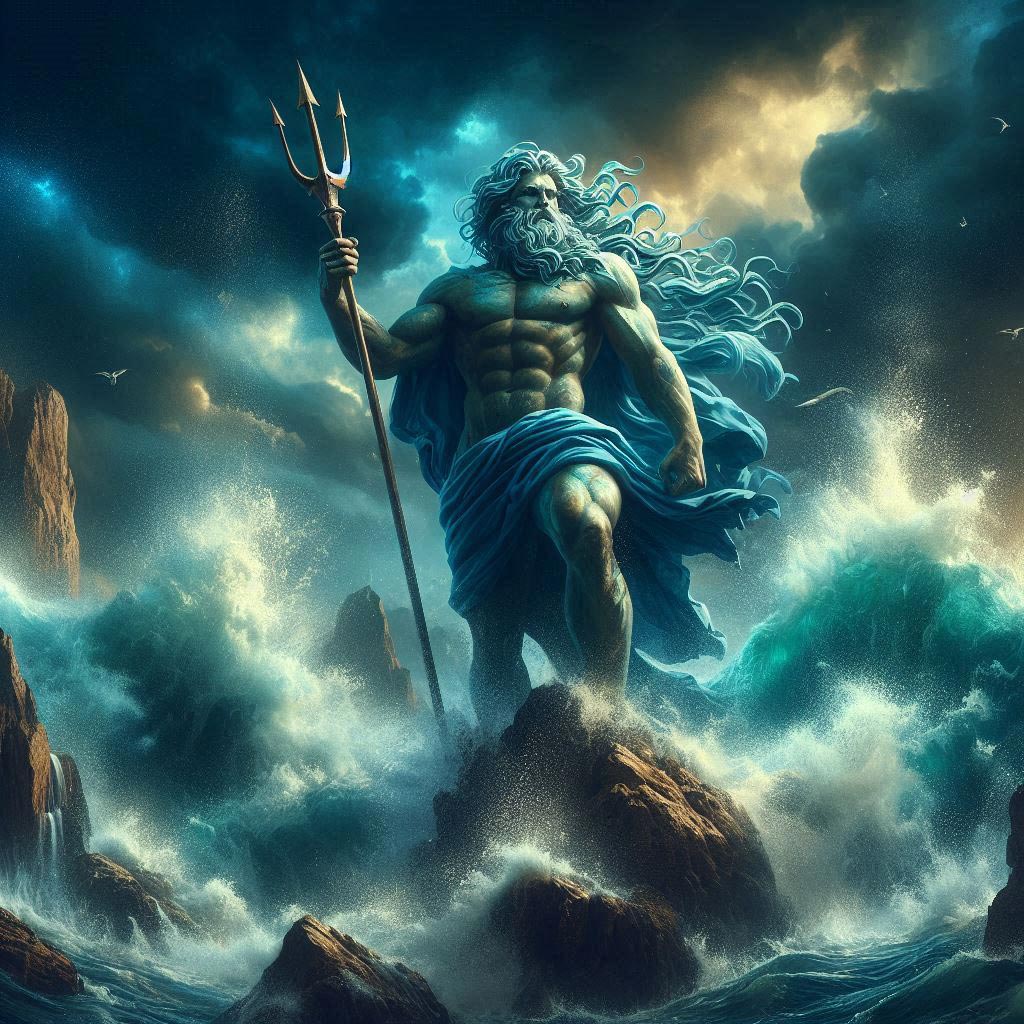
Poseidon, the god of the sea, earthquakes, and horses, was one of the most formidable and unpredictable of the Olympian deities. As the ruler of all waters, he commanded the oceans, seas, rivers, and lakes, wielding his trident to create storms, calm waters, or even cause devastating earthquakes. The Greeks saw Poseidon’s temperament as reflective of the sea itself—sometimes calm and generous, other times violently destructive.

He was both a provider, ensuring safe passage for sailors and abundant fishing, and a punisher, bringing shipwrecks and disasters upon those who displeased him. Poseidon’s influence also extended to land, where he was considered the creator of horses, often depicted alongside these noble animals. He was known to contest other gods for dominion over regions, such as his famous rivalry with Athena over the city of Athens, which he lost after offering the Athenians a saltwater spring while she provided the olive tree.

In mythological narratives, Poseidon played a pivotal role, as seen in the Odyssey, where his wrathful pursuit of Odysseus transformed a journey home into a decade-long ordeal. Though his temperament could be volatile, Poseidon was highly respected and feared by those who depended on the sea for their livelihoods.

Dimitra (Demeter)

Demeter
Demeter

Demeter, the goddess of agriculture, fertility, and the harvest, was central to the survival and prosperity of ancient Greek society. She governed the growth of crops, the fertility of the land, and the cycles of the seasons, making her a key figure in the rhythms of life. Wheat, barley, and corn were her symbols, embodying the agricultural abundance she bestowed upon the earth.

Her connection to the life cycle was embodied in the myth of her daughter Persephone, whose abduction by Hades brought about the changing seasons. Demeter’s grief during Persephone’s time in the underworld caused the earth to become barren, leading to winter, while her joy at her daughter’s return brought forth spring and renewal. This myth, central to the Eleusinian Mysteries, a major religious cult in ancient Greece, emphasized the themes of death and rebirth, and offered initiates promises of a better afterlife.

Demeter’s presence was also tied to rituals of life, death, and fertility, and her worship included sacrifices and ceremonies meant to ensure good harvests and protect against famine. As a motherly figure, she was both nurturing and formidable, embodying the life-sustaining power of the earth and its ability to give and take life.

Athena
Athena
Athena

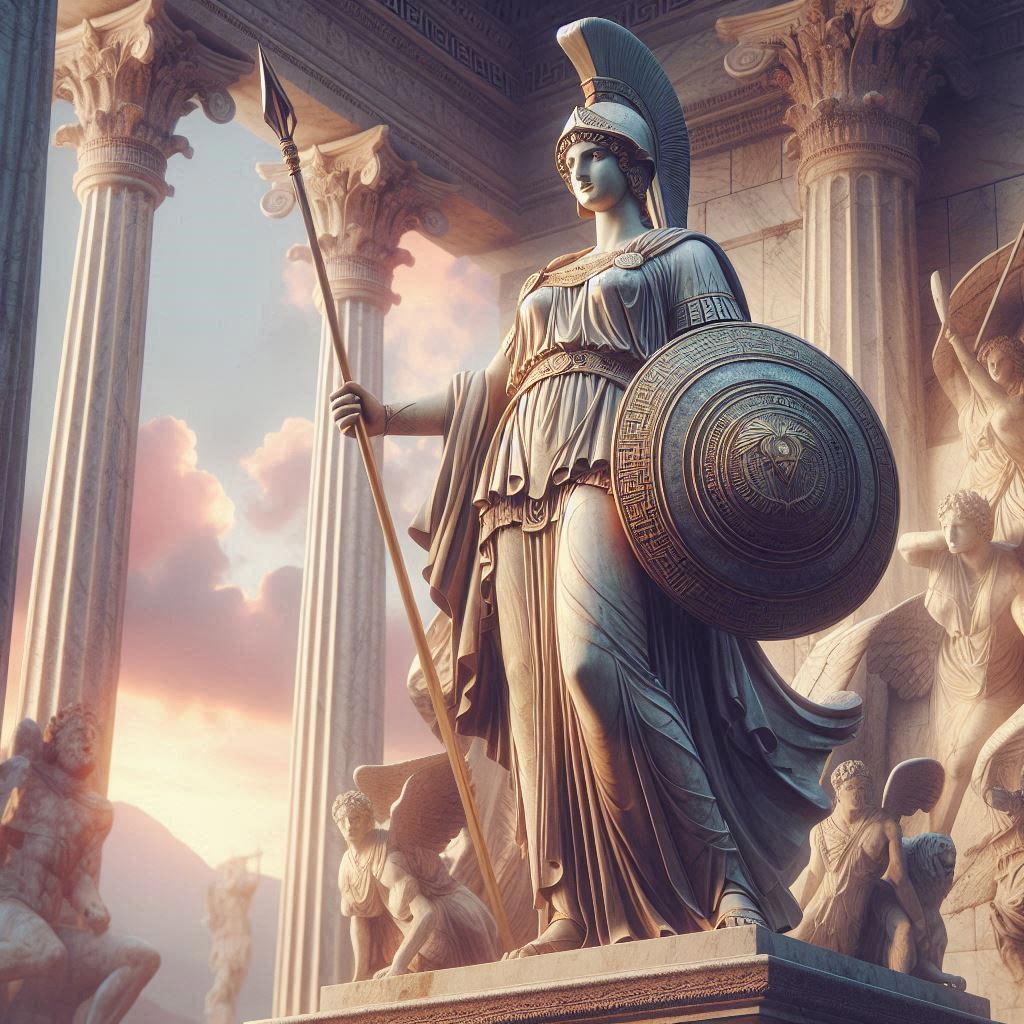
Athena, the goddess of wisdom, warfare, and crafts, was born fully armed from the head of Zeus, symbolizing her role as a deity of intellect and strategic warfare. Unlike her brother Ares, who represented the brutal and chaotic side of war, Athena was known for her tactical acumen, guiding heroes like Odysseus, Perseus, and Heracles to victory through cleverness and strategy.

She was also the patron goddess of Athens, named in her honor after winning a contest against Poseidon. Athena’s wisdom extended beyond the battlefield; she was a goddess of crafts, such as weaving, and a symbol of civilization, law, and justice. Often depicted with an owl and wearing a helmet, she embodied the ideal of rational thought and leadership, making her a favored deity among philosophers and statesmen.

Despite her martial prowess, Athena was also a virgin goddess, representing purity and self-discipline. Her role as a protector of cities and heroes cemented her as one of the most respected and revered figures in Greek mythology, known for her calm demeanor and impartial nature in matters of justice and war.

Apollon (Apollo)
Apollon
Apollon

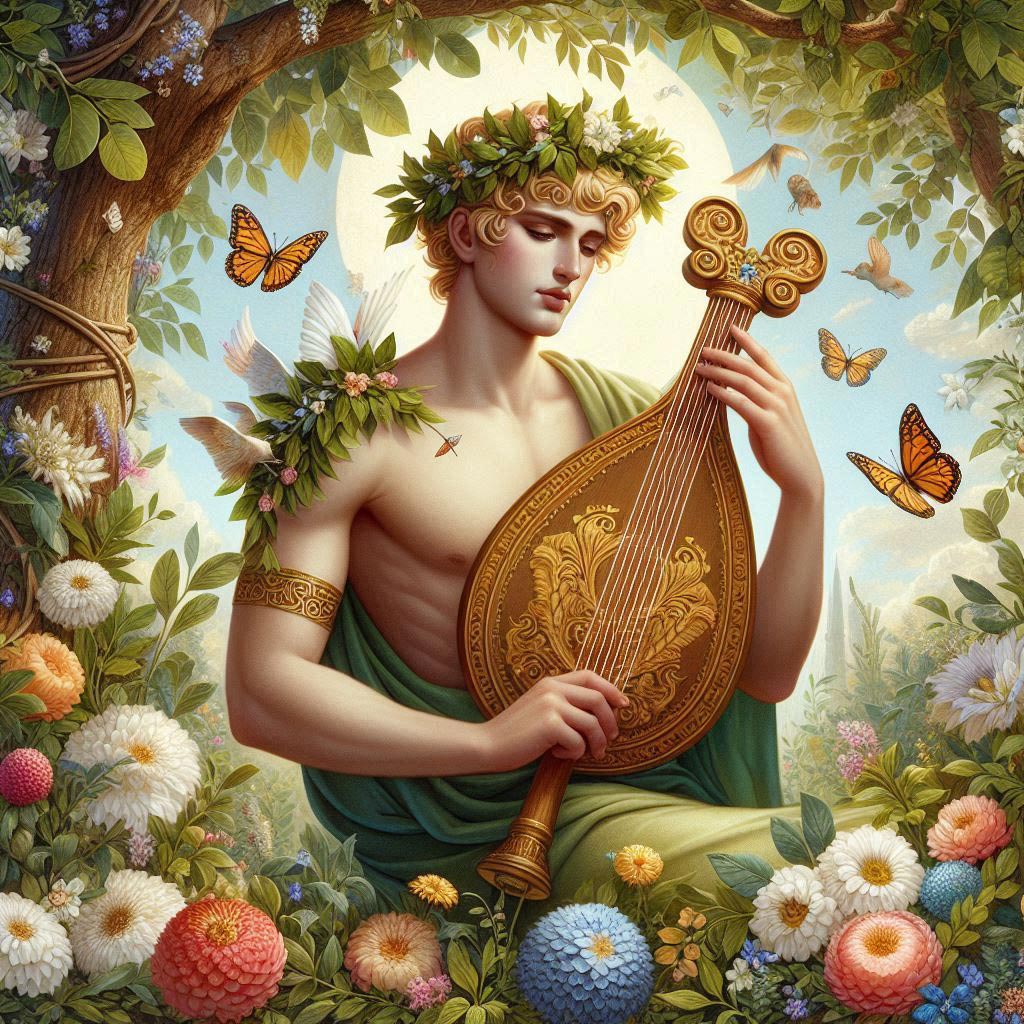
Apollo, the god of the sun, music, poetry, prophecy, and healing, was one of the most versatile and revered deities in the Greek pantheon. As the son of Zeus and Leto, and the twin brother of Artemis, Apollo was often depicted as a youthful and radiant figure, symbolizing beauty and harmony. He rode his chariot across the sky each day, bringing light and warmth to the world, but his influence extended far beyond that of a solar deity.

Apollo was known for his mastery of the lyre, which he used to inspire both gods and mortals with music and poetry. He was also the god of prophecy, with his most famous oracle located at Delphi, where priests and priestesses interpreted his cryptic messages. These oracles played a significant role in guiding the decisions of individuals and city-states, making Apollo a god of wisdom and foresight.

His dual nature as a healer and bringer of plague highlighted his power over life and death. While he could cure diseases and bring relief through his knowledge of medicine, he could also unleash devastating plagues with his arrows. Apollo’s complexity and cultural significance made him a central figure in many myths, ranging from his tragic love affairs, like that with the nymph Daphne, to his role as a divine protector of Troy during the Trojan War.

Artemis
Artemis
Artemis

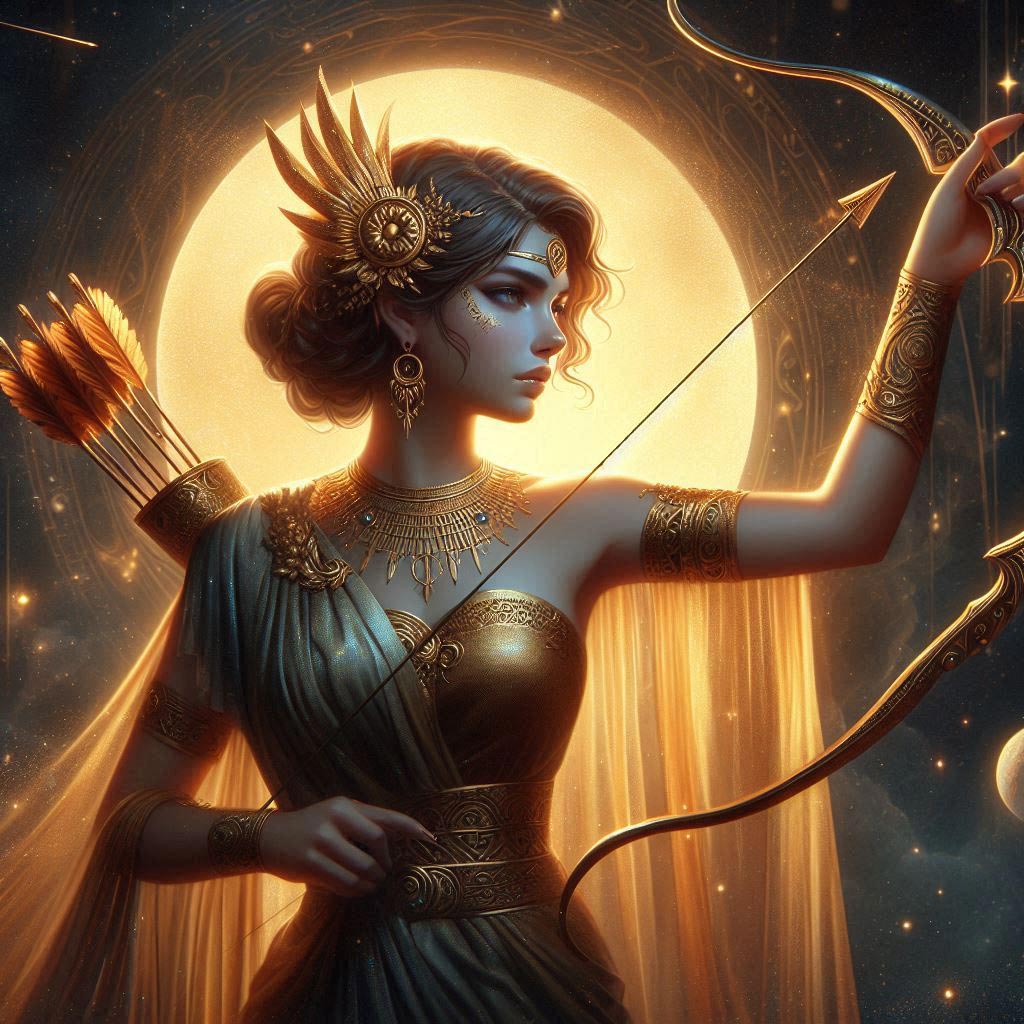
Artemis, Apollo’s twin sister, was the goddess of the hunt, wilderness, and childbirth, as well as a protector of young women. She roamed the forests and mountains with her band of nymphs, wielding her silver bow and arrows with unmatched skill. Artemis was often depicted as a virgin huntress, fiercely independent and unwilling to be tied down, representing the untamed and free aspects of nature.

As a protector of animals and nature, Artemis held sway over wild creatures and the moon, guiding hunters and ensuring balance in the natural world. She was also associated with childbirth and the safety of women during labor, highlighting her role as a nurturing yet fierce guardian. This duality made her both a goddess of life, safeguarding the young and the vulnerable, and a bringer of swift retribution to those who defied her or threatened her purity.

Ares
Ares
Ares

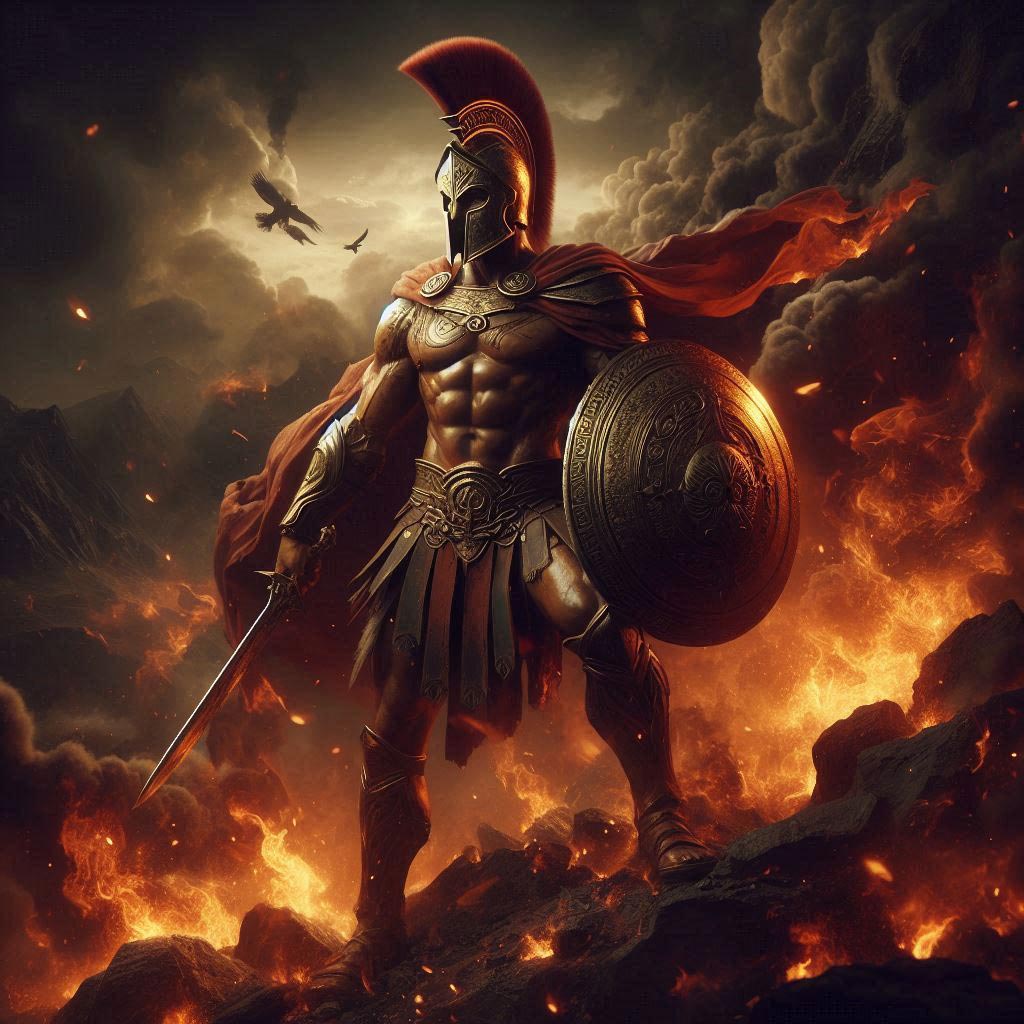
Ares, god of war, embodied the brutal, chaotic, and bloodthirsty side of battle. Unlike Athena’s strategic wisdom, he thrived in raw violence and chaos, often depicted as a fierce warrior stirring fear and fury on the battlefield.

Despite his power, he lacked favor among gods, including his father Zeus, who saw him as reckless and destructive. Few temples honored him compared to other gods.

His love affair with Aphrodite blended love and war, adding complexity to his character.

In myths, Ares often faced defeat or capture, reminding Greeks of war’s uncontrollable, destructive nature.

Aphrodite

Aphrodite
Aphrodite

Aphrodite, goddess of love, beauty, and desire, wielded irresistible power over gods and mortals. Born from sea foam near Cyprus, she embodied physical beauty and attraction’s mysteries.

Her influence extended beyond romance to all passion—marriage, seduction, and chaotic desire.

Her role in myths like the Trojan War, sparked by the golden apple of beauty, highlights her importance. Married to Hephaestus but unfaithful with Ares, her affairs caused jealousy and rivalry among gods.

Yet, Aphrodite blessed lovers, fostering harmony, and ruled over art, music, and sensual pleasures—forces binding the universe.

Hephaestos
Hephaestos
Hephaestos

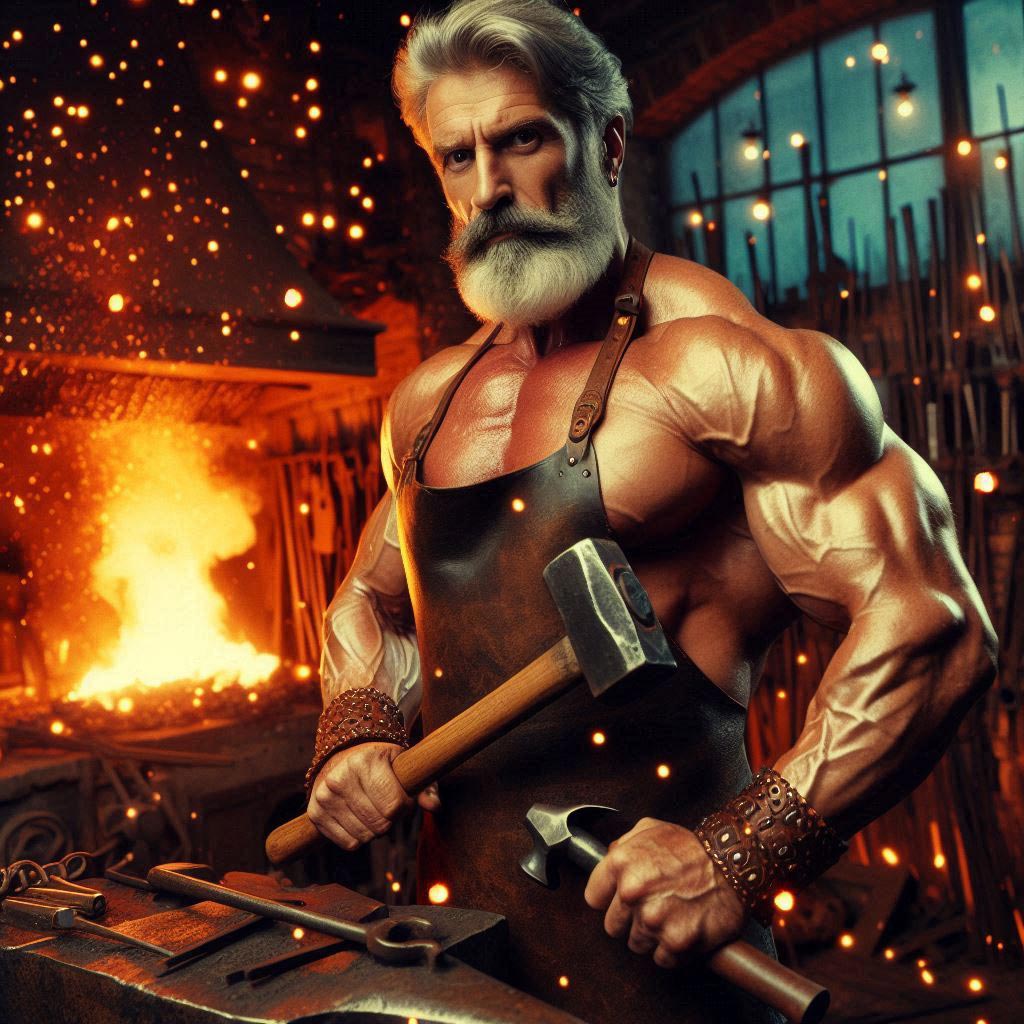
Hephaestos, god of fire, metalworking, and craftsmanship, was the divine smith forging weapons and art for gods. Despite being lame from birth or after a fall from Olympus, his skill was unmatched.

He made Zeus’s thunderbolts, Achilles’ armor, and Prometheus’s chains, central to divine order.

His workshop beneath volcanoes symbolized fire’s power and danger. Cyclopes often assisted him.

Married to Aphrodite, their contrast symbolized art and nature’s complex interplay.

Though less majestic, Hephaestos was revered by artisans and laborers as a master of fire’s transformative power.

Hermes
Hermes
Hermes

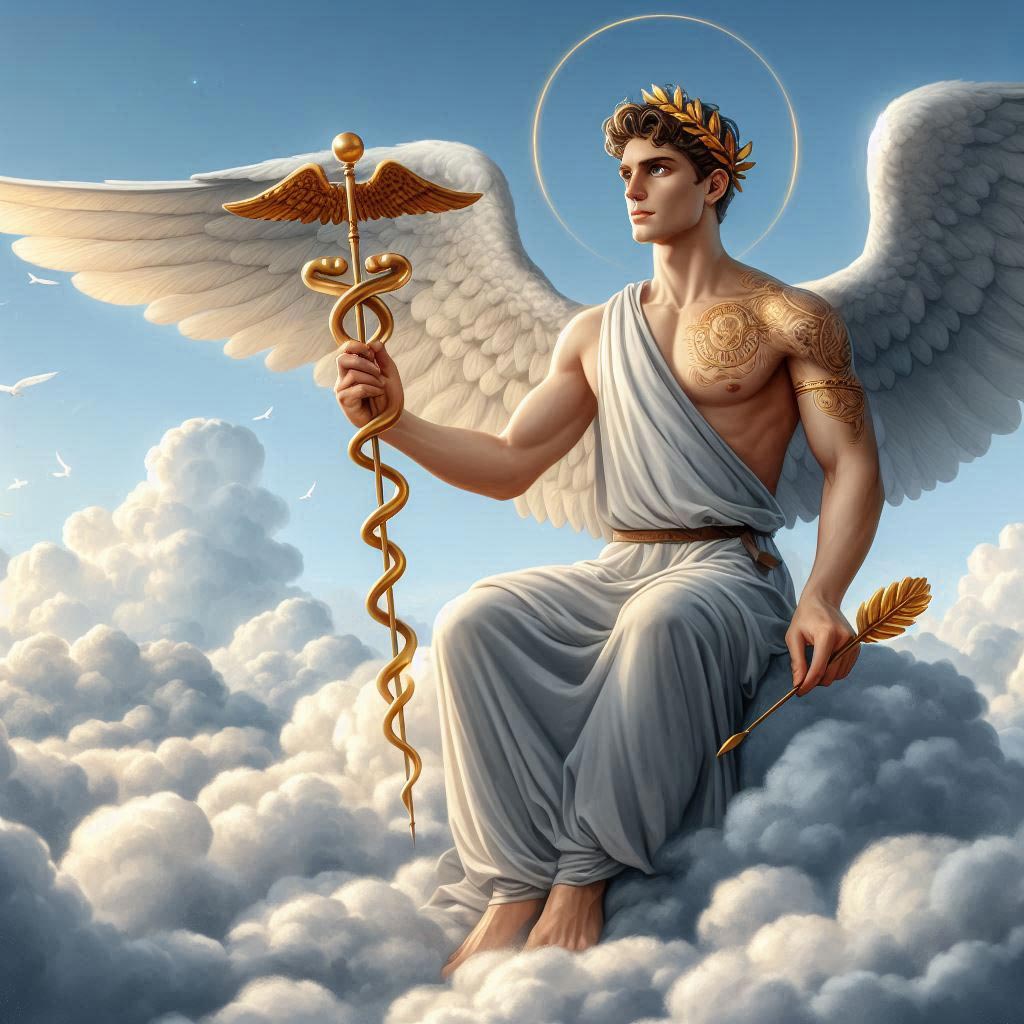
Hermes, fleet-footed messenger of the gods, ruled communication, commerce, and travel. With winged sandals and caduceus, he moved freely between gods and mortals, guiding souls to the underworld and delivering messages.

Protector of travelers and merchants, associated with trade, luck, and persuasion.

Also a trickster, known for cunning—for example, stealing Apollo’s cattle as a child but cleverly avoiding punishment.

Despite mischief, Hermes helped heroes like Odysseus and Perseus, also guiding souls in the afterlife.

Dionysos
Dionysos
Dionysos

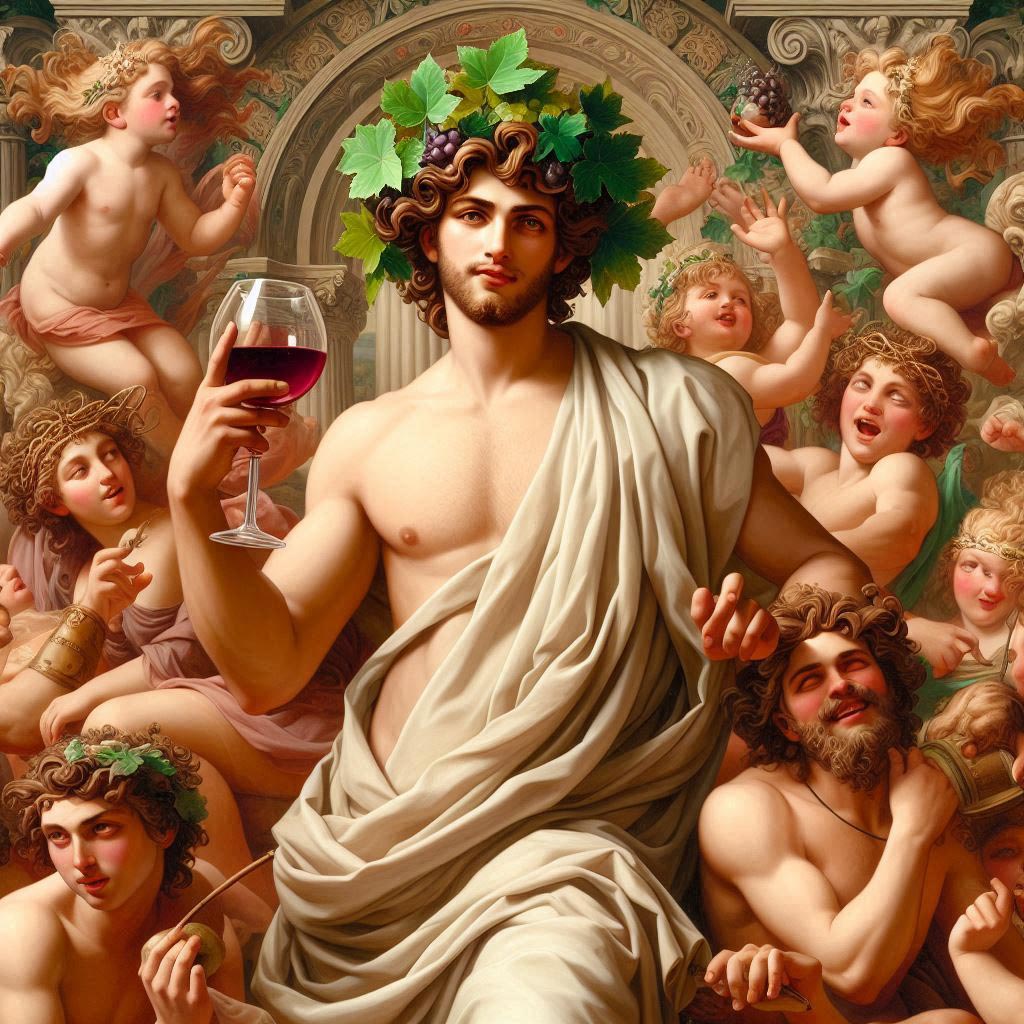
Dionysos, god of wine, ecstasy, and revelry, represented nature’s liberating forces and intoxication’s transformative power.

Born of Zeus and mortal Semele, he blurred the lines between divine and earthly.

Spreading viticulture and wine mysteries, he inspired joy, madness, and divine connection.

His rites, the Dionysian Mysteries, allowed breaking societal norms to commune with the divine—both creative inspiration and chaotic frenzy.

Followers included satyrs and maenads, wild and ecstatic figures.

Despite chaos, Dionysos symbolized rebirth and regeneration, like the annual grapevine cycle.

Main gods not living in Olympus

Hestia
Hestia
Hestia

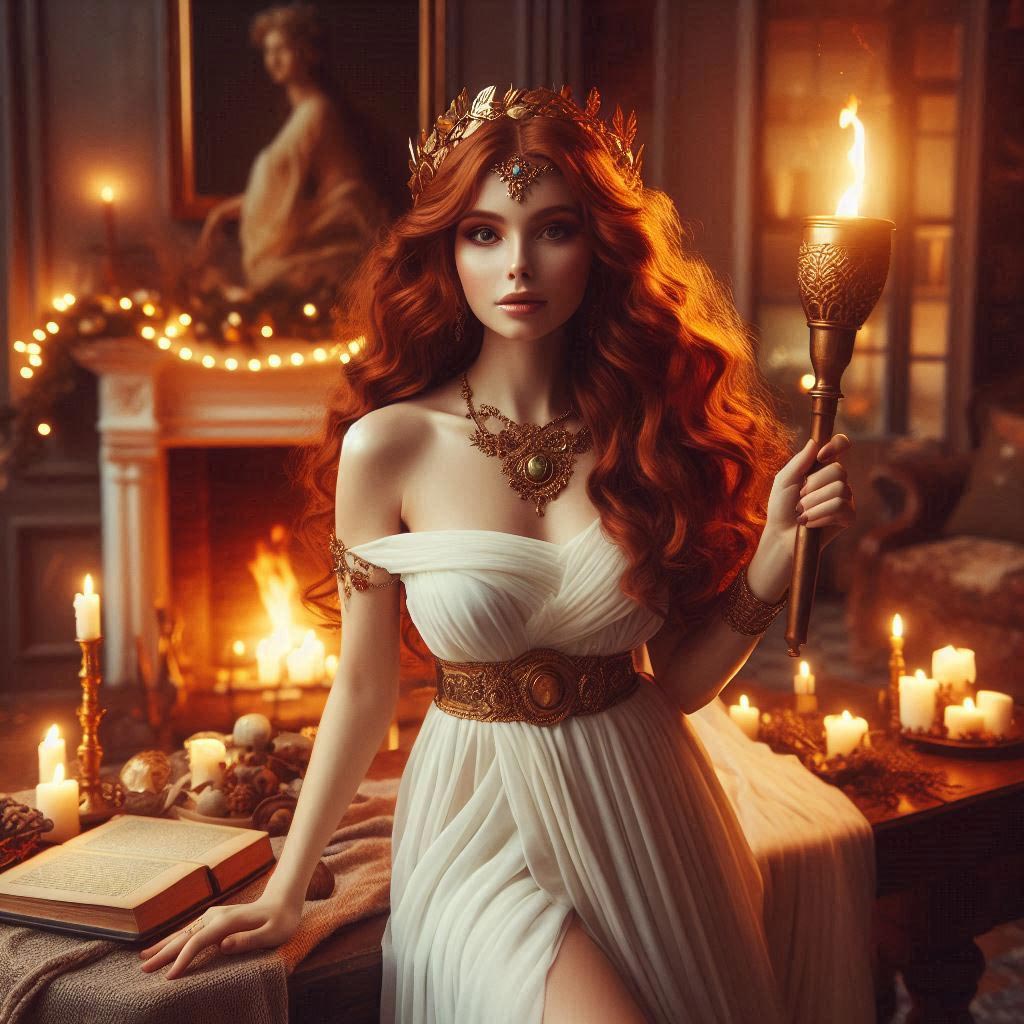
Hestia, goddess of hearth, home, and domesticity, held a unique place among Olympians. She stepped down for Dionysos to keep the number twelve but remained deeply revered.

Keeper of the sacred flame, symbolizing household stability and communal harmony.

Every Greek home honored her with offerings, representing hospitality and reverence.

A virgin goddess like Athena and Artemis, emphasizing a nurturing yet independent spirit.

Though less dramatic, Hestia’s influence was central to family and state well-being, with her eternal flame a symbol of unity.

Hades
Hades
Hades

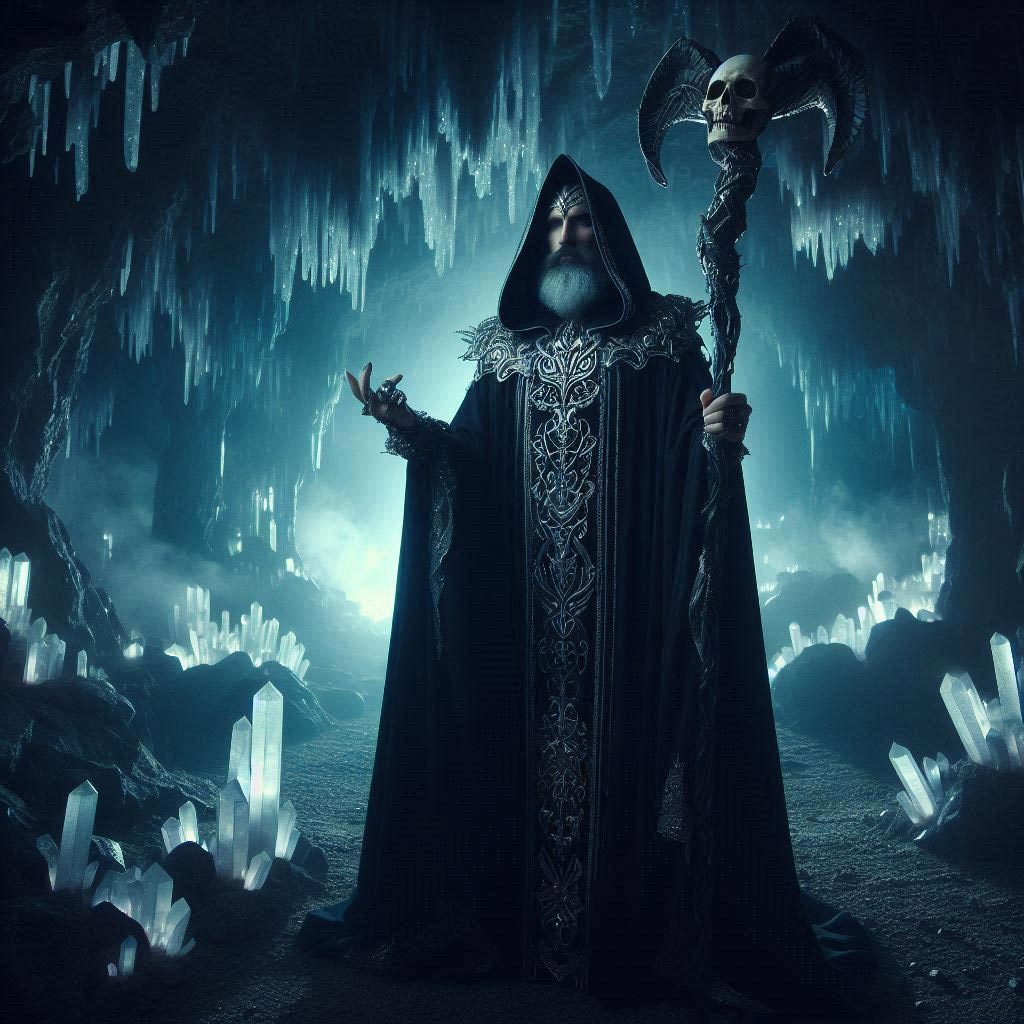
Hades, god of the underworld, ruled the realm of the dead with stern justice, one of the most feared and misunderstood Greek gods.

Brother to Zeus and Poseidon, he claimed the underworld after the Titan defeat—a shadowy domain far from Olympus’s light.

His kingdom wasn’t just torment but a complex afterlife with different regions for souls. The River Styx formed a boundary, with Charon ferrying souls across.

Hades ruled alongside Persephone, abducted from the living world, explaining the seasons.

Though grim, he wasn’t evil—just a necessary part of life and death’s cycle.

Called “Plouton” (the wealthy one) for earth’s hidden riches, he symbolized both death’s finality and fertility through buried treasures.

Few temples existed, as Greeks feared invoking him, but he was respected as the order’s guardian between the living and the dead.

Summary: Why the Greek Gods Still Matter

The Greek pantheon remains relevant because it captures the complexity of existence through relatable, imperfect divine figures. Whether it’s Dias’s authority, Athena’s wisdom, or Dionysos’s wild abandon, these gods show us the many faces of power and passion.

They remind us that life is a mix of order and chaos, creation and destruction, light and shadow. Their myths explain natural phenomena, cultural values, and ethical dilemmas — lessons that resonate even in modern times.

While we may no longer light sacred flames or consult oracles, the stories of the Greek gods continue to inspire literature, art, psychology, and popular culture. They serve as a mirror reflecting our struggles, strengths, and dreams — an evergreen source of meaning that transcends time.

So whether you’re a history buff, a mythology fan, or simply curious about how ancient Greeks saw their world, diving into the tales of these gods is a journey into the roots of Western thought and storytelling.

Note: All photos are created using AI, as we were unable to settle an interview with all the gods. We did our best and tried, but Zeus never answered the call, and the others seemed to be very busy. So, forgive us for presenting the fruits of AI. You’ll be seeing a lot of AI images in the future anyway, so don’t complain!
Empousa

Meet Empousa, Fantasos, and 4 Monsters of Greek mythology

How many creatures in Greek mythology do you know? I’m sure that most of you have heard of the Minotaur, Scylla, and Charybdis, as well as the Centaurs and the Cyclops.

Possibly you know even more, but here we will meet Empousa, Fantasos, and 4 other of the most terrible monsters ever to exist in the Greek world.

How?

Simply by traveling to the deep chambers of the earth, where they are hidden, waiting perhaps for their chance to rise again into the world of the living.

The Minotaur
The Minotaur

Forgotten Monsters of Greek Mythology

Today, we will not talk about the famous fantastic creatures that have appeared in movies and books countless times. Instead, we will try to find the monsters that were once mighty, powerful, and terrible, but now have been forgotten.

There are many of them, so we will not find them all. But we will definitely get a picture of a different, fantastic mythological world of Bronze Age Greece that has remained invisible.

The rich Greek mythology covers a huge range of fiction. In its stories, you will find countless witches, monsters, elves, demons, ghosts, giants and dwarves, winged dragons and horses, enchanted objects, and mechanical beings.

Fantastic creatures, really strange for a 21st-century human mind, but at the time they were born and many centuries later, they were considered real.

Some said that they saw them, some heard them, and some were destroyed or saved by them. Most of these creatures are featured in the tales about the labors of ancient Greek heroes.

For the human of antiquity, his mythology was his history, his religion, and his teaching, in short, a part of his daily life.

That is why we should not be impressed that many of these strange mythological beings, such as the Lamies, the Dragons, and others, survived until today and are still alive in the newest legends and folk tales of the Greek tradition.

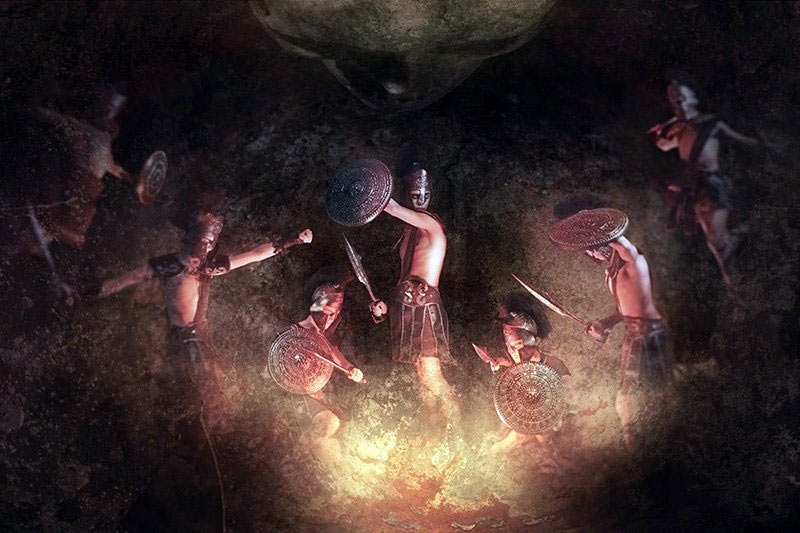
Monsters of Greek Mythology are not dead, they are just imprisoned in deep caves from which they can not escape, unless…someone releases them!

We just want to meet them, so we have to travel deep into the earth, using, where necessary, a lot of our imagination.

A fantastic trip in the depths of the Earth

But let’s talk no more, and let’s start the descent. We will go back, we will sink into the depths of our mind, to its unknown side, where the subconscious resides.

In search of these strange mythological creatures, we will travel to the space-time of fantasy. In these deep caves, we will find everything gathered. So let’s move on!

We are already inside the cave. It is slightly illuminated by the torch we are holding. The light from its flames, in combination with the stalactites, forms strange, eerie shadows.

Ancient words are engraved on its walls, in unknown languages ​​that once existed or have not existed yet. A smell of dirt and moisture is around, and water drips from the top, while whispers are heard all around.

It’s about time to start the long descent. We will find seven levels here, and we will go very deep down. What did you think? The long-lost imaginary creatures are not so easy to find.

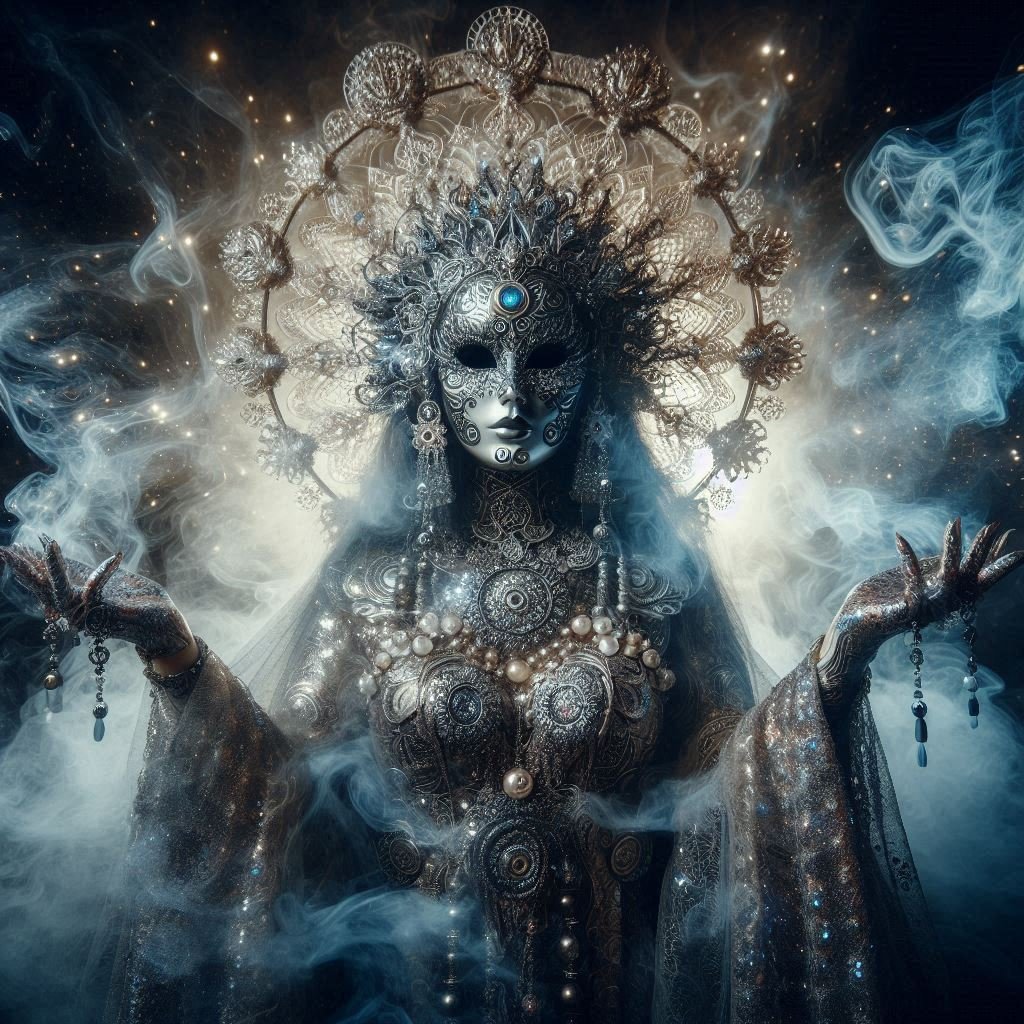
Apatee – The goddess of Deception

Apatee - The goddess of deception
Apatee – The goddess of deception

So we reached the first level. It is difficult as the place is getting dark and narrow. It leads us to an opening that is the entrance of the first chamber.

We first insert our heads and look carefully inside.

There is a woman-like creature sitting in the center. She has snakes instead of hair, bat wings come out of her back, and her hands end up in lighted torches.

There are other engravings around the walls, depicting her with fingers from vipers or whips. She looks at us with glowing eyes.

She looks like Erinyes, goddesses of Curse and Revenge. She is no other than Apatee, the goddess of Deception, the personification of deception, deceit, and falsehood.

Apatee (according to Hesiod) was a Greek primordial deity who represented deceit and trickery.

She was the daughter of Erebos (Darkness) and Nyx (Night).

She was associated with several other deities, such as her half-sister Themis (Justice) and her brothers Dolos (Guile), Momos (Blame), and Oizys (Distress).

Apatee was said to have deceived the gods and mortals alike, leading them to believe lies.

Her schemes could often be so convincing that even the gods were fooled, though they eventually saw through her plans and punished her accordingly.

In some versions of Greek mythology, it was said that she had helped Zeus win the Great War against the Titans by sowing confusion among the enemy ranks.

Apatee’s power over deception is seen throughout many Greek myths and stories. She is sometimes seen assisting the gods, such as when she helped create the chaos that ultimately led to the fall of Troy.

Other myths recount tales of Apatee using her powers against unsuspecting mortals. She is often linked with other figures who are known for their cunning and trickery, such as Hermes, Odysseus, and Circe.

The name Apatee is the Greek word apatee, meaning “deception”, and the verb apatao, meaning “I cheat” or “I deceive”.

The goddess is closely associated with several epithets related to her power over deception, such as Apateelos (Deceiver), Apateon (Cheater), and Ecxapatise (Deception).

With her hand, she shows us a recess in the rock, from there we have to go if we want to continue even lower.

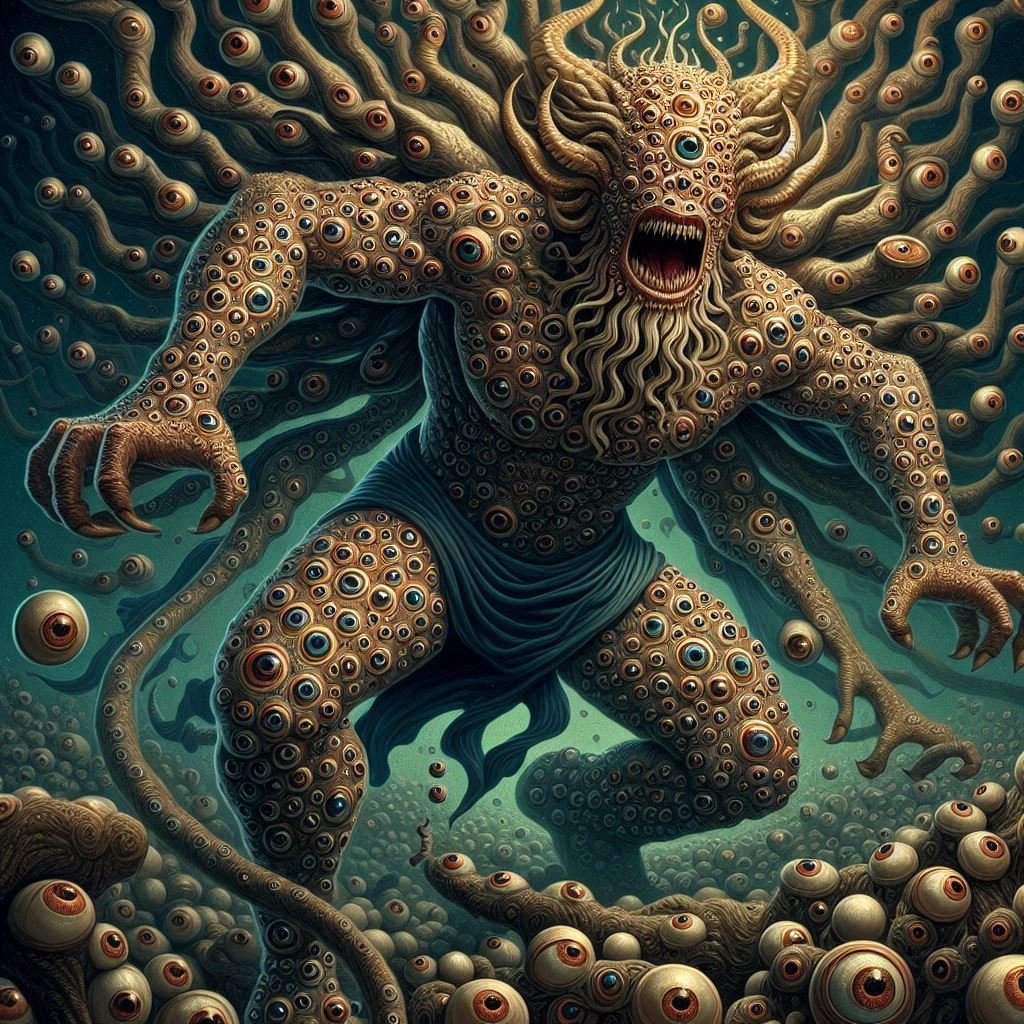
Argos or Panoptis

We follow her advice, and we reach the second chamber. A huge creature is waiting for us. A shepherd monster with a hundred eyes, a creature trained to guard people and animals.

Argos or Panoptis
Argos or Panoptis

His name is Argos (which means “bright”) or Panoptis (“The one who sees everything”). Just remember the words optics and panoptic.

It makes sense if you consider that he had eyes everywhere, in front of and behind his head, and all over his body, while they say that when he slept, he only closed half of them, while the rest kept him awake.

He was a descendant of Okeanos and Tethys and one of the most terrible monsters of Greek mythology.

Historian Ferekidis records that his eyes were only four, two in front and two behind (plus one that was placed on his neck by Hera, the wife of Zeus), while others claim that they were infinite.

Aeschylus calls him “Myriopon voutan”, which means “the million-eyed herdsman”

The only time that Argos fell asleep was when, watching the transformation of Io into a cow, Io, on behalf of Hera (so that Zeus could not make her a woman again), Hermes, sent by Zeus, put him to sleep with his flute and killed him with his sword.

Argos was owned by the deity Hera and guarded her secret places when she was away.

It is good to mention here that Io was a beautiful woman, a mistress of Dias; therefore, the jealous Hera transformed her into a cow and set Argos to guard her, but after Argos’s death, the cow Io started running across the earth like crazy after being bitten by Oιstros, a large horsefly sent by Hera.

Here, the ancients wanted to explain the presence of the horseflies in cows and horses…very artistic conception indeed.

The giant all-seeing monster was slain by the hero Heracles (Hercules) as one of his Twelve Labours. In some myths, Heracles blinded Argos before killing him.

After his death, Hera, in sorrow, decided to honor him by depicting his eyes on the peacock’s tail, one of the birds symbol of Hera, and the starry sky.

You see, reading Greek Mythology, we discover so many peculiar things, even horseflies as punishers!

The Hecatoncheires (Men with a Hundred hands)

The further we go, the heavier we get. And at the same time, we feel that we are slowly disappearing into space.

We are in the third chamber now. It is incredibly big. It does not seem to have a roof over it, only deep darkness.

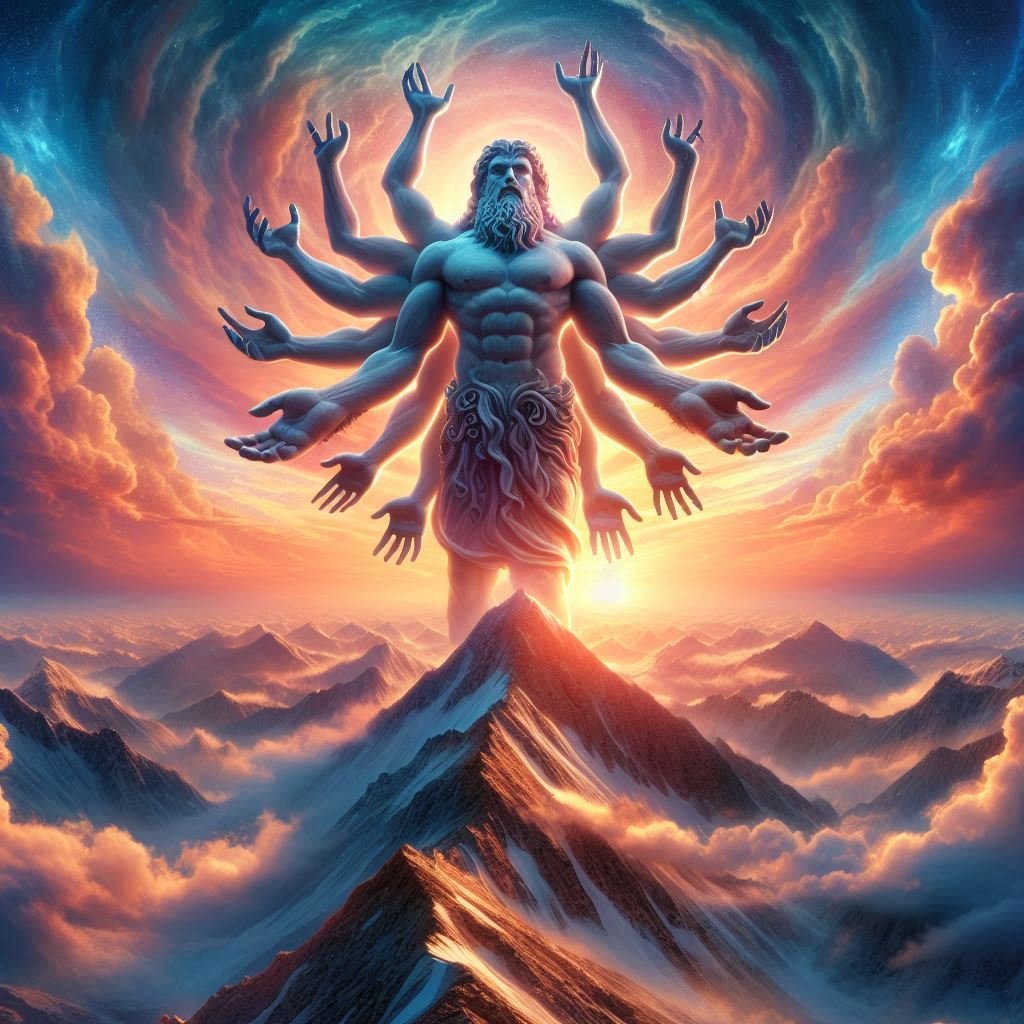
The Hecatoncheires-Men with a hundred hands

Three huge giants are standing in front of us.

(Greek: Εκατόνχειρες, Hekatoncheires, also known as the Hundred-Handed Ones) There were three giants of incredible strength and ferocity, ugly as they say, and bad characters mentioned in the religious texts of ancient Greek mythology.

They were the offspring of Gaea (Earth) and Uranus (Heaven), and their names were Cottus, Briareos, and Gyges.

All three had fifty heads and one hundred arms, which made them incredibly powerful. They were later imprisoned by their father, Uranus, in Tartara(Tartarus), a region of the underworld.

They symbolized the uncontrollable forces of nature, especially the clouds.

Little is known about the Hecatoncheires themselves, except that they were very strong and could cause great destruction with their hundred arms.

They were said to have bluish skin, though this is uncertain, as they are never described in detail.

Their role in mythology is most often overshadowed by their brethren, the Cyclopes, who were featured more prominently in various tales.

The Hecatoncheires are sometimes mentioned alongside other mythological figures like the Titans and Cronus, as well as various monsters like the Chimera or Minotaur.

Ultimately, however, they are seen as powerful but ultimately forgotten characters in Greek mythology.

Zeus liberated them so they could fight to support him in the great war of the gods against the Titans. In the end, they became the captives of the Titans in Tartarus. Maybe they still guard the Titans down there.

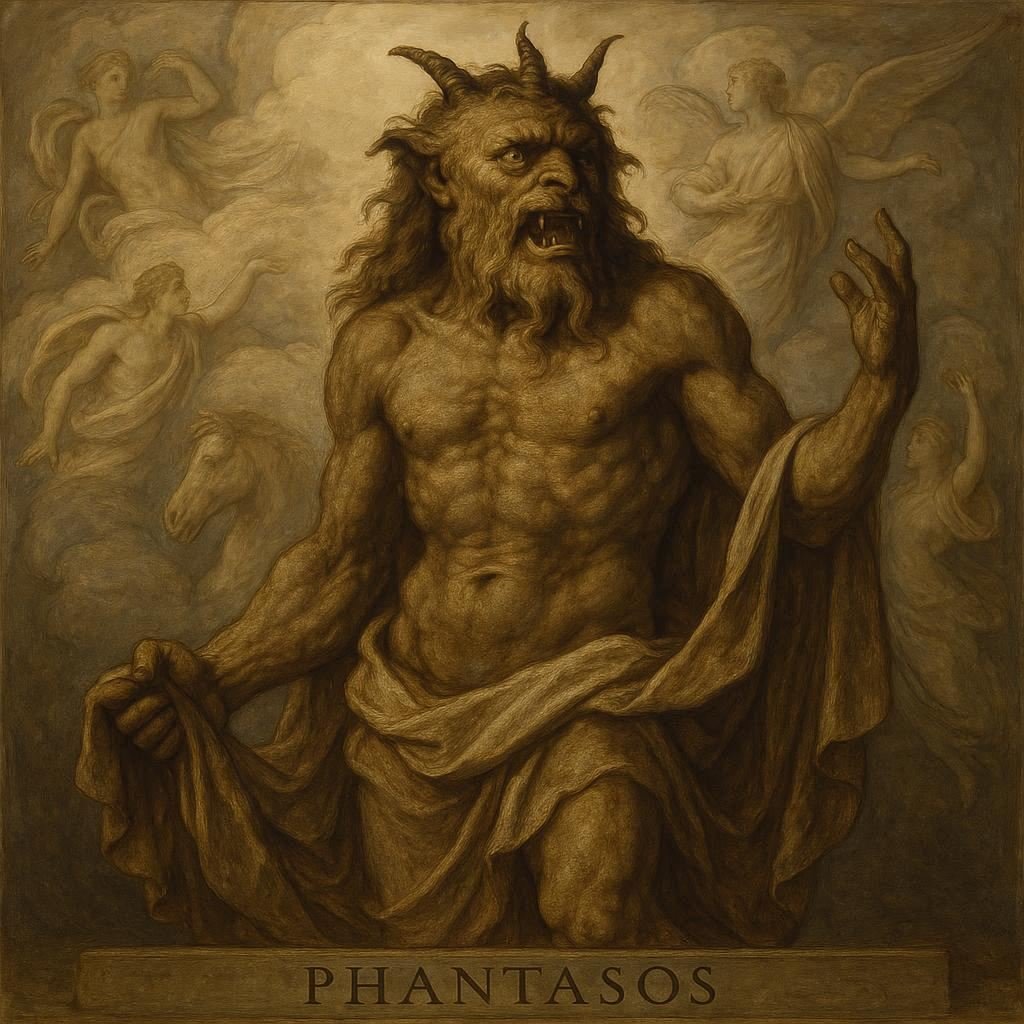
Phantasos: The monster that could take any form

Phantasos-the monster-that could take any form

We move even lower. Into the fourth chamber. It looks empty, but it’s not.

On the walls around are carved all the dreams that man has ever seen or will see. At its center, there is a strange creature without a clear form.

Its name is Phantasos, a being who can transform into any inanimate thing, real or imagined, and present himself to humans in any form he wishes.

Son of Hypnos(the god of Sleep), and the Pasithea, one of the Charites (Graces).

His brothers were the god of dreams, Morpheus(Who could take the form and imitate the voice of every human being), and Phoebus or Phobetor (who could imitate any animal).

Phantasos was believed to be a shapeshifter, often taking the form of animals or birds. He is also associated with fantasy and imagination.

He was revered as a god of creativity and ideals, allowing mortals to escape reality through their dreams and visions.

But we do not sleep now, so we do not see it clearly, and he does not even know if we have a human form, so he can’t harm us.

Empousa: The one who penetrates

Empousa
Empousa

From a small hole, we keep going down lower and lower.

We reach the fifth chamber. Whispers and murmurs surround us.

At the edge of the night stands a thing that once pretended to be a woman.

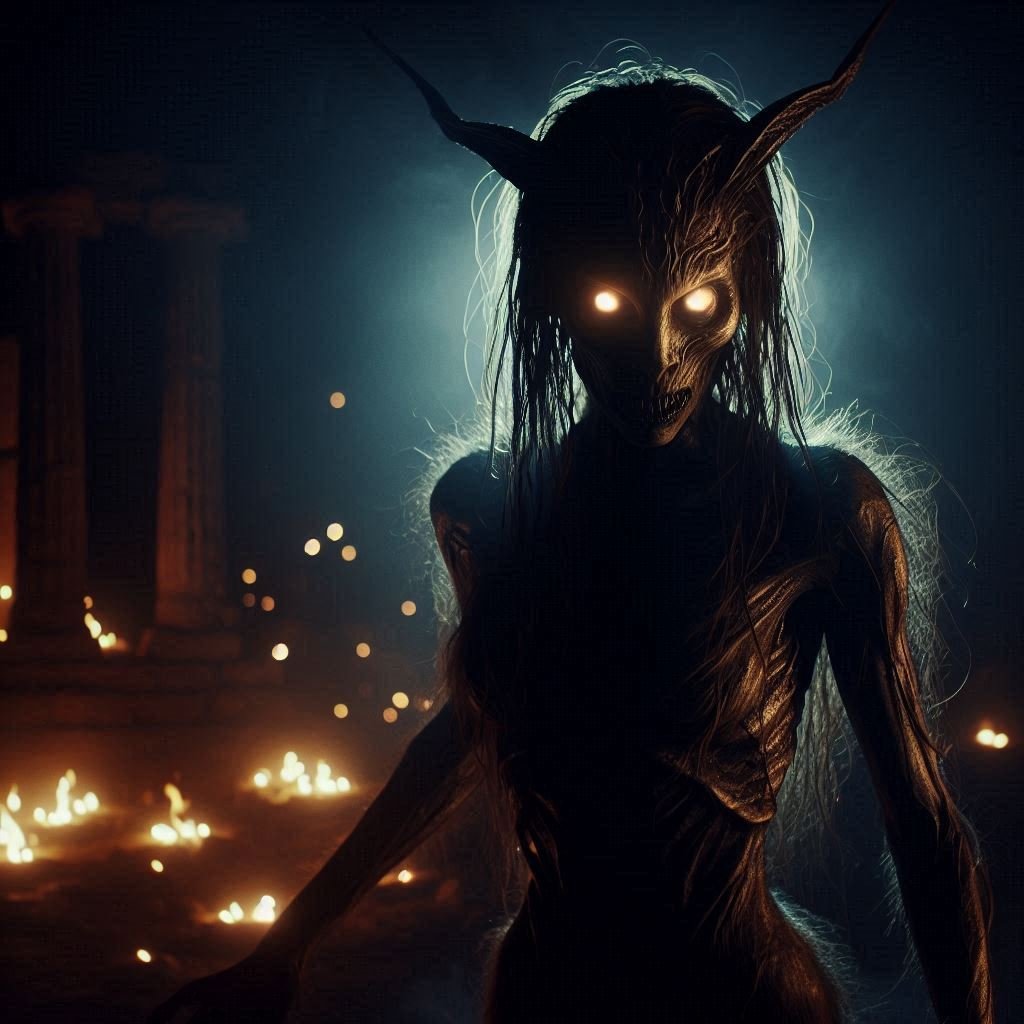
Empousa is a vampiric demon that has one single donkey leg — and the other has a bronze sandal that strikes sparks when she walks — and from her thighs hang the parts of beasts best left unnamed. Daughter of Hecate, the witch queen of the Underworld, she slips from the shadows where the dead whisper and walks among the living when the moon is thin.

Her face is worse than any devil’s, twisted in the way nightmares bend a human smile — like the thing in The Exorcist, only older, hungrier, and real. Her eyes roll white, her mouth stretches too wide, and when she laughs it sounds like metal tearing. Her arms hang too long, ending in hooked nails that could rake the ground if she wished. Sometimes she burns from within, her skin glowing like embers. Sometimes she wears another face — a fawn, a wolf, or the perfect mask of beauty — until the moment you’re too close to turn away.

She hunts the lonely, the lost, the ones who think no one is watching. When she feeds, the air itself curdles; dogs refuse to bark, and oil lamps die without smoke. What happens next is better left unspoken.

The old ones said there was one way to drive her off:
curse her name, and mean it.

The dwarf demons Daktyloi (Fingers) or Idaioi

We are moving forward; now we are moving almost intangibly. We have to hurry because the lower we go, the more we get lost.

We are in the sixth chamber. Some creatures in the form of low rocks are here.

Mountain dwarf demons have magical qualities, and they are also great metallurgists.

People say that they jumped from the ground when the Titaness Rhea put her fingers in the ground, as she was giving birth to Zeus. Five women came out of her left hand, and five men from the right, and they stood there next to her as assistants in childbirth. However, there is no clear evidence as to the origin of these mysterious figures, and their mythology has been lost through time.

They are called Daktyloi or Idaioi. The name comes from the Greek daktylos, meaning “finger,” suggesting their small size.

According to some sources, they may have been related to similar figures from other cultures, such as the dakini in India and the aluxob in Latin America, who both have close associations with magic and mystery.

The Daktyloi of Eleusis were mythological figures in classical Athens, dating back to the 6th century BCE.

According to myth, they were a race of dwarf demons who protected the Mysteries of Eleusis, a set of secret ceremonies that were at the heart of the mystery cult at Eleusis.

They were said to have taken the form of snakes, dogs, and eagles with the ability to fly.

According to some accounts, they could even enter human bodies and control them.

Daktyloi or idaioi craftsmen

They got their name either because they jumped out of the holes in the ground made by the goddess’s fingers or because they were small, like finger-length, but they were great craftsmen.

It is said that later it was these women who went to the island of Samothrace and began their worship ceremonies, the Mysteries of Daktyloi (Fingers) – which later became the Kaverian mysteries. The maple leaf symbolized the five Fingers, that is, the palm of Rhea.

According to Strabo, they numbered from three to one hundred. Others report twenty right-handed blacksmiths and thirty left-handed women witches.

They are quite often identified with the Kerkopes, a small race of demonic beings who lived, they say, in Asia Minor.

But we have said a lot, and it is time to continue.

The mighty Typhon, the father of all monsters

Typhon
Typhon

And here we are in the last chamber, the seventh.

Our torch is about to go out, but in the shadows, something fades.

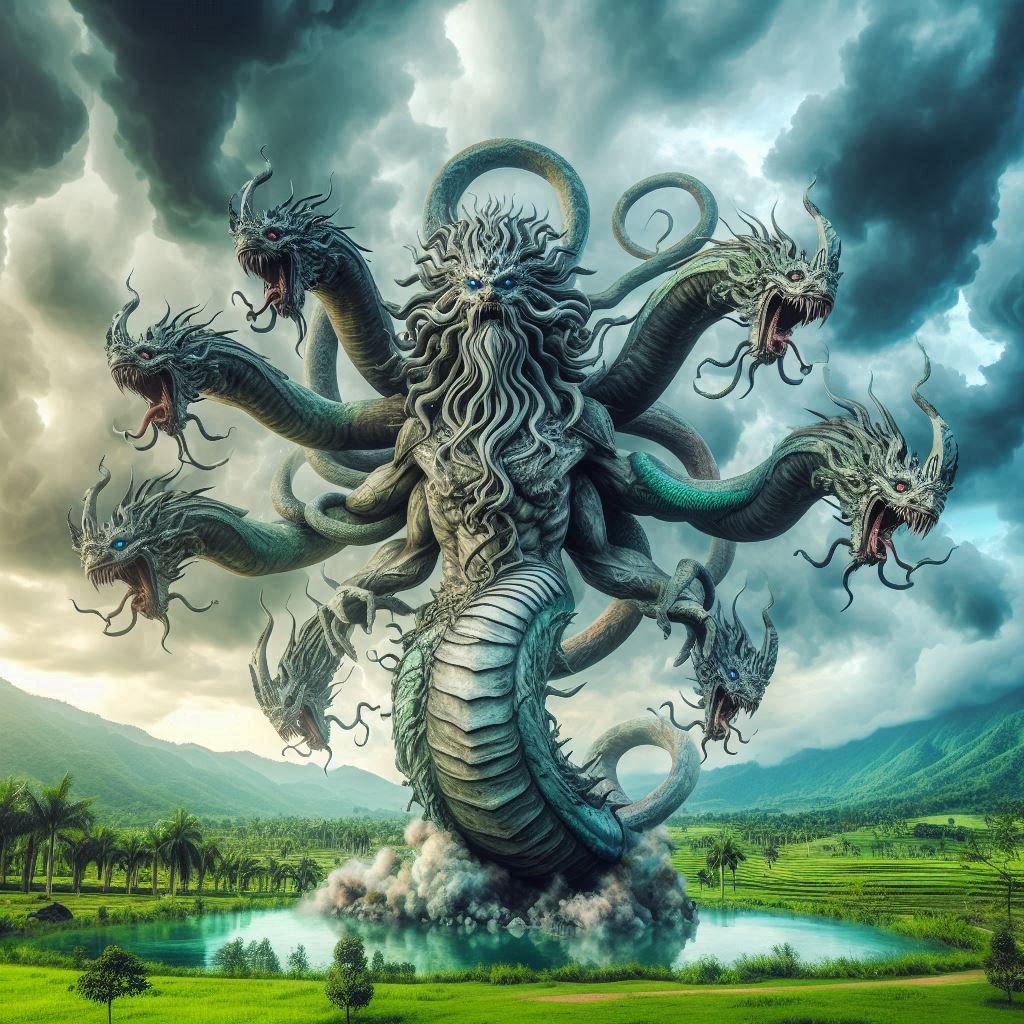
It is the strongest and largest imaginary creature that has ever walked the earth. The son of the god of the abyss, Tartarus and Gaia, He is the mighty Typhon. The father of all monsters of Greek mythology.

He is described as being a giant humanoid, with a hundred dragon heads on the tips of his serpentine hands, which were so long (a hundred leagues each, they say) that one reached the ends of the world while his feet were said to touch the depths of Tartarus.

He was a powerful force of destruction and could spew fire from his many heads.

Tall to the stars and with huge wings that, when opened, cover the sky. From the middle and above in the form of a man, and from the middle and below like two coiled echidnas(snakes). With long hair and a beard on every head while the rest of the body is covered by its wings.

Many say they had seen him with a huge donkey head and eyes throwing fire, a mouth firing hot rocks, and a voice as if thousands of people and animals and birds, and reptiles were screaming at the same time.

Typhon’s awful children

His children were Cerberus, the Lernaean Hydra, the Lion of Nemea, the Chimera, and the Sphinx of Thebes.

After the war of the Titans, he was the one who fought against Zeus to seize power, but lost.

The bloodshed by the mortally wounded Typhon gave its name to the mountain range of Aimos that delimits the Balkan peninsula (as Aima is the word for blood in Greek).

It is said that he was buried under the volcano of Mount Etna in Sicily, together with Egelados( the god of earthquakes).

According to Hesiod, the windstorms are the children of Typhon.

Finally, Typhon is said to symbolize the last resistance of the savage and uncontrollable forces of nature against the enforcement of the order of natural laws. Maybe that’s why we had to go so deep to find him.

Time to return, before we get completely lost and forgotten in the dark caves and labyrinthine basements we have dived into. Take a deep breath, and time counts backward. We return today. In our place and present time.

Monstrous conclusion

We got only a little taste of those awful creatures that are hidden in the sanctuaries of the collective subconscious.

There are many caves, underground labyrinths, and galleries down there that, in a unique way, connect the various mythologies all over the world.

But we will talk about more creatures and even more deadly monsters of Greek mythology on another fantastic trip. For now, I hope you do not panic the next time you enter a cave…

10 Things to Know Before Traveling To Greece

Posted in: All posts to Greece 0
Santorini Landscape
Santorini Landscape

With a past so rich and a future too promising, Greece is amongst the best places to visit if you seek life-changing experiences. The unique culture, traditions, and customs of the place will not only leave you thrilled and entranced but much more learned.

With that said, we recommend all our readers prepare themselves beforehand when traveling to Greece.

No – it won’t ruin your adventure.

No amount of preparation can truly, thoroughly prepare you for the magic of Greece. Even after months of planning and prep, we tell you, you’re going to go there and ask yourself: why didn’t I look it up before?

Nevertheless, here are ten things that we think you should know. Scroll down to have a glimpse of the diversity of experiences that awaits!

1. April – May: Best time to travel

If this happens to be your first-ever trip to Greece, the best time to travel is April – May. It is the shoulder season, which is relatively cool and comfortable as compared to the high season, which ranges from June – to September

The costs for car rentals and hotels are also not as high as during the hot season.

October & November are also good months to schedule your trip to Greece, but we wouldn’t advise any time between late November to Early April.

Seasoned travelers call this the low season, wherein the temperature’s too cold, and the buzz in the streets is almost non-existent.

2. There are loads of ruins to explore!

Now, the sound of the word ruins may not excite you. But trust us, this is what all those Greek legends are all about!

There are dozens of archaeological sites all across Greece, including:

Sanctuary of Delphi: This is the iconic place where the spirit of Apollo got filled into the oracle of Delphi. Historically, it is the prime worship place for Apollo and other gods & goddesses.

Corinth: Previously, Corinth happened to be one of the notable establishments in Greece. Later it was sacked by the Romans, which explains the presence of several magnificent Roman buildings there. You may also visit the Temple of Apollo, the Temple of Aphrodite there, and the secret passage that leads to a shrine.

Ancient Epidaurus: Epidaurus is a historical place that’s a must-visit for music lovers. Here you will get to see the remains of music theatres that Greeks still use for performances and live concerts during summer.

Acropolis of Athens: With four distinct pillars and the highest point of the city, it is amongst Europe’s most important preserves of the ancient world.

Ancient Olympia: This is the place where the very first form of the Olympic games was held once every four years, i.e., the Pan-Hellenic Games. It is also the place of worship of Zeus (the god of the Greek gods).

Palace of Knossos: Located in Crete, the remains of this once-expansive palace are the place where you will find the very famous labyrinth of the Theseus and Minotaur. Along with that, there are several artworks to explore
You will have plentiful bits of history to learn!

3. Driving is a tough job

The land of Greece is rough and tough. The roads move back and forth with loads of jumps and turns. You may feel as if you are on a mission during the first 10 minutes or so. But as time ticks by, your time on the road will tire you out. So, make sure you take sufficient breaks during the drive.

Another aspect that makes driving a rather tough job is the unique driving rules and regulations of Greece. The speed limit varies by area. For example, in cities, you will have an allowance of 50 km/h. In the countryside, you will have an allowance of 110 km/h, and on freeways, 120km/h is okay.

It is also a common opinion that local Greeks are highly impatient when driving. They may overtake your vehicle, speed up to get past you and take turns at full speed. So, you should better let the locals pass first!
Moreover,  the Greeks drive on the right side of the driving lane. So, if you are from the UK or Australia, you might find it difficult initially.

4. Wiser to Rent a Car

Given Greek road struggles, it’s best to keep yourself well-informed about car rental services in Greece. Rented cars will conveniently get you to and from different destinations without draining your energy and busting a hole in your pocket. Most car rentals are pretty reasonable in Greece.

5. One can’t miss gorgeous Greek beaches

Lastly, you should know well enough about the Greek beaches. They rank as the best beaches in the whole of Europe and truly have magnificent views and magical feels.

Mykonos and Naxos have some of the most popular beaches of all. These are good for fun activities and relaxation respectively.

Lalaria Beach is also widely gets recognized for its mesmerizing emerald water and carpeting white pebbles that make the beach all the more beautiful. The beach offers a soothing and entrancing experience.

The same is true for Shipwreck Bay at Zakynthos.

In total, there are about 400 beaches! (And nine marinas). Now, you can imagine the number of water wonders and scenic beauty that Greece has to offer!

6. Best to explore as many islands as possible

Did you know? Greece has about 226 inhabited islands that house loads of excitement from watching sunsets to exquisite fests.

Most of them are only an hour apart if you travel by ferry. And with so much majesty and adventure all clustered in one place, we guess Greece will most probably rank amongst the top yet again in the list of the best honeymoon destinations in the world!

On that note, we’ll advise you to visit as many islands as you can, instead of spending all your time on one.

7. Birthdays – Not a Celebration

It may sound strange, but the elderly Greeks do not celebrate their Birthdays. In actuality, the elderly may not even remember their birth dates because they associate birthday celebrations with self-obsession and self-centeredness. Instead, the naming days get celebrated.

On naming days, the Greeks arranged an open house and let willing people pay a visit to the person who got named. The guests may bring gifts. And the host arranges a feast. This celebration is similar to that of birthdays.

8. Sundays are Off

As a resident of any other country, you would naturally expect Sunday to be the busiest day of the week, at least on the streets.

But in Greece, it is vice versa. Sundays are the only days that some people get to rest. And so most bakeries, museums, shopping outlets, gas stations, and everything else are closed down. Some restaurants and coffee shops may be open.

9. Greet Good Morning until Dark

No, no – don’t get Greeks wrong. They know the difference between afternoons and evenings. But they will still greet Kalimera, i.e., good morning to one another at any point of the day as long as it isn’t.

10. Late-night plans are a city thing!

Greeks prioritize their midday nap over their night’s sleep. It is almost a part of the modern Greek culture to take some rest during 3-5 pm. Naturally, they tend to stay up late at night.

Children even have their extracurricular activities scheduled for 8 or 9 pm, while you – as a tourist – can easily think of making a booking or appointment at 11 pm!

5 Books to Read During Quarantine to Feel Like Traveling in Greek Islands

Posted in: All posts to Greece 0
Reading on the beach
Reading on the beach – Image by StockSnap from Pixabay

Probably every tourist will agree that a trip to Greece will remain in the heart forever. This country is a favorite destination for many tourists and a dream for those who have never been there. Azure water, antique luxury, olive paradise, white sand, and antic mysteries are just a part of those that attract people to Greece from all over the world.

Now avid travelers feel confused as most of their favorite destinations are closed due to COVID-19. Fortunately, quarantine is not a limitation of our imagination and everyone can go on a journey without leaving their home. All you need to do is get the right book. Greece has been the muse of many writers for millennia, and today dreamers have a lot of books to read to feel like they are on the Greek islands.

Top 5 Books to Feel Like Traveling in the Greek Islands

An Aegean landscape in Santorini
An Aegean landscape in Santorini – Image by Michelle Raponi from Pixabay

Do you miss Greece? Or are you just dreaming of going on a trip? One way or another, COVID-19 dictates its own rules and changes the plans of people around the world. However, you still can feel like traveling across this ancient country since books are still great tools to travel without leaving your home.

There are many books about Greece, and the first thing that comes to mind is mythology. However, in addition to antiquity, history, and mythology, some books inspire travel.

If you want to find yourself in Greece under the scorching sun, breathe in the sea air, and find yourself among the olive trees, then the following books will help you do it. There are no books on Greek mythology here, and most of them can be a real discovery for the reader.

1. The Names by Don DeLillo

This book is suitable for those who not only want to travel to Greece but also love detective stories. This book by a famous author is not as popular as the others. But this is a real guide to Greece, that will be familiar to tourists.

The author is not only a writer but also a guide. He describes the details as a true traveler and an excellent observer just like how top-notch freelance authors write the best website content.

His text can evoke a love for Greece, even for those who have never wanted to go there. The text seems to take the reader into the bright sun, to the bell tower against the background of a blue-blue sky, stones, and sand. If you have ever been to Greece, then the description of nature and the general atmosphere will make you say “Yes, yes. That’s so true. ”

2. The Corfu Trilogy by Gerald Durrell

The books from this trilogy tell about the five years of the life of the author and his family on the island of Corfu. Initially, the author wanted to describe the animal and natural world of the island in the Ionian Sea. But the author could not omit the stories about his family, so in addition to the delightful description of the island of Corfu, the reader will receive interesting characters and stories.

These books will tell you how Corfu influenced the future of the writer and will immerse you in the life of the island. The words from the book will make you consider a popular tourist destination from another angle, and perhaps your next trip to the island will be a discovery for you in another context.

3. Greece on My Wheels by Edward Enfield

This book is a mix of the author’s journey and Greek history. It will allow the reader not only to imagine Greece but also to plunge into antiquity and historical mysteries. There is no doubt that this book will make you smile and dream.

This book is more than a fun guide. This is a gripping tale of a journey with a mix of historical knowledge and wit that was undoubtedly inherited from the author from his father. If you are looking for a book that will help you delve into various milestones in history, this will be the right choice. This production will open up new pages of Greek history for you, as well as slightly open the veil of the stories of other peoples – Romans, Turks, Albanians, and other nations.

4. Greek to Me: Adventures of the Comma Queen by Mary Morris

If you are in love with Greece and want to find a like-minded person, then Marry Morris is what you need. In short, the title of this book perfectly describes what you read about. This whole book is a declaration of love for Greece, for its language, myths, legends, and culture.

The book is written with such warmth and love for the country that everyone will want to give up all their deals and go to this sunny destination. If you are fond of foreign languages and philology, then you will like this book since the author also focuses on the Greek language, its alphabet, and linguistic details.

5. Greece and The Greek Islands by Lonely Planet

Even though this is not a book but a real guidebook, it will appeal to both experienced Greek tourists and a newcomer. Most people note that this travel guide surpasses many online resources and even Pinterest with its beautiful photos. The guide will allow you to discover new interesting places, and sights of Greece and may become your real helper in your future journey.

There is a lot of information here, not only about the regions and islands but also about which restaurants you should dine in. Therefore, if you plan to go to Greece at the end of the quarantine, then here you can find a lot of useful and interesting information for your future trip.

The Bottom Line

Navayio beach in Zakynthos
Navayio Beach in Zakynthos – Image by Pexels from Pixabay

Most likely, people love Greece so much because from early childhood they are well familiar with its fascinating history and mythology. The above books will allow you to stay in Greece without leaving your home. A person’s imagination has no boundaries, and books are a good impetus to start your exciting journey.

Two babies smile

Beautiful Baby Names Inspired by Greek Mythology

Posted in: Greek Mythology 0
a baby
Child playing with colorful toys.

Every parent wants to pick the most beautiful names for their babies. Each country and culture has quite a few unique names to choose from for your baby. One of the richest sources of unusual and one-of-a-kind names though, is Greek mythology.

If you have run out of ideas or wish to browse through baby names with an interesting backstory, why don’t you choose an ancient Greek name?

Read further. Here are some of the most unusual baby names, as well as their background stories, to help you choose the right name for your baby.

1. Demeter (Demetra)

Demeter or Dimitra in Greek, was the Greek goddess of fertility, grain, and harvest. She was one of the Twelve Olympian gods who lived on Mount Olympus. Demeter was a very important goddess to ancient Greek farmers and peasants who relied on her for good crops for the season. She was the sister of Zeus and the mother of Persephone.

2. Achilles

Achilles was one of the most popular Greek heroes in the Trojan War and was considered to possess remarkable strength and bravery. His weakness, the “Achilles heel,” became a phraseological unit and is widely used worldwide. He is considered a real person belonging to the race of Myrmidon. Myrmidons meant ants, and they lived in Fthiotis, being the first to be called Hellenes.

3. Terpsichore

Terpsichore was the goddess of dance and chorus as well as one of the nine Muses in ancient Greek mythology. Her name means ‘the joy of chorus’ and is oftentimes associated with the word “terpsichorean”, which means “of or relating to dance”. She is depicted holding a lyre and accompanying the dancers with her music.

This would be a great choice for a baby girl born into a family of musicians or people who are truly devoted to these arts.

4. Evander

Evander’s name translates to a good or strong man. He was a hero from Arcadia who brought the alphabet, laws, and pantheon of Greece to Italy. He was also the son of the goddess Carmentis and the god Hermes.

5. Helios

Helios was the personification of the Sun, and he was one of the Titans, the son of Hyperion and Theia. His siblings were Eos, the Dawn, and Selene, the Moon. One of his most memorable images in Greek mythology is of him riding his chariot. He was married to Perse and had several children.

6. Electra

Elektra was a popular character in two ancient Greek tragedies. She was the daughter of King Agamemnon and Queen Clytemnestra of Mycenae. This beautiful name translates to a woman who is radiant with grace.

7. Apollo

Apollo was a god in Greek mythology, one of the Twelve Olympians, and the son of Zeus and Leto, the twin brother of Artemis. He is, among others, considered the god of medicine, archery, music, poetry, and also the sun. He is also the god of justice. Along with all these, this name is also tied to a significant mission.

The US Apollo is a NASA space program that sent the first humans to the moon. This will be a catching topic to write essays on when your child is of school age. With the right educational resources available, they will be able to understand their name and feel proud when writing any school paper.

8. Arete

Arete translates to grace and dignity, and she was a goddess that people connected to many qualities deemed attractive. Some of those were excellence, courage, and knowledge. Arete is also greatly connected to reaching a person’s full potential and is, therefore, an essential quality to the Greeks.

9. Endymion

Endymion was the son of Zeus, and he was known for his beauty, probably having gotten his handsome looks from his father. He was a shepherd who lived in the region of Elis, and he was believed to have been a king. Endymion’s beauty was so great that Selene, the Titan goddess of the moon, fell in love with him. She then asked his father to give him eternal youth.

10. Adonis

Adonis was considered to be a handsome man and a symbol of masculine beauty. He was the mortal lover of the Goddess Aphrodite. As myth has it, the place where Adonis took his last breath was where red roses bloomed for the first time.

To this day, this name is widespread in the US as more and more parents choose it every single year. A very nice name, but destroyed, as today it happens to be the name of the most detestable Greek minister.

11. Iris

Iris, in Greek, translates to the rainbow. In ancient Greek mythology, she was the goddess of the rainbow and an urgent messenger of the Olympian gods. She was also often considered to be the personal messenger of Hera.

Iris was a goddess of the sea and the sky. She was the daughter of another Electra, an Oceanid born by the Titans, and Thaumas, “the wondrous”, a marine god.

12. Hermes

Hermes was an Olympian deity in ancient Greek mythology. He was the herald of the gods as well as the God of boundaries, athletes, speed, and commerce. Hermes was the son of Zeus and Maia, the Pleiad. He was also often regarded as “the divine trickster”.

13. Calypso

Calypso was the daughter of the Titan Atlas, and she was a beautiful nymph of the mythical island Ogygia. If Ogygia was real it should be the island of Othonoi, a small island a few miles northwest of Corfu Island where there is a cave named Cave of Calypso.

She was an influential character in Homer’s Odyssey as she followed the journey of Odysseus for seven years. She tried to promise him immortality, but his longing for his home was a lot more powerful than that.

14. Leander

Leander was a young man who came from Abydos. He lived on the eastern shore of the Hellespont. He was known in Greek mythology as a very powerful swimmer. When he fell in love with one of Aphrodite’s priestesses, he became famous for swimming across the Hellespont every night, so he could see her.

You didn’t find a name to like on our list yet? No problem.

Greek Mythology offers thousands of choices; here are some more beautiful names, mostly for girls!

15. Eris

Eris was one of the primordial gods and means Dispute, but it sounds beautiful as a woman’s name when spelled.

16. Io

Io was a nymph, one of the many lovers of Dias, a Beautiful name that means moon.

17. Leto

Leto was the mother of the gods Apollo and Artemis, a nice and frequent among Greeks.

18. Alkmene

Alkmene is an oceanic nymph, the mother of the most famous hero, Heracles.

19. Metis

Metis was the first wife of Dias and the mother of the goddess Athena.

20. Selene

Selene is the daughter of Titan Hyperion and the personification of the moon.

21. Artemis

Artemis, an Olympian goddess, daughter of Dias and Leto, and sister to Apollo, is a very frequent name in Greece.

22. Athena

Athena was the daughter of Dias and Metis, the goddess of wisdom who gave her name to Athens.

23. Jason

Jason was the hero who, with his Argonauts, stole the Golden Fleece from Colchis.

24. Nereus

Nereus, the old lord of the sea, a Titan, son of the primordial god Pontos.

25. Phoebe

Phoebe was the daughter of Hermes and Aphrodite.

26. Nike

Nike means Victory and was a daughter of the first god of war, Pallas. Also, a very used and nice name.

27. Zelea

Zelea was the Goddess of Jealousy and sister to Nike. As a name is uniquely strange and also very attractive.

If there is a chance for your little girl to become an actress, follow our advice and call her Zelea.

28. Rhea

Rhea, the most important Titaness, wife of Cronos, and mother to Dias. One of the best-sounding names for a beautiful woman.

A woman named Rhea is obliged to be beautiful; otherwise, she has to change her name.

29. Themis

Themis, a Titaness, this name can be used for both girls and boys.

30. Dione

Dione, another Titaness, and a beautiful name.

31. Pandora

Pandora was the first woman on Earth, who married Epimetheus, the name means all-gifted.

32. Enyo

Enyo was the daughter of Dias and Hera, a nice and strange name.

33. Hebe

Hebe was the sister of Enyo, the personification of adolescence.

34. Rhode

Rhode was the daughter of Hermes and Aphrodite. Rhode means Rose, an unusual as well as nice name.

Greek mythology is an endless source of inspiration, fascinating stories, and impressive characters. If you want to give your kid a unique and outstanding name, make use of this list.

Bonus: 100 more names

For girls

  1. Adara – “fire”
  2. Althea – “healer”
  3. Amphitrite – “goddess of the sea”
  4. Andromeda – “ruler of man”
  5. Aphrodite – “goddess of love”
  6. Ariadne – “most holy”
  7. Artemis – “goddess of the hunt”
  8. Athena – “goddess of wisdom and warfare”
  9. Atalanta – “balanced”, a heroine.
  10. Calliope – “beautiful voice”
  11. Calypso – “she who hides”
  12. Cassandra – “she who entangles men”
  13. Circe – “bird”, she was a witch.
  14. Clytemnestra – “famous for her might”
  15. Demeter – “goddess of agriculture”
  16. Dione – “goddess of love”
  17. Echo – “echo”
  18. Electra – “shining”
  19. Eurydice – “wide justice”
  20. Gaia – “Earth”
  21. Hecate – “goddess of magic”
  22. Hera – “queen of the gods”
  23. Hermione – “messenger”
  24. Hestia – “goddess of the hearth”
  25. Io – “moon”
  26. Iris – “rainbow”
  27. Isidora – “gift of Isis”
  28. Leda – “Happy”
  29. Leto – “goddess of motherhood”
  30. Medusa – “protector”
  31. Melaina – “dark, black”
  32. Naiad – “water nymph”
  33. Nyx – “goddess of the night”
  34. Pandora – “all-gifted”
  35. Penelope – “weaver”
  36. Persephone – “the voice of Perseus”
  37. Phoebe – “radiant”
  38. Rhea – “mother of the gods”
  39. Selene – “goddess of the moon”
  40. Thalia – “flourishing”
  41. Thea – “goddess”
  42. Thetis – “sea nymph”
  43. Tyche – “goddess of fortune”
  44. Urania – “heavenly”
  45. Xanthe – “yellow, blond”
  46. Xenia – “hospitable”
  47. Yara – “water lady”
  48. Zephyra – “west wind”
  49. Zephyrine – “west wind”
  50. Zoe – “Life”

For boys

  1. Aeneas – “praise, worthy”
  2. Ajax – “eagle”
  3. Alastor – “avenging spirit”
  4. Apollo – “manly beauty”
  5. Atlas – “enduring”
  6. Castor – “beaver”
  7. Chrysippus – “golden horse”
  8. Cronus – “time”
  9. Damon – “to tame, subdue”
  10. Darius – “wealthy”
  11. Demetrius – “follower of Demeter”
  12. Dionysus – “follower of Zeus”
  13. Endymion – “to dive into”
  14. Hector – “steadfast”
  15. Helios – “sun”
  16. Heracles – “glory of Hera”
  17. Hermes – “messenger to gods”
  18. Icarus – “to fly”
  19. Jason – “healer”
  20. Kadmos – “the east”
  21. Leander – “lion man”
  22. Lysander – “liberator”
  23. Menelaus – “strength of the people”
  24. Narcissus – “sleep”
  25. Nestor – “voyager”
  26. Odysseus – “wrathful”
  27. Orion – “son of fire”
  28. Orpheus – “to be deprived”
  29. Paris – “wallet, purse”
  30. Perseus – “to destroy”
  31. Phoenix – “dark red”
  32. Pollux – “very sweet”
  33. Priam – “redeemed”
  34. Proteus – “the first”
  35. Theseus – “to set”
  36. Tiberius – “the Tiber River”
  37. Titan – “strength”
  38. Triton – “son of Poseidon”
  39. Tycho – “hitting the mark”
  40. Ulysses – “wrathful”
  41. Xanthus – “yellow, blond”
  42. Xenophon – “friend of strangers”
  43. Yannis – “God is gracious”
  44. Zephyr – “west wind”
  45. Zeus – “leader of gods”
  46. Aries – “god of war”
  47. Acastus – “unwavering”
  48. Aristaeus – “best”
  49. Erasmus – “beloved”
  50. Evander – “good man”
The Flood of Deucalion

Who are The Hellenes? The Real Name of the Greeks

Posted in: Greek Mythology 2

Hellas is the land of Hellenes, that is, the land of the Greeks. But why do we call Greece Hellas, and who are the Hellenes?

Well, the question is wrong and should be reversed! It should be as follows: Why do we call Hellas Greece, and who are the Hellenes?

The term “Hellenes” is the historical name for the Greeks and has been used to refer to the people of Greece since antiquity. Its origins can be traced back to ancient Greek mythology and history, specifically linked to Hellen, the legendary son of Deucalion and the ancestral figure of the Greek people.

The word “Hellenes” was commonly used to describe the Greek people and their culture in ancient times and is still used today within the country of Greece, both officially and among the Greeks themselves.

The Mythological Origin of the Hellenes and Hellas

Please note that the name Hellen has nothing to do with Helen of Troy; rather, it refers to Hellen (written with two ‘ll’s), who was the first son of Deucalion.

According to Hesiod’s Theogony, the Flood of Deucalion marked the beginning of Hellenic civilization.

A common feature in nearly all mythologies is the blending of myths with historical reality, making it difficult to discern what is true and what is fictional.

The Aegean islands of Cyclades and Crete were inhabited and prospered for many centuries before the emergence of the Achaeans, the first Greek civilization in Mycenae.

In the Cyclades, the Pelasgians established the earliest European civilization, dating back to 3000 BCE.

Not much is known about them, except that they had a written language using the Linear A script, which remains undeciphered to this day. Later, they adopted Linear B, evidently an evolution of Linear A.

Linear B has been deciphered and can be understood; it is a syllabic writing system that reveals Greek words and Greek names when read.

The precise relationship between the Pelasgians and the Greeks is still not fully understood.

On the island of Crete, the same civilization is known as the Minoans, named after their most famous king, Minos. The Minoans also employed the Linear B writing system, as did the Mycenaeans.

Greek Mythology - The flood
Greek Mythology – The flood

The Flood of Deucalion

Flood of Deucalion - The first Hellenes
Flood of Deucalion – The first Hellenes

Here is a portion of Hesiod’s Theogony that describes the origin of the Greeks (Hellenes), and consequently, the origin of the names Hellenes and Hellas.

Greek Theogony, though a work of mythology, is often more engaging than the Bible’s more prosaic cosmogony.

These tales have been passed down from generation to generation, each time perhaps becoming slightly embellished or distorted.

Let’s dive into it!

Following a catastrophic flood (distinct from Noah’s), all people vanished, leaving only two survivors: Deucalion and Pyrrha.

Deucalion was the son of the Titan Prometheus, who had created the human race and bestowed upon them the gift of fire.

Pyrrha, on the other hand, was his wife and the daughter of Pandora, the first woman created by the gods. Pandora’s name is likely familiar to many.

Before the flood, Prometheus advised his son Deucalion, who ruled in Thessaly, to construct a substantial ark, stock it with provisions, and pray for the best outcome.

Soon, the heavens opened, and the Earth was inundated. Deucalion and Pyrrha’s ark drifted for nine days and nights until it came to rest atop Mount Parnassus. From this vantage point, they had a clear view of Delphi, where the renowned Oracle would later be established.

Delphi was regarded as the navel, the very center of the Earth, in the beliefs of ancient Hellenes.

Does any of this sound reminiscent of the biblical tale of Noah’s ark? It certainly does; it’s essentially the same myth.

How were the first Hellenes born after the Flood?

After Deucalion and Pyrrha were rescued, they received an order from the God of Gods, Zeus (Jupiter). They were instructed to gather as many stones as they could find and toss them over their shoulders.

The stones that Deucalion threw transformed into men, while those thrown by Pyrrha became women.

They were the first Hellenes to repopulate Hellas, because the first stone thrown by Deucalion became a man named Hellen or Hellenas, who went on to have many children. Among his offspring were Aeolus, Dorus, Xuthus, and Ion.

These descendants became the ancestors of the Greek tribes known as the Aeolians, Dorians, Achaeans, and Ionians, respectively.

They were all referred to as Hellenes, and their land was known as Hellas.

It’s a fascinating story, isn’t it?

Roman imposition of Christianity and suppression of Hellenism

Hellenes posed a constant challenge to the early Roman Empire because they championed free thinking and rejected the doctrines of the emerging religion.

Emperors employed persecutions, massacres, and the destruction of ancient monuments. They even went so far as to burn libraries containing invaluable ancient knowledge, stalling human progress. Oppression and numerous other atrocities were unleashed upon the Hellenes.

The first documented destruction of the Parthenon occurred in the 4th century CE at the hands of Christian extremists. This is an undeniable historical fact often omitted from our educational system.

However, Greek culture proved too resilient to be suppressed, prompting the Emperors to take more drastic measures to neutralize the Hellenic threat, including a change of name.

The Romans referred to the Hellenes of Southern Italy as “Graecus“.

Both Hellas and its inhabitants were renamed Graecia (Greece) and Graecus, respectively, in the wake of this shift. This was done to eradicate the term “Hellas” and reduce any perceived threat to the new religion, as the Hellenes continued to identify as Pagans.

It’s well-documented that the use of the word “Hellenes” was strictly forbidden for several centuries in the Roman and later Byzantine Empires.

Consequently, the Latin names Graecia and Graecus persisted in Romance languages, designating both the land and its people.

Is Greek Mythology Real?

For the people of that era, these myths were absolutely real—they structured daily life, explained natural phenomena, and guided moral conduct, much like Christian narratives still dictate society today. The question isn’t whether they believed—they did. The real wonder is how long such influence persists.

Humanity lost nearly twenty centuries of progress under the weight of rigid religious dogma, as invaluable knowledge was destroyed and free thought suppressed.

The correct name for Greece should be Hellas

Therefore, the correct name for the Greeks is “Hellenes,” and their land should be called “Hellas.”

In 1827, the Greeks achieved their independence from the Ottomans. European public opinion, especially among Philhellenes, expressed a desire to name the new country “Hellas”

However, the Greek Orthodox Church vehemently opposed the international adoption of the name “Hellas” for the new nation. To the clergy, this name evoked memories of the old Hellenic legacy and the pagan religion.

However, within the country, the name “Hellas” prevailed. In countries where Romance languages were spoken, the Roman-derived name “Greece” became the standard.

Now, why doesn’t the Greek state attempt to internationally change the name, considering that “Hellas” is the only commonly used name within the country among the Greeks?

Buckle up, because changing a country’s international name is no small feat. It’s like deciding to rearrange your entire room – pros and cons galore.

At that time, folks believed it would be a monumental task with results that might not be all rainbows and butterflies. They figured the gain wouldn’t match the effort. So, despite “Hellas” being the beloved name at home, the international stage didn’t get the memo.

And there you have it – a tale of tradition, identity, and a decision that might’ve seemed simple but came with a whirlwind of complexities. The name “Hellenes” might be the heart of the country, but sometimes, change is like an intricate puzzle that takes time and consideration to piece together.

1 12 13 14 15 16 17 18 52