



Nyx (Νύξ) is the primordial Greek goddess of Night, one of the first beings to emerge from Chaos in Hesiod’s Theogony. She is older than Zeus, older than the Titans, and older than Gaia’s full formation. The Romans knew her as Nox. Unlike the Olympians, she has no fixed form and no temples—she is the darkness itself, present everywhere light recedes.
In Hesiod’s genealogy, Nyx is among the very first divine powers, born directly from Chaos alongside Gaia (Earth), Tartarus (the abyss), and Eros (desire). She is the mother of Sleep, Death, the Fates, Strife, Retribution, and dozens of other forces that shape mortal life. Even Zeus feared to cross her.

Who Is Nyx in Greek Mythology?
Nyx is the personification of night in Greek mythology, a primordial deity born from Chaos at the beginning of the cosmos. She is one of the oldest divine powers, predating the Titans and the Olympians. In Hesiod’s Theogony, she is named among the first beings to exist, alongside Gaia, Tartarus, and Eros.
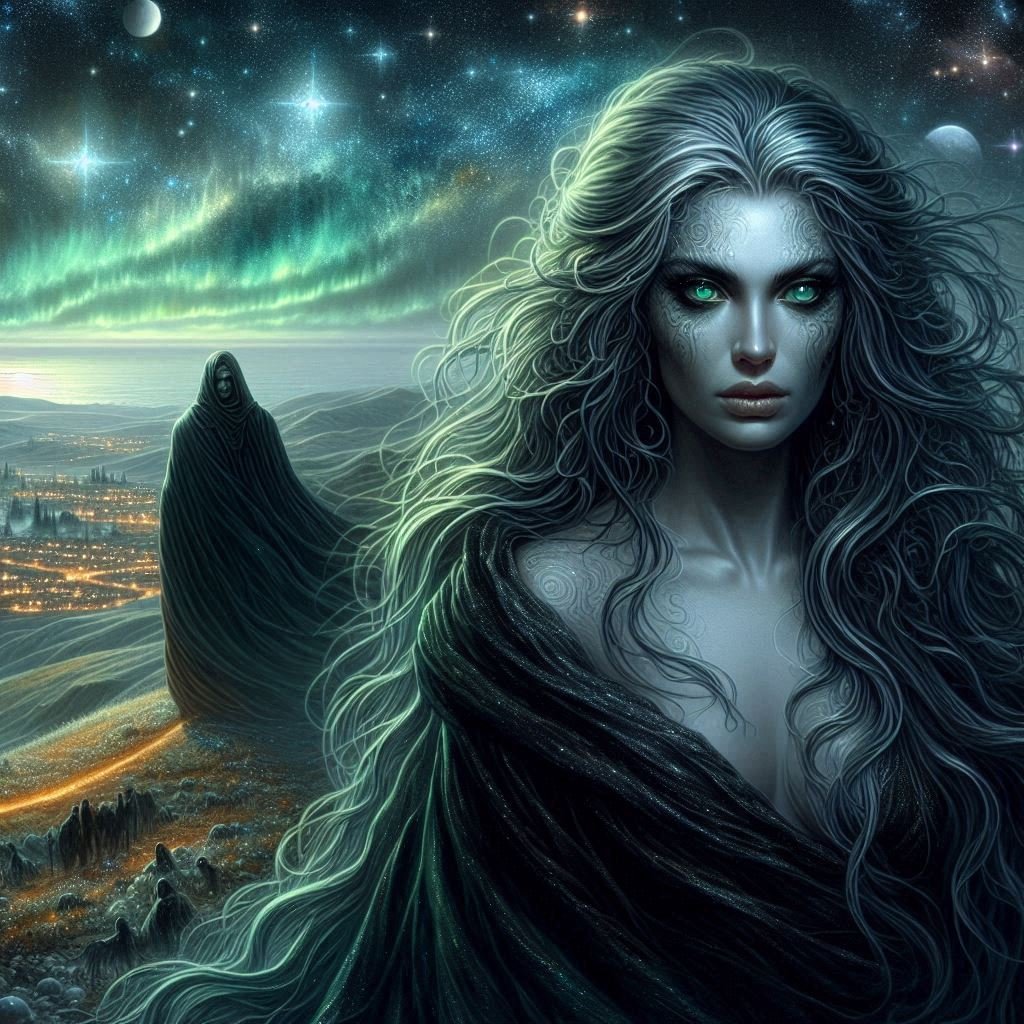
Nyx has no fixed physical form. She is not depicted as a woman with a specific face or body in the earliest sources—she is the darkness that settles when light recedes, present everywhere at once rather than rooted in one place. Her Roman counterpart is Nox.
Nyx’s Origin: Born of Chaos
According to Hesiod’s Theogony, Nyx emerged directly from Chaos, the primordial void that preceded all form and order. She was not born from a union of two parents; she came into being alongside Gaia, Tartarus, and Eros as one of the first forces of creation.
This origin places Nyx among the most ancient powers in the Greek cosmos. She exists before the Titans, before the Olympians, and before the structured divine order that Zeus would eventually impose. In the Orphic tradition, she is sometimes described as an even greater first principle, a power dwelling in a starry cave consulted by Uranus and Cronus themselves.
Nyx and Erebus: Brother, Consort, and the Birth of Light
Nyx’s consort is Erebus (Ἔρεβος), the primordial god of darkness, who is also her brother. Together they produced Aether (the bright upper air) and Hemera (the day), a genealogy that makes light the offspring of darkness rather than its opposite.

This genealogy is significant: in Hesiod’s account, even daylight traces its origin back to Night. Aether and Hemera are not Nyx’s enemies but her children, born from her union with Erebus before the later generations of gods took shape.
Children of Nyx: The Forces That Shape Mortal Life
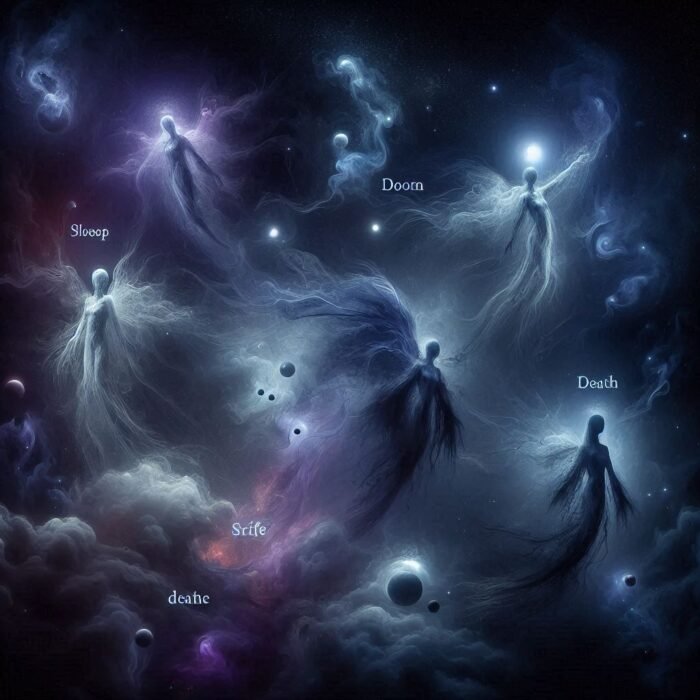
Nyx gave birth to a vast family of personified forces, most of them born without a partner. In Hesiod’s Theogony, her independent offspring include Hypnos (Sleep), Thanatos (Death), the Oneiroi (Dreams), the Moirai (Fates), Nemesis (Retribution), Eris (Strife), Apate (Deceit), Oizys (Misery), Momus (Blame), Geras (Old Age), Philotes (Affection), Moros (Doom), and the Keres (violent death spirits).

The range is striking: sleep and death, dreams and doom, vengeance and affection all trace back to Night. Nyx is not a purely sinister figure in the earliest sources—she is the mother of both the shadow and the warmth that exists within it. Hypnos (Sleep) and Thanatos (Death) are twins, one gentle, one final, and both are hers.
For a complete list of Nyx’s children with their meanings and sources, see our separate guide to the children of Nyx.
Even Zeus Feared Nyx: The Iliad Episode
In Homer’s Iliad, Zeus refrains from pursuing Hypnos into Nyx’s domain out of fear or respect for her, establishing her as a boundary even the king of the gods would not cross. The episode occurs when Hera asks Hypnos to lull Zeus to sleep so the Greeks can gain an advantage in the Trojan War. Hypnos hesitates, remembering a previous time when Zeus nearly threw him into the sea, and flees to his mother Nyx for protection.
Zeus, despite his fury, does not follow. The implication is clear: Nyx’s authority predates and exceeds even the Olympian order. She is not a goddess to be challenged, but a primordial condition to be respected.
Worship and Symbolism of Nyx
Nyx had no temples or cult statues in the manner of the Olympian gods. The Orphic tradition describes her as a great, all-seeing power dwelling in a starry cave, consulted even by Uranus and Cronus. For ordinary people, night itself was her presence: shelter for travelers, cover for lovers, danger for those caught unprepared after dark.
Later writers sometimes cast Nyx as a sinister or monstrous figure, since darkness is easy to fear. But in the earliest Greek sources, she represents balance rather than malice. Sleep and death, dreams and strife, vengeance and affection all trace back to her, and none is treated as purely evil. The Romans continued her worship under the name Nox.
Nyx vs. Gaia: Which Primordial Goddess Is Older?
In Hesiod’s Theogony, Nyx and Gaia emerge from Chaos in the same primordial generation, but Nyx is not described as Gaia’s daughter or subordinate. The question of “which is older” depends on the source. Hesiod lists them together as children of Chaos. Orphic traditions sometimes place Nyx even earlier, as a first principle from which other powers derive.
What is consistent is that Nyx belongs to the first generation of divine beings, before the Titans and before the Olympians. She is not a descendant of Gaia; she is a contemporary of Gaia, born from the same primordial void.
Nyx in Later Art and Literature
Later ages kept returning to Nyx as the eternal mother of night, and her Roman counterpart Nox appears in art and literature as a figure of mystery and power. She is not a major character in surviving Greek drama, but her children—especially Thanatos, Hypnos, and the Fates—appear throughout the myths of heroes and gods.
Modern retellings often emphasize her role as a primordial power older than Zeus, a framing that is consistent with the earliest sources. The image of Night as a vast, silent force that existed before form and order is one of the most enduring ideas in Greek cosmology.
FAQ: Nyx, Primordial Goddess of Night
Who is Nyx in Greek mythology?
Nyx is the primordial goddess of Night, born directly from Chaos in Hesiod’s Theogony. She is one of the oldest divine powers, older than Zeus and the Titans, and the mother of Sleep, Death, the Fates, and many other forces.
Is Nyx older than Gaia?
In Hesiod, Nyx and Gaia emerge from Chaos in the same generation. Neither is described as older than the other in the Theogony. Some Orphic traditions place Nyx earlier as a first principle.
Who are Nyx’s parents?
Nyx has no parents in the conventional sense. She emerged directly from Chaos, the primordial void, alongside Gaia, Tartarus, and Eros.
Who is Nyx’s consort?
Nyx’s consort is Erebus, the primordial god of darkness, who is also her brother. Together they produced Aether (upper air) and Hemera (day).
Why did Zeus fear Nyx?
In the Iliad, Zeus refrains from pursuing Hypnos into Nyx’s domain, establishing her as a boundary even the king of the gods would not cross. Her authority predates the Olympian order.
Did Nyx have temples?
No. Nyx had no temples or cult statues in the manner of the Olympian gods. She was worshipped as the night itself, and the Orphic tradition describes her dwelling in a starry cave.
What is Nyx’s Roman name?
Nyx’s Roman counterpart is Nox. The Romans continued her worship under that name.
Final Thoughts
Nyx is not the soft night of moonlight and gentle shadows. She is the deep, endless darkness that existed before form or shape, the curtain of silence from which everything that moves, breathes, or dreams would eventually emerge. In the earliest Greek sources, she is not a villain but a condition—the primordial mother who terrifies kings and rules the dark hours on silent, grand wings.
Go back to Greek mythology.

Comments