



Αυτό το άρθρο μου έβγαλε το λάδι, αλλά θα στρίψω διά του αρραβώνος πριν πάρω ανάποδες και με πιάσουν στα πράσα, γιατί θα γίνει της Πόπης και θα τα πάρω στο κρανίο. Αλλά προκειμένου να βγάλω το φίδι από την τρύπα, θα κάνω την πάπια μέχρι να πω δεν βαριέσαι…
Greek idioms don’t just describe life — they perform it.
Greek Idioms and Everyday Expressions in Context explores how Greek is spoken in real life, focusing on the meaning and use of everyday idioms beyond literal translation.
Instead of listing phrases, this guide explains each expression in a natural context, showing how it works in real conversation and how tone or situation can shift its meaning.
All expressions are explained by a native Greek speaker, reflecting authentic, lived-in language rather than textbook or overly formal interpretations.
This selection includes around 18 carefully chosen idioms commonly used in everyday speech.
Many cannot be translated word-for-word into English, which makes their real usage essential to understanding them.
Each entry aims to reflect how Greeks truly speak in everyday situations, offering a practical and culturally grounded view of the language.
How Greeks Actually Speak in Daily Life
Ela more
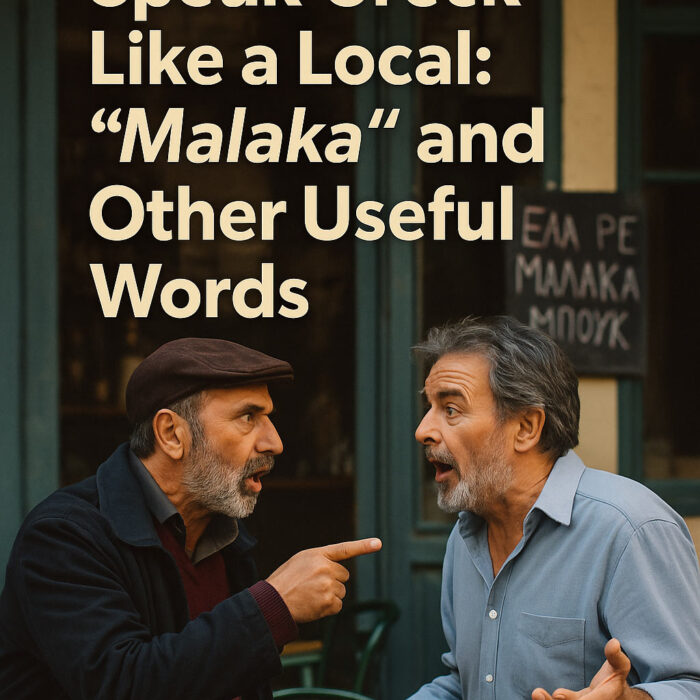
“Έλα μωρέ” is one of the most versatile expressions in everyday Greek, with a meaning that shifts depending on tone, context, and the relationship between speakers. It functions more as an emotional reaction than a literal phrase, often combining dismissal, familiarity, disbelief, or playful annoyance.
It is commonly used to downplay something or signal that it should not be taken too seriously. In other contexts, it can express frustration when something feels exaggerated or unnecessary.
Among close friends, it often becomes affectionate and humorous, adding warmth and shared understanding to the conversation.
Its strength lies in its flexibility: it does not have a fixed meaning, but reflects attitude and emotion in speech, like a verbal shrug that can range from irritation to affection.
Example:
“I lost my wallet…” — “Έλα μωρέ…”
Kano tin papia
“Κάνω την πάπια” literally translates as “I do the duck” and is used when someone pretends not to notice something to avoid involvement, responsibility, or awkwardness. The image is humorous, suggesting a duck that appears indifferent while things happen around it.
The expression is often linked in popular tradition to a Byzantine official known as “Papias,” said to avoid responsibility and act unaware, though this remains an informal and unverified explanation.
Due to his name “papias” that sounds the same as papia (duck), the expression shifted wrongly to the bird.
In everyday use, it describes situations where someone is clearly aware of what is going on but chooses to act oblivious. It is commonly used when responsibility is shared or avoided, and no one wants to openly acknowledge a problem.
The phrase is playful in tone but can also carry mild criticism, suggesting avoidance or passive behavior, though it remains widely used in informal speech.
Example:
“Who broke the vase?” — everyone “kanei tin papia”.
Ta pira sto kranio
“Τα πήρα στο κρανίο” is a vivid Greek expression describing a sudden and intense burst of anger. Literally meaning “I took them to the skull,” it conveys emotions rising sharply to the head, reaching a point of loss of control.
It uses the “skull” (kranio) as a metaphor for pressure, capturing the moment when emotional intensity becomes overwhelming, and reaction turns immediate and uncontrollable.
The expression is highly common in informal speech and is used to dramatize frustration or rage. It does not simply mean being annoyed, but reaching a breaking point where patience is lost completely.
Despite its intensity, it is often used with exaggeration or humor, especially when recounting past events, giving anger a slightly theatrical tone.
Example:
“Με ξαναέγραψε τελευταία στιγμή και τα πήρα στο κρανίο.”
Mou efyge to kafasi
“Μου έφυγε το καφάσι” is a slang expression describing a sudden emotional impact, usually surprise, admiration, or being completely taken aback. It refers to the moment when something is so striking that it temporarily disrupts your composure.
The expression uses “kafasi” (a wooden or plastic crate) as a metaphor for the head, creating a humorous image of mental shock or disorientation, as if something inside you “drops” or slips out of place.
In everyday speech, it is used when a person sees someone, something, or a situation so impressive or unexpected that it momentarily overwhelms them. The reaction can range from admiration and attraction to shock or disbelief depending on context.
It is a playful and informal expression often used in storytelling among friends to exaggerate a reaction, capturing that instant where reality feels unexpectedly intense or “different.”
Example:
“Μπαίνω στο μαγαζί και τη βλέπω… μου έφυγε το καφάσι.”
Den Variese
“Δεν βαριέσαι” comes from the verb βαριέμαι (“to be bored”), so literally it means “don’t get bored/don’t be bored.”
In everyday spoken Greek, however, the literal meaning has largely faded. The phrase has shifted into an attitude of acceptance or resignation, meaning “it doesn’t matter,” “let it go,” or “whatever.”
It is used when something goes wrong or is not worth stressing about anymore, marking a shift from concern to indifference or emotional release.
Example:
“I lost the job… δεν βαριέσαι.”
Stin ygeia mas or Geia mas
A common toast meaning “to our health” (Greek: Στην υγειά μας).
It is used when saying “cheers” in social gatherings and is one of the most frequently heard expressions in Greece when people raise their glasses — whether at a family dinner, a seaside taverna, or a casual coffee with friends.
Beyond a polite phrase, it carries a sense of togetherness, expressing a shared wish for health, longevity, and good moments.
Even in informal settings, it is often said warmly, with eye contact and the ritual of clinking glasses.
Example:
“Stin ygeia mas! Finally, we’re all together again.”
Gia tin Ellada re gamoto
“For Greece, damn it!” (Greek: Για την Ελλάδα, ρε γαμώτο)
It is a spontaneous, highly emotional phrase spoken by Βούλα Πατουλίδου after her victory at the 1992 Summer Olympics. It has no literal meaning; instead, it is an outburst of emotion, pride, and intense relief at the moment of success.
It can simultaneously carry a meaning similar to “damn it!” and “finally!”, expressing a burst of tension at the peak of an achievement or effort. It is not a calm statement, but an emotional release that can include both relief (“we finally made it”) and intensity (“it’s done, we did it”).
Halara
“Χαλαρά” literally means “in a relaxed way,” but in everyday Greek it goes beyond describing an action and reflects an attitude.
It is used when something should happen without stress, pressure, or urgency, meaning “take it easy” or “no need to rush.” It is often said to calm someone down or ease tension in the moment.
The expression is strongly associated with Thessaloniki and is often linked to a more relaxed rhythm of life and communication.
Example:
“Will we make it on time?” — “Chalara.”
Chaos, Irony & the Power of Greek Expression

Vazei nero sto krasi tou
“He puts water in his wine” (Greek: Βάζει νερό στο κρασί του).
The expression originates from the ancient Greek practice of diluting wine with water, since wine was not typically consumed “neat” (akratos), but mixed to reduce its strength and maintain sobriety during symposia.
Today, it is used metaphorically to describe someone who softens their opinion, compromises, or makes a stance less strict or intense than it originally was.
In everyday Greek conversation, it often appears in contexts such as arguments, relationships, or situations where a person who was once firm or uncompromising becomes more flexible over time. It is no longer about wine, but about attitude and behavior.
Depending on context, it can carry either a mildly positive tone, suggesting reasonableness and compromise, or a slightly critical one, implying that someone has backed down too much.
Example:
“After so much refusal, he finally changed his mind… he put water in his wine.”
Kakó skýli psófo den echei
“A bad dog never dies” (Greek: Κακό σκυλί ψόφο δεν έχει).
The expression comes from observations of rural life and nature, where tough and aggressive stray dogs often survived despite harsh conditions and constant hardship. Over time, it became a metaphor for people with a difficult or “hard” character who seem to endure illness, adversity, or challenges without being easily defeated.
Literally, the phrase does not form a logical sentence in either Greek or English and should not be read word-for-word. It is a traditional proverb whose meaning is entirely metaphorical.
In everyday use, it describes someone resilient or unusually hard to bring down — a person who keeps overcoming difficulties. It is often used with a mix of admiration and irony for someone who “never goes down easily,” including cases of serious illness or major life challenges followed by recovery.
De sfaxane
A sharp refusal meaning “that’s out of the question” or “no way that’s happening,” literally “they didn’t slaughter (any animals)” (Greek: Δεν σφάξανε).
The expression comes from older times when meat was scarce, and animals were slaughtered only on special occasions such as festivals or major celebrations. In that context, it could literally imply that there was nothing to offer, and metaphorically that expectations or hopes were unrealistic.
In modern everyday speech, it has shifted completely in meaning. When someone says “de sfaxane,” they are not referring to food or violence, but rejecting an idea outright.
It is used for requests or suggestions that feel unrealistic, unfair, or simply not going to happen, and functions as a direct refusal with emphasis and attitude. The tone is strongly dismissive, often carrying frustration or irony, similar to “let’s be serious” or “don’t even think about it.” Depending on context, it can sound playful among friends or firm in an argument.
Example:
“Can I borrow your car for the weekend?” — “De sfaxane.”
Tin vapsame
A light, informal expression meaning ‘uh-oh, we’re in trouble’ or ‘we’re in trouble’ used when something small or manageable has just gone wrong (Την βάψαμε).
This is the mildest of the three and is often said the moment you realize something is not going as planned, but before things get serious.
It can refer to small mistakes, forgotten tasks, or minor inconveniences that still feel fixable. The tone is usually half-serious, half-humorous, like an early warning signal among friends.
Example:
“I locked the house but left the keys inside…Κλείδωσα το σπίτι αλλά άφησα τα κλειδιά μέσα… tin vapsame.”
Tin patisame
A light, informal expression meaning “uh-oh, we’re in trouble,” used when something small or manageable has just gone wrong (Greek: Την βάψαμε).
It is the mildest of similar expressions and is usually said the moment you realize something is not going as planned, but before the situation becomes serious.
It refers to minor mistakes, forgotten tasks, or small problems that still feel fixable. The tone is typically half-serious and half-humorous, acting as an early warning among friends.
Example:
“I locked the house but left the keys inside… την βάψαμε.”
Tin poutsisame
A very vulgar slang expression meaning “we’re seriously screwed” or “we’re completely in trouble” (Greek: Την πουτσίσαμε). It is used only in very informal contexts among close friends.
This is the strongest and most crude version in the group, typically used as an emotional outburst rather than a literal statement. It expresses frustration in a raw, exaggerated, and often humorous way when things have gone very wrong.
It often appears in chaotic or hopeless situations, sometimes accompanied by nervous laughter, reinforcing a shared sense of collective misfortune.
Example:
Used among friends when a situation goes badly wrong, and consequences are expected.
Xese psila kai agnanteve
A very rough folk expression used when a situation has completely derailed, and nothing can be done except observe and accept it (literally: “shit in high ground and watch”).
The expression is commonly associated with folk tradition from the time of the Greek Revolution, when the klephts would climb to high ground and look around during the most basic human moments, to check if Turks were around, though this remains an informal and unverified explanation.
It is used when a situation is beyond control, and any further effort feels pointless. Its meaning is entirely metaphorical and far removed from the literal wording.
Rather than simple indifference, it conveys a sense that things have fundamentally gone wrong, leaving only ironic or resigned observation as a response. Depending on tone, it can sound humorous, bitter, or exhausted.
It is often used to comment on failed plans or collapsing efforts when the outcome is already obvious.
Example:
“Constant power cuts, everything’s falling apart… xese psila kai agnanteve.”
Petegoletsa
A Corfiot carnival street-satire tradition (Greek: Πετεγολέτσα) where humor, irony, and public mockery are performed theatrically, often targeting local politics.
It is a traditional form of performance from Corfu, especially during the carnival period, combining acting, satire, and improvisation through exaggerated characters and situations that comment on social and political life.
Its purpose goes beyond entertainment, serving as a public critique expressed through humor and irony. A key feature is the use of the Corfiot dialect, often exaggerated for comedic effect.
In some cases, performances extend into the streets, with actors appearing from balconies and windows, turning the old town into a live, multi-level stage. The tone is usually playful and sarcastic, but can also become sharply critical depending on the subject.
Example:
“During carnival, Petegoletsa performances use exaggerated Corfiot dialect to satirize local politicians from balconies and streets.”
Eklase i nyfi, sholase o gamos
A traditional folk expression meaning that a planned situation has completely collapsed and is over, literally “the bride (farted), the wedding is over” (Greek: Έκλασε η νύφη, σχόλασε ο γάμος).
The expression is rooted in the old social perception that even a single inappropriate or “shameful” act by the bride during the wedding ceremony could irreparably offend the groom’s family, leading to the immediate collapse of the marriage before the celebration even began.
Vgazei apo to myga xygki
A strong folk expression meaning “He is trying to gain even from the smallest thing / He is being extremely stingy or opportunistic,” literally “extract the fat from a fly” (Greek: Βγάζει από το μύγα ξύγκι).
This phrase is used for people who try to benefit financially or materially from every tiny opportunity, even when there is almost nothing to gain. It carries a critical tone and is often said about someone who is perceived as overly cheap, calculating, or constantly trying to “win” even in trivial situations.
The imagery is deliberately exaggerated: a fly is something useless and tiny, so trying to extract “fat” from it symbolizes extreme greed or pettiness.
It is informal, slightly mocking, and often used in everyday speech when describing stingy or overly opportunistic behavior.
Example:
“He does bazaars even for 1 euro…Greek: Ακόμα και για 1 ευρώ κάνει παζάρια… vgazei apo to myga xygki.”
Summary
Greek idioms and everyday expressions rarely remain within their literal meaning. Over time, most of them have shifted far away from their original imagery and now function primarily as metaphors shaped by tone, context, and shared cultural understanding.
What begins as a concrete image or phrase often becomes entirely abstract in real conversation — a reaction, an attitude, or an emotional shortcut rather than a direct statement.
This is one of the most distinctive features of Greek as it is actually spoken: language is rarely single-layered.
Almost every expression carries a second meaning beneath the surface, and in many cases, the literal interpretation is no longer relevant at all in everyday use. Instead, meaning is carried by rhythm, emphasis, and situational awareness.
In this way, Greek idioms reveal a language built on dualities — between literal and metaphorical, seriousness and humor, calm and emotion, formality and informality.
The same phrase can shift meaning completely depending on how it is said and who says it, creating a living system of expression that is deeply contextual rather than fixed.
This flexibility is what makes spoken Greek both challenging and uniquely expressive: it is not just about what is said, but how, when, and why it is said.







Comments